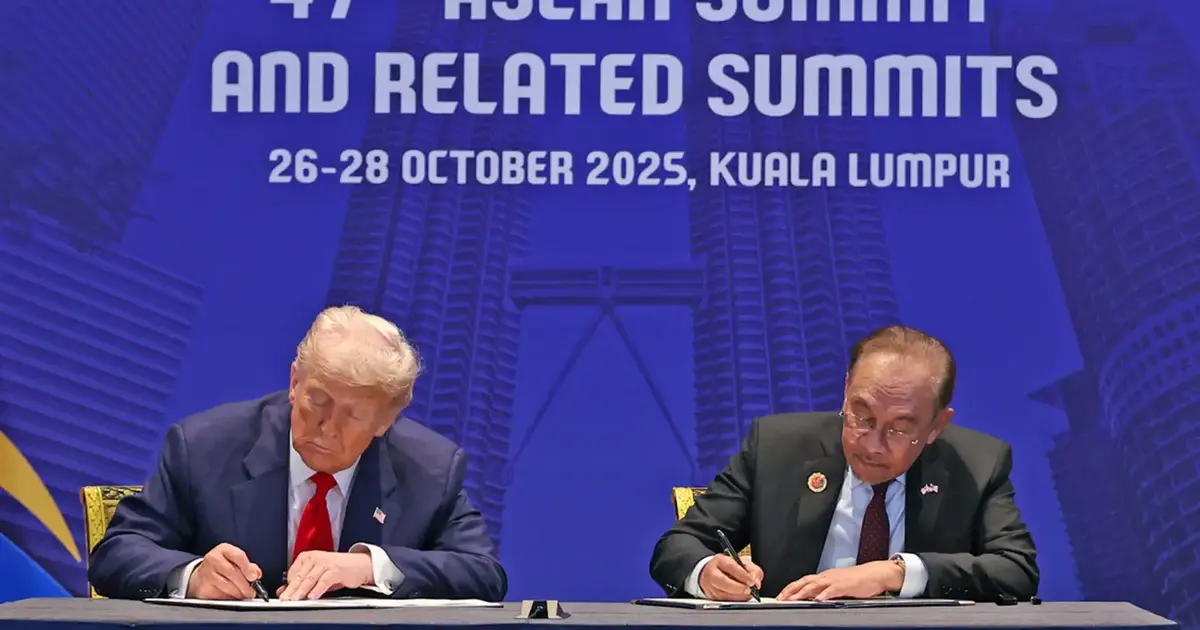
Prime Minister Anwar Ibrahim's government has launched a legal maneuver to quash a lawsuit initiated by opposition members of parliament who are contesting the validity of the reciprocal trade agreement between Malaysia and the United States. The application to strike out the case represents the administration's attempt to resolve the matter at an early procedural stage rather than proceeding to full trial on the substantive issues raised by the dissenting MPs.
The broader dispute centres on whether the trade accord was properly authorised under Malaysian constitutional and parliamentary procedures. Opposition legislators have raised concerns about the agreement's implications for domestic industries, worker protections, and Malaysia's economic sovereignty in negotiating with Washington. The disagreement reflects deeper tensions about the government's approach to international commercial arrangements and the extent to which parliament should scrutinise such pacts before implementation.
The opposition MPs have simultaneously filed a parallel application requesting that the Federal Court address several constitutional questions stemming from the trade agreement's validity. This dual-track legal strategy allows the opposition to challenge the government on multiple fronts—contesting the court's jurisdiction to hear the original case whilst simultaneously asking the highest judicial body to clarify fundamental constitutional principles governing international treaty ratification and parliamentary oversight in Malaysia.
Constitutional questions of this nature typically involve matters that go beyond the specific facts of a single case and establish precedent for how future governments should handle similar situations. By seeking this referral, the MPs are attempting to create a binding judicial interpretation that would shape how Malaysia enters into and implements international agreements going forward. Such rulings can significantly constrain executive discretion in foreign policy and trade negotiations, forcing greater legislative consultation and transparency.
The Malaysia-US reciprocal trade agreement carries substantial economic and geopolitical significance for both nations and for Southeast Asia more broadly. For Malaysia, which relies heavily on manufactured exports and supply chain integration, trade terms with the United States directly affect competitiveness, employment in key sectors, and industrial policy flexibility. The dispute also touches on Malaysia's ability to maintain domestic protections for sensitive industries whilst complying with liberalisation commitments to its largest trading partner after China and other Asian neighbours.
Anwar's government has positioned itself as committed to strengthening ties with Washington as part of its broader foreign policy realignment. The administration views the reciprocal trade agreement as advantageous for Malaysian exporters and as strengthening the bilateral relationship during a period of strategic competition in the Indo-Pacific region. From this perspective, legislative obstruction represents an impediment to national economic interests and geopolitical positioning, justifying the government's decision to seek dismissal of the opposition's challenge.
The opposition's constitutional questions likely probe whether the agreement falls within the executive's treaty-making authority or requires specific parliamentary approval procedures. Malaysian constitutional law distinguishes between different categories of international agreements based on their scope and domestic legal implications. Some arrangements can be concluded by the executive under the royal prerogative, whilst others require parliamentary ratification or specific legislative authority, particularly when they affect taxation, tariffs, or domestic regulation. The MPs' legal team presumably argues that the reciprocal trade agreement falls into categories requiring more rigorous parliamentary involvement than the government provided.
If the opposition succeeds in compelling constitutional referral, the Federal Court would essentially serve as a referee between the executive and legislative branches regarding their respective roles in international commerce. Such intervention, even if not explicitly invalidating the agreement, could impose requirements for future transparency, consultation, or explicit parliamentary approval that reshape how Malaysia negotiates international deals. This would have ramifications extending far beyond the current bilateral arrangement with the United States.
The procedural wrangling over whether the original case should be struck out before reaching the merits reflects competing judicial philosophies. The government argues that the MPs lack standing, the court lacks jurisdiction, or the claims are legally deficient on their face—grounds for dismissal without extensive litigation. The opposition contends that genuine constitutional issues demand adjudication and that striking out the case would deny parliament's representatives an opportunity to defend institutional prerogatives and scrutinise executive action affecting the nation's trade relationships.
For Malaysian business communities, the litigation creates uncertainty about the agreement's enforceability and implementation timeline. Importers, exporters, and investors benefit from clarity about regulatory frameworks and tariff schedules, and prolonged legal disputes delay the certainty necessary for supply chain adjustments and strategic investment decisions. Extended litigation could impose costs on businesses irrespective of who ultimately prevails in court.
The case also reflects broader questions about opposition parliamentary strategy in Malaysia's political environment. Legal challenges allow opposition MPs to contest government decisions where they lack the votes to block them legislatively, leveraging the judiciary as a check on executive power. However, courts must balance respect for democratic choice—voters elected Anwar's government—against their duty to uphold constitutional constraints on any government's authority.
As the legal proceedings unfold, both the government's motion to strike and the opposition's constitutional referral request will likely draw submissions from interested parties including trade associations, labour unions, and civil society organisations concerned with transparency in international negotiations. The court's decisions on these procedural matters will substantially influence whether and how the substantive constitutional questions ultimately receive judicial consideration, making the coming orders potentially as significant as the eventual judgment on the trade agreement's validity itself.