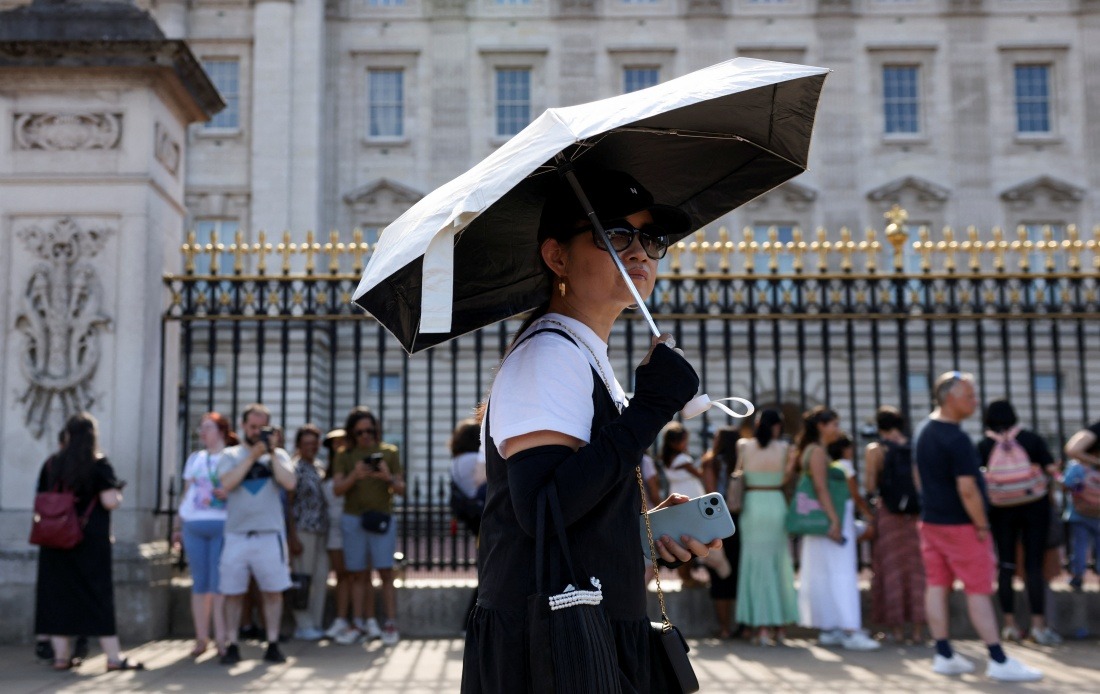
Britain's iconic ceremonial guard changes at Buckingham Palace have been cancelled this week as the United Kingdom grapples with an unprecedented heatwave that has prompted authorities to issue a rare red weather alert across multiple regions. The Household Division announced the suspension of all formal guard ceremonies in Windsor and London, citing forecasted temperatures that are expected to shatter the nation's June heat record and pose serious risks to both military personnel and public spectators.
The Met Office's decision to issue a red weather warning on Monday reflects the exceptional nature of the threat posed by this heatwave. Such warnings are rarely deployed and indicate weather conditions that could prove dangerous or even fatal for vulnerable populations. Meteorologists are predicting temperatures will surge to 39 degrees Celsius on Wednesday and Thursday, with some southern regions potentially experiencing even higher readings that could approach or exceed 40 degrees—temperatures rarely recorded in the UK and for which much of the infrastructure and population are unprepared.
The Household Division's statement prioritised the welfare of its soldiers, the military working horses that form a crucial part of the ceremonial spectacle, and the thousands of tourists and locals who gather daily to witness the changing of the guard. These outdoor ceremonies typically involve soldiers in full dress uniforms standing in direct sunlight for extended periods, while the horses endure similar conditions without adequate shelter. The decision reflects a recognition that such conditions create genuine health hazards that outweigh the cultural and ceremonial importance of the events.
While the guard changes have been completely suspended for Tuesday, Wednesday, and Thursday, the Royal Horse Guards' ceremony scheduled for Wednesday will proceed in a modified form. Rather than the full ceremonial display with its traditional pageantry and timing, the event will be moved to earlier morning hours when temperatures remain lower. Additionally, soldiers will be positioned in shaded areas wherever possible and will be rotated more frequently to prevent heat exhaustion and heat stroke among personnel wearing heavy uniforms and body armour in extreme conditions.
The impact of this heatwave extends well beyond London's tourist attractions and military ceremonies. Across southern England, educational institutions have begun shutting their doors in response to conditions that make classroom environments unsafe. Somerset County Council announced that approximately 100 schools throughout the county would remain closed during the period of extreme heat, recognising that school buildings—many lacking air conditioning systems—would become dangerously hot and unsuitable for teaching and learning. The decision prioritises student health and acknowledges that attempting to operate schools under such conditions would be neither safe nor practical.
Buckinghamshire has similarly suspended classes across roughly the same number of educational facilities, while Gloucestershire reported that more than 80 schools had cancelled in-person instruction. These three counties, along with London, fall within the area covered by the Met Office's red weather alert, indicating they face the most severe heat impacts. In London itself, nearly ten major schools have opted to suspend in-person lessons, shifting to remote learning or closing entirely until temperatures return to safer levels.
This widespread school closure scenario illustrates how extreme weather events can disrupt critical infrastructure and services across multiple sectors simultaneously. Unlike some nations accustomed to regularly managing intense summer heat, the UK's infrastructure, public services, and population behaviour patterns have evolved in a temperate climate context. Air conditioning remains uncommon in British homes, schools, and many public buildings. Public transport systems lack cooling capacity, roads and pavements absorb and radiate excessive heat, and the population lacks cultural strategies for managing extended periods of extreme heat.
The cancellation of Buckingham Palace's guard ceremonies carries symbolic weight beyond operational considerations. The changing of the guard represents one of Britain's most recognisable cultural traditions, attracting hundreds of thousands of visitors annually. For many international tourists, witnessing this ceremony ranks among their primary reasons for visiting London. The suspension, even if temporary, underscores the unprecedented nature of current conditions and signals that even the institutions most central to British heritage and identity are not exempt from the constraints imposed by severe weather.
For Malaysia and Southeast Asia, this situation offers instructive parallels and contrasts. While tropical nations routinely experience temperatures exceeding 35 degrees Celsius, the UK's lack of adaptation infrastructure, air conditioning prevalence, and population acclimatisation means that comparable temperatures pose disproportionate risks to public health and institutional operations. The suspension of guard ceremonies and school closures across one of Europe's most developed nations demonstrates that climate resilience involves more than simple temperature thresholds—it encompasses built environment design, institutional preparedness, and population adaptation patterns. Regional policymakers might observe how institutions in temperate climates struggle to maintain normal operations under conditions that Southeast Asian societies manage routinely, yet also recognise the unique vulnerabilities created when extreme events fall outside historical experience ranges.
The immediate practical response from British authorities—rescheduling ceremonies to cooler morning hours, rotating personnel more frequently, and closing schools—represents crisis management rather than systemic adaptation. As climate patterns shift and extreme heat events become more frequent globally, even traditionally cool regions will face increasing pressure to develop the infrastructure and institutional flexibility that tropical nations have long required for normal functioning.