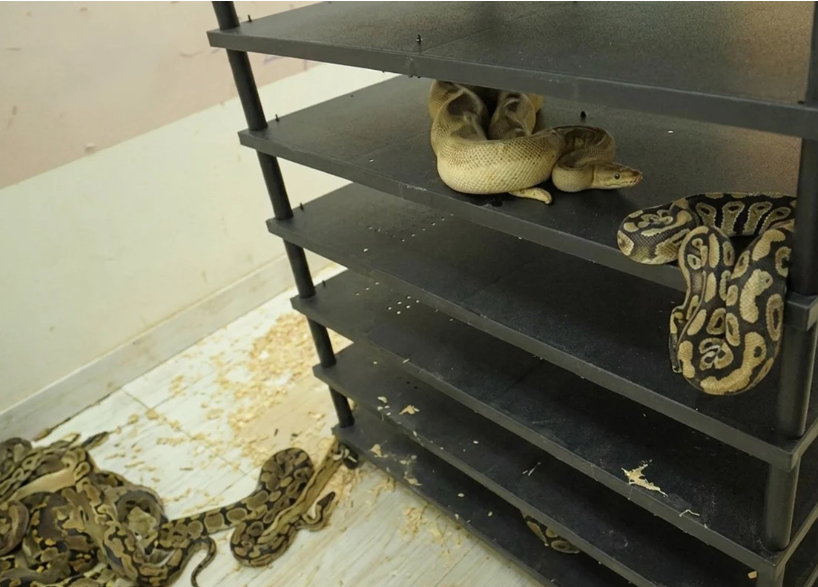
A man in eastern China has been convicted and jailed for operating an extensive illegal python breeding operation from his residential apartment, with authorities uncovering the scheme through an unexpected lead involving electricity consumption anomalies. The case, which came to light in late June through state broadcaster CCTV, exemplifies how environmental monitoring and investigative methods can expose violations of wildlife protection laws that might otherwise remain concealed within urban residential settings.
The operation came under official scrutiny when a pensioner in Taizhou, Zhejiang province, encountered a large python near the base of a local mountain in March 2024. The discovery of what appeared to be a non-native species in an unusual location sparked the elderly resident to report the incident to authorities. Police initially theorised that the reptile had escaped from a captive breeding facility rather than occurring naturally in the region, particularly given that snakes typically remain dormant during the winter months and would not be actively moving through the landscape at that time of year.
Investigators developed a sophisticated lead by consulting professional reptile specialists who explained the biological requirements of python husbandry. These experts noted that pythons demand consistently warm and humid conditions, requiring breeders to maintain ambient temperatures between 20 and 30 degrees Celsius throughout the year. This insight led officers to hypothesise that any large-scale breeding operation would necessarily leave an unmistakable trace through abnormally elevated electricity consumption. Police began systematically examining power usage patterns among residents living near the location where the escaped snake was discovered, a methodical approach that eventually identified the suspect.
The investigation eventually focused on a man surnamed Guo, who lived alone in the area and had no formal employment. Detectives observed that another individual named Di made frequent visits to Guo's apartment and regularly collected parcels from courier stations. Upon further investigation, police traced these deliveries to online purchases of small white mice in bulk quantities. Online sellers subsequently confirmed to authorities that such purchases were typical of customers maintaining reptile collections, as these rodents serve as staple food for many predatory species. The connection between the mysterious escaped python, the unusual electricity consumption, and the pattern of rodent deliveries began to coalesce into a coherent investigative picture.
Additional evidence emerged when authorities examined Guo's social media activity and discovered photographs of snakes posted across various platforms. These posts contained subtle references to the availability of pythons for sale, suggesting an ongoing commercial enterprise rather than merely a personal hobby. Police obtained transaction records indicating that Di had facilitated the sale of at least two pythons to a third party for 1,000 yuan, or approximately US$150 per animal. Armed with this cumulative evidence, authorities obtained warrants to arrest both Guo and Di on suspicion of illegal breeding and trafficking in protected species.
When police officers entered Guo's apartment, they encountered a scene of extraordinary scale. The residential space had been completely repurposed to accommodate the breeding operation, with Guo having consolidated all his personal furniture and living necessities into a single bedroom while converting the remaining two bedrooms and the living room into housing units for his pythons. Hundreds of plastic containers stacked from floor to ceiling, each containing individual pythons, filled the available space. Authorities ultimately seized a total of 309 pythons from the residence, which were subsequently transferred to a local zoo for care and long-term housing.
During interrogation, Guo acknowledged his long-standing fascination with snakes and disclosed that he had initiated his breeding activities in 2014 when he first purchased four pythons. He described his work with considerable pride, noting his ability to produce pythons displaying various colour morphs and mutations. Guo characterised his breeding efforts as a form of creative expression, describing himself as feeling like a creature creator. The suspect's apparent lack of concern regarding the legal status of his activities suggested that the distinction between legitimate hobby breeding and illegal commercial production had blurred considerably in his own understanding.
The investigation revealed that Guo and Di had successfully sold approximately 80 pythons prior to their arrest, suggesting the operation had generated significant commercial revenue over the preceding years. Police also arrested Deng, a shop owner who had sold four pythons to Guo a decade earlier in 2014. Authorities discovered an additional 47 pythons at Deng's residence, indicating that the network of illegal breeders and distributors extended beyond the initial suspects. Collectively, the investigation involved confiscating 436 pythons with a combined value exceeding 30 million yuan, equivalent to approximately US$4.4 million at contemporary exchange rates.
Under Chinese law, pythons are designated as Grade Two protected animals, placing them under the highest tier of wildlife protection statutes. The legislation explicitly prohibits the purchase, sale, breeding, or transportation of such species without obtaining specific government authorisation. Violators face potential imprisonment of up to five years alongside financial penalties, though the specific sentences imposed on Guo, Di, and Deng were not disclosed in official reports. For readers across Southeast Asia, this case illustrates how even wealthy nations with sophisticated enforcement mechanisms continue to struggle against the illegal wildlife trade, a phenomenon that extends across the entire region and contributes to significant conservation challenges.
The investigation methodology employed by Chinese authorities offers valuable lessons for wildlife enforcement agencies throughout Asia. The identification of unusual electricity consumption as an investigative tool demonstrates how indirect monitoring systems can expose illegal activities that perpetrators believe they have successfully concealed. As demand for exotic pets and breeding stock continues to rise across Asia's growing middle class, the sophistication of enforcement techniques must correspondingly advance. The case underscores the tension between personal liberty and conservation imperatives, particularly regarding charismatic species like pythons that attract dedicated enthusiasts willing to circumvent legal protections. For Malaysia and neighbouring nations where biodiversity conservation remains a critical policy concern, the case provides evidence that determined enforcement can still dismantle even substantial illegal wildlife operations.

