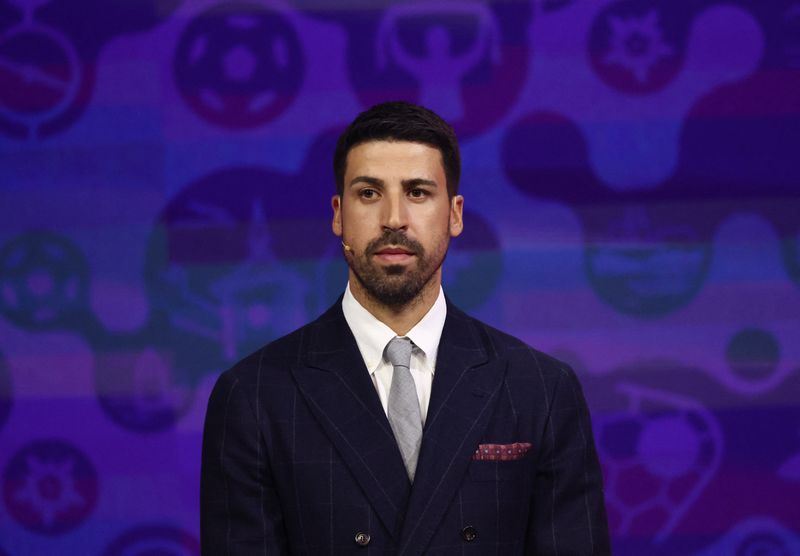
Sami Khedira, who lifted the World Cup trophy with Germany in 2014, carries a perspective shaped by his own lived experience of straddling two nations. Speaking at football's most iconic institution, he articulated a nuanced view on an increasingly common phenomenon: siblings competing for rival countries at the sport's greatest stage. Rather than seeing this as a problem or an identity crisis, the former midfielder and current Global Ambassador for Football at FIFA's Home of Football museum in New York frames it as an authentic reflection of contemporary global society, where families and loyalties transcend political borders.
Khedira's own story provides the foundation for his thinking. His brother Rani currently represents Tunisia at the World Cup, their father's homeland, while Sami chose to represent Germany, where he was born and raised to a German mother and Tunisian father. This dual heritage is not, in his view, something that must be resolved or chosen exclusively. Instead, he sees it as a natural expression of belonging to multiple communities simultaneously. When speaking with La Gazzetta dello Sport during his visit to the Home of Football museum, he emphasised that carrying two flags in one's heart reflects the reality of millions of people navigating identity in an interconnected world.
The current World Cup tournament provides a striking illustration of this trend, with eight sets of siblings distributed across competing nations. Four pairs of brothers are representing the same country—Theo and Lucas Hernandez for France, Jurrien and Quinten Timber for the Netherlands, and Laros and Deroy Duarte for Cape Verde—while another four have taken divergent paths. The Williams brothers, Inaki and Nico, have become perhaps the most visible example, with both playing for Athletic Bilbao at club level but choosing Ghana and Spain respectively for their international careers. Similarly, Guela and Desire Doue represent the Ivory Coast and France, while Brian Brobbey and Derrick Luckassen, brothers through their mother but using different surnames derived from their fathers' nationalities, play for the Netherlands and Ghana. Australia and Scotland claimed Harry and John Souttar, while Leandro and Juninho Bacuna committed to Curacao.
What struck Khedira most profoundly was witnessing the Doue brothers sing both the French and Ivorian national anthems before their countries' friendly match earlier this month. That moment encapsulated for him the deeper humanity that football can express beyond competitive sport. The image resonated precisely because it showed two young men honouring their complete identity rather than compartmentalising it. This, he argues, sends a powerful message about multiculturalism at a time when such affirmations matter greatly. Football's global platform allows these personal stories to become teaching moments for millions, demonstrating that belonging need not be binary or mutually exclusive.
Khedira acknowledged that he himself has faced questions about his authenticity in both contexts. In Germany, some questioned his Germanness based on his name and appearance, markers that in their minds seemed inconsistent with a supposedly homogeneous national identity. Conversely, when in Tunisia, he encountered assumptions that he was fundamentally German despite his father's heritage. Rather than treating these as contradictions to resolve, he simply accepts both as simultaneously true. He carries both mentalities and both cultures as an integrated whole, an approach he describes as making his generation special.
The expansion of the World Cup to 48 teams has inadvertently created pathways for nations historically excluded from football's highest stage. Khedira observed that smaller footballing nations such as Cape Verde, Curacao, and Haiti can now demonstrate their capabilities on the world's biggest platform. This structural change has had the effect of narrowing the traditional gap between European and South American dominance and the emerging footballing strength of African and Asian confederation nations. Improved coaching education, infrastructure investment, and administrative capacity in these regions have contributed to more competitive global football, though Khedira stressed that European nations bear a responsibility to support development at its source rather than merely benefiting from harvesting dual-nationality players for their own squads.
However, Khedira's optimism about the beauty of this phenomenon is tempered by recognition of the enormous pressure placed on young people during this decision-making process. The choice of which national team to represent is not merely a sporting decision; it carries profound emotional, cultural, and familial weight. Adolescents and teenagers, still forming their understanding of identity and belonging, face approaches from multiple football federations, each seeking to claim them for their own purposes. Politics, family pressure, and historical connection can all cloud what should ultimately be a deeply personal decision rooted in genuine feeling rather than external compulsion.
Khedira recalled his own experience at eighteen, when he faced this consequential choice. That period of his life remains etched in his memory as genuinely difficult, a moment when he had to determine not where he was born but where his heart pulled him. The decision cannot be forced by politics, pressure, or heritage alone; it must arise from an internal sense of belonging and identity. He engaged respectfully with the Tunisian Football Association out of deference to his father's nation, but ultimately followed his authentic feeling. This process, he reflected, represents an immense psychological burden on young people who lack the maturity and life experience to fully comprehend the lifelong implications of their choice.
Yet despite acknowledging this burden, Khedira celebrates the fact that young players in the modern era can make this choice at all, even if the process proves difficult. In previous generations, fewer opportunities existed for individuals with dual heritage to represent a nation other than where they were born. The expansion of global football and increased international mobility has created genuine agency for these young athletes. His message to young people navigating this decision is clear: listen to your instincts, seek counsel respectfully, but ultimately trust your gut feeling about where your deepest sense of community and belonging resides.
For Malaysian and Southeast Asian readers, this discussion carries particular relevance given the region's own complex histories of migration, diaspora, and multicultural societies. Many Southeast Asian nations are home to significant communities with roots across multiple countries, creating similar situations where individuals maintain genuine connections to more than one nation. Football's increasingly global nature means Malaysian players and others from the region may face comparable questions about representation and belonging. Khedira's perspective—that multicultural identity should be celebrated rather than seen as a problem requiring resolution—offers a refreshing counterpoint to more restrictive nationalist approaches to sport and identity.
The broader implication of Khedira's position is that modern football is becoming a powerful platform for demonstrating that belonging in the contemporary world is inherently complex and multifaceted. Rather than demanding that individuals cleave to singular national identities, the sport increasingly accommodates the reality that many people carry genuine connections to multiple nations, cultures, and communities. This evolution reflects deeper demographic and social changes reshaping societies worldwide, particularly in Europe where immigration and multicultural family formation have become increasingly commonplace. Football, in this sense, serves not merely as entertainment but as a mirror reflecting contemporary reality while also offering a vision of what inclusive, multicultural societies might look like.