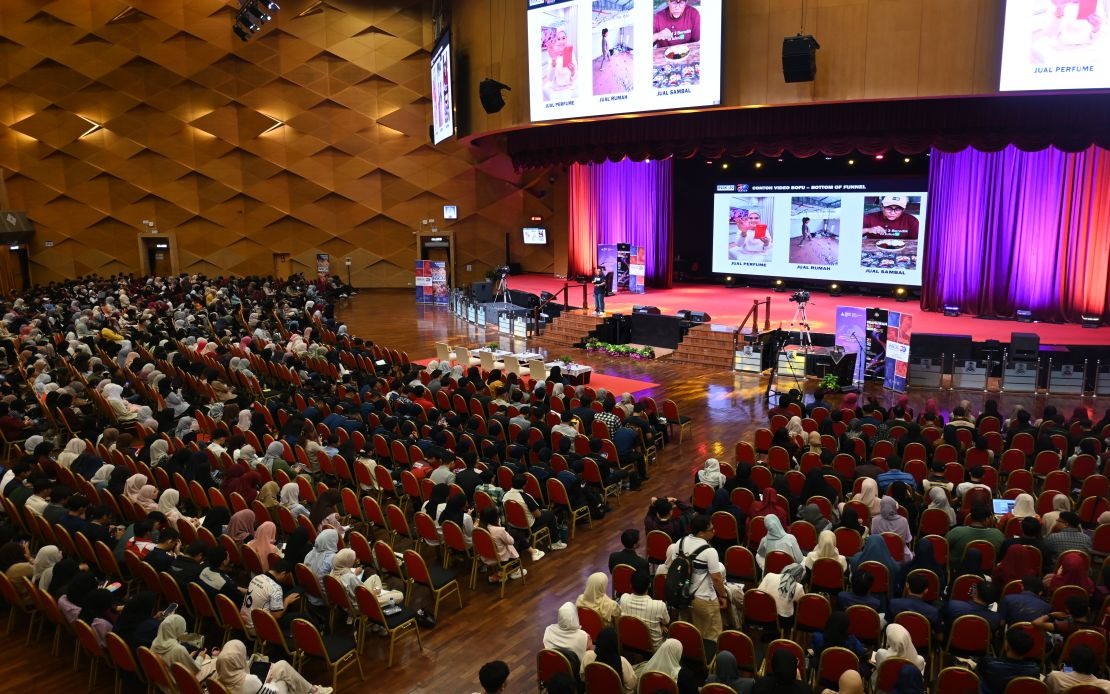
A landmark entrepreneurship seminar in Shah Alam has set a new national record, bringing together nearly 7,000 university students and aspiring business leaders for an intensive knowledge-sharing event. The Usahawan MADANI Mega (SUM MEGA) 2026 programme, jointly organised by the National Entrepreneurship Institute (INSKEN) and the Malaysian Academy of SME and Entrepreneurship Development (MASMED) alongside Universiti Teknologi MARA, achieved recognition from the Malaysia Book of Records as the largest student participation in an entrepreneurship seminar. The hybrid format, enabling both physical attendance at UiTM Shah Alam and online participation across the country, reflects the broadening accessibility of entrepreneurial education in Malaysia's higher education sector.
The seminar underscores a significant shift in how Malaysia's government and educational institutions are positioning entrepreneurship within the economic narrative. Entrepreneur and Cooperatives Development Deputy Minister Datuk Mohamad Alamin emphasised that the event's scale signals genuine traction among younger Malaysians viewing business creation as a credible career trajectory. Rather than entrepreneurship remaining a niche pursuit, it has gained momentum as a mainstream pathway, particularly among university cohorts who increasingly view job creation and self-employment as preferable alternatives to traditional corporate hierarchies. This cultural shift carries substantial implications for Malaysia's economic competitiveness, as countries with deeper entrepreneurial benches tend to innovate faster and adapt more readily to disruption.
From the government's vantage point, entrepreneurship transcends individual ambition and touches upon national economic architecture. The MADANI administration, channelled through the Ministry of Entrepreneur and Cooperatives Development (KUSKOP), has framed small and medium enterprises and startup ecosystems as central to sustained growth. Mohamad Alamin articulated this perspective by noting that entrepreneurs generate employment, solidify domestic supply chains, catalyse innovation, and ultimately buttress national prosperity. In a region where competition for investment and talent is intensifying—particularly as Vietnam, Thailand, and Indonesia expand their startup ecosystems—Malaysia's emphasis on embedding entrepreneurial thinking into higher education represents a strategic counter-move to ensure the nation produces sufficient homegrown wealth creators rather than becoming a talent exporter.
The MOFA framework introduced during the seminar—encompassing marketing, operations, finance, and administration—provides a practical scaffold for translating entrepreneurial enthusiasm into operational competence. Many university graduates harbour business ambitions yet lack systematic exposure to the functional disciplines required to sustain ventures beyond the ideation phase. By structuring capacity-building around these four pillars, organisers attempt to bridge the gap between aspiration and execution. For Malaysian entrepreneurs, particularly those entering competitive sectors or global markets, this grounding in fundamentals can mean the difference between a venture that flickers out within two years and one that achieves sustainable traction.
UiTM's prominent role in hosting and partnering on SUM MEGA 2026 signals recognition that Malaysia's public universities must evolve beyond traditional degree-conferment roles into incubators of economic dynamism. As the nation's largest university by enrolment, UiTM's student body represents a substantial reservoir of potential entrepreneurs. The decision to marshal this cohort through structured entrepreneurship programming, rather than leaving such exposure to private institutions or chance encounters, reflects a deliberate policy choice to democratise access to business knowledge. For regional policymakers observing Malaysia's approach, the model suggests that public higher education institutions can function as entrepreneurial catalysts without abandoning academic rigour.
Datuk Mustaffa Kamil Ayub, chairing INSKEN's Board of Trustees, articulated an important conceptual reframing: entrepreneurship must be understood as a mindset and cultural orientation rather than merely a career slot. This perspective aligns with international research suggesting that entrepreneurial thinking—comfort with ambiguity, willingness to take calculated risks, resilience in face of setback—benefits workers across all sectors. Even graduates entering corporate roles, civil service, or professional fields benefit from internalising entrepreneurial sensibilities. The emphasis on building entrepreneurial culture, therefore, extends beyond counting new business registrations and speaks to cultivating a population psychologically and intellectually equipped for an economy in flux.
The seminar's timing and scale also reflect post-pandemic recalibration of Malaysia's economic strategy. The disruptions of 2020-2022 accelerated digital adoption, exposed supply chain vulnerabilities, and forced many Malaysians to reconsider employment models. Against this backdrop, a government initiative channelling resources into entrepreneurship education represents recognition that the traditional model of large employers absorbing cohorts of graduates faces structural pressures. By cultivating entrepreneurial capability within the student population before entry into the labour market, policymakers position entrepreneurship not as a backup plan for the unemployed but as a first-choice pathway worthy of serious preparation.
INSKEN's broader portfolio—encompassing the INSKEN Masterclass, BANGKIT, and PROTÉGÉ programmes—demonstrates a tiered approach to entrepreneurial development. Different programmes address different cohorts and stages of venture maturity, suggesting recognition that one-size-fits-all approaches prove insufficient. Some participants may need foundational training, others may possess operational ventures requiring scaling strategies, and still others may seek mentorship and access to networks. The ecosystem-thinking implicit in this multiplicity aligns with international best practice, where successful entrepreneurial regions combine awareness-raising, skills development, financing mechanisms, and networking infrastructure.
Collaboration between government agencies, universities, financial institutions, and industry players represents another structural dimension worthy of attention. Entrepreneurship does not flourish in isolation; successful ventures require access to capital, customer networks, regulatory clarity, and technical expertise. By convening stakeholders around a shared agenda—producing resilient and competitive entrepreneurs—SUM MEGA 2026 models the multi-institutional coordination that mature entrepreneurial ecosystems require. For Southeast Asian economies competing for foreign direct investment and global talent, the ability to field robust domestic entrepreneurial ecosystems increasingly matters as a competitive asset.
The connection to the National Entrepreneurship Policy 2030 anchors SUM MEGA 2026 within longer-term strategic planning rather than treating it as a standalone event. Policy continuity, extending across electoral cycles, creates predictability that enables businesses and educational institutions to make sustained investments in entrepreneurship development. For Malaysian entrepreneurs and aspiring business founders, this policy consistency offers some assurance that government support mechanisms will persist beyond the current administration. In contrast, in countries where entrepreneurship policy fluctuates dramatically with leadership changes, investors and founders exercise greater caution, potentially dampening dynamism.
Looking forward, the challenge extends beyond convening large numbers of enthusiastic students. The true measure of SUM MEGA 2026's success will emerge in subsequent years, as participating students transition to business formation and early-stage operations. Tracking how many participants move from seminar attendance to business registration, employment creation, and revenue generation will provide empirical grounding for assessing the initiative's return on investment. Malaysian policymakers and higher education leaders would benefit from establishing longitudinal tracking of participant cohorts, enabling evidence-based refinement of entrepreneurship curricula and programming. Such data would also inform regional peer institutions considering similar initiatives.
For multinational businesses and investors eyeing Malaysia, the visible commitment to cultivating entrepreneurial human capital represents a positive signal about the nation's medium-term economic dynamism. Ecosystems rich with entrepreneurs and small business operators tend to produce innovation, create supply chain diversity, and generate consumer demand. Additionally, as automation and artificial intelligence reshape labour markets globally, economies that foster entrepreneurial thinking among their populations build resilience against technological displacement. The investment INSKEN, UiTM, and government agencies are making in entrepreneurship education, therefore, extends well beyond immediate business formation metrics and touches upon Malaysia's capacity to remain economically competitive and socially adaptive in coming decades.