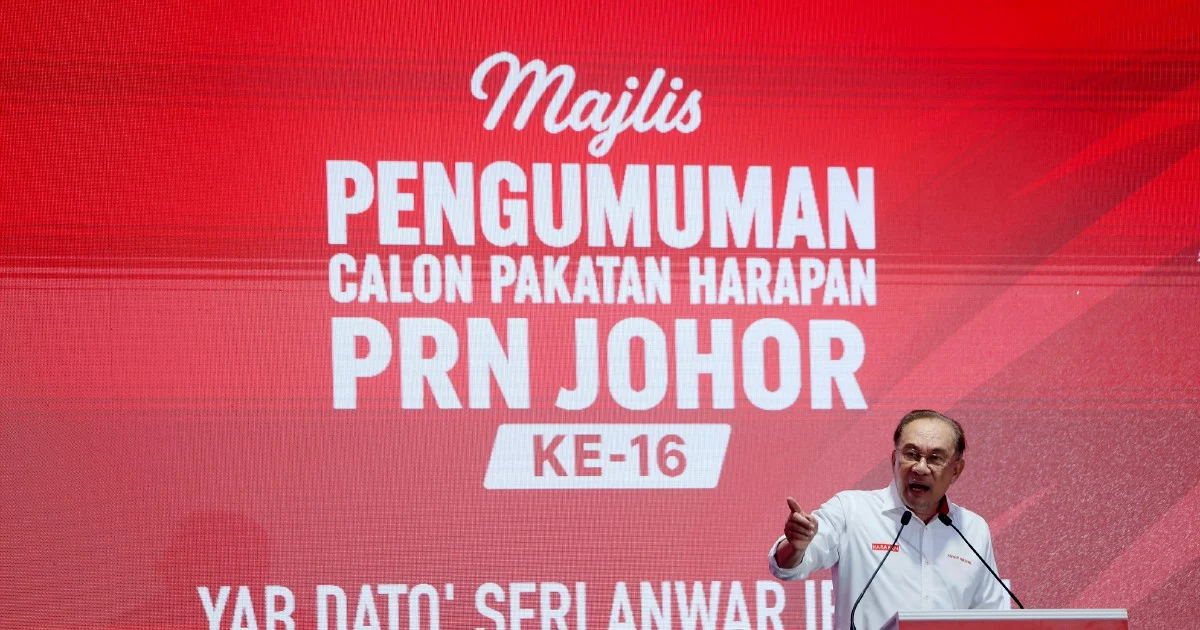
Prime Minister Datuk Seri Anwar Ibrahim disclosed in Tangkak that the federal government has directed more resources toward Johor than the state has surrendered in tax revenues over the past three years, highlighting the centre's commitment to development across the nation's southern industrial heartland. Speaking to constituents, Anwar explained that Johor channelled RM14 billion to federal coffers during this period, while simultaneously receiving RM16 billion in direct allocations and development funding, creating a net positive inflow of RM2 billion for the state.
This revelation carries significance for understanding how Malaysia distributes public resources across its thirteen states and three federal territories. The federal fiscal framework relies on revenue concentration in Kuala Lumpur and several major urban centres, yet the government must balance development aspirations across all regions to maintain political stability and economic cohesion. Johor, home to roughly 4.2 million people and encompassing the critical Iskandar Malaysia development zone, represents a substantial portion of the nation's economic base, making allocation decisions toward the state particularly consequential for broader prosperity.
Anwar's statement underscores a policy direction where federal government spending in states often exceeds local tax contributions, a pattern that reflects deliberate redistribution and development strategy rather than a market-driven outcome. This mechanism allows less economically developed regions to access capital for infrastructure, healthcare, and education without waiting for local revenue bases to strengthen organically. For Johor specifically, the additional RM2 billion has funded various initiatives spanning transportation infrastructure, healthcare facilities, educational institutions, and economic zones designed to attract private investment and employment opportunities.
The three-year period encompassing these figures corresponds broadly with the current administration's tenure, suggesting that resource allocation patterns have shifted or stabilised under the Pakatan Harapan and subsequent Unity Government coalitions. Prior administrations operated under different fiscal priorities and political considerations, making historical comparisons instructive for voters evaluating government performance. The emphasis on net positive federal support to Johor may also reflect acknowledgment of the state's earlier support for the current government coalition, though such calculations remain largely implicit in official statements.
From a Malaysian development perspective, maintaining adequate federal investment in economically significant states like Johor remains essential for preventing regional inequality from widening excessively. The state's proximity to Singapore, its position as a manufacturing and logistics hub, and its status as home to port facilities at Port Klang's southern extension and Port of Tanjung Pelepas create disproportionate national economic importance. Strategic federal allocation toward Johor therefore generates returns exceeding the direct spending figures, through catalysing private investment, employment generation, and tax collection that ultimately flow back to the federal treasury.
The breakdown between revenue contributions and allocation receipts also illuminates the mechanics of Malaysian fiscal federalism. States levy their own taxes on land, entertainment, and certain commercial activities, but income tax, corporate tax, and consumption taxes flow primarily to federal government. The federal system then redistributes portions through allocations to states for development, grants for operational expenditure, and transfers for specific programmes. Johor's position as a contributor state means its residents and businesses generate substantial income tax and corporate tax, yet the state benefits from generous re-allocation reflecting federal priorities and developmental needs.
Context matters significantly for interpreting these figures for Malaysian readers. The nation maintains a complex intergovernmental fiscal relationship where federal dominance is constitutionally established, yet states exercise influence over land use, licensing, and certain revenue sources. This creates incentive structures where politically favoured states may receive enhanced allocations, and development-focused administrations may prioritise states perceived as critical to national growth. Johor's receiving more than it contributes could reflect both genuine development needs and political calculation, though Anwar's public articulation suggests the government wishes to characterise the arrangement as equitable resource distribution rather than selective patronage.
Regional implications extend across Southeast Asia, where Malaysia's fiscal federalism model attracts scholarly attention from neighbouring nations managing similar centre-periphery tensions. Indonesia, Philippines, and Thailand each grapple with concentration of resources in capital regions and major urban centres, while struggling to develop provincial economies. Malaysia's approach of significant federal redistribution toward major states, despite those states' economic contributions, represents one model for managing regional development demands whilst maintaining macroeconomic discipline and fiscal sustainability.
Looking forward, the sustainability of directing RM16 billion annually toward a single state while other states receive comparable or smaller allocations depends on maintaining robust federal revenue collection and managing national debt responsibly. Economic slowdowns, declining commodity prices, or reduced consumer spending could constrain the federal government's capacity to sustain such allocation levels across all states. The statement therefore also serves as implicit acknowledgment that the government currently perceives its fiscal position as adequate for maintaining generous allocations to Johor and other major states.
For Johor residents and investors, confirmation that federal support exceeds state contributions offers reassurance regarding the state's priority within national development planning. The RM2 billion net inflow represents meaningful capital available for infrastructure improvement and economic expansion beyond what Johor's own revenue generation could independently fund. This positions the state favourably for attracting manufacturing relocations from higher-cost Asian neighbours and justifies continued business confidence in Johor as a regional investment destination. As the government navigates post-pandemic economic recovery and faces elections within the coming years, Johor's status as a recipient of substantial federal largesse will likely remain a focal point in political messaging and development announcements.