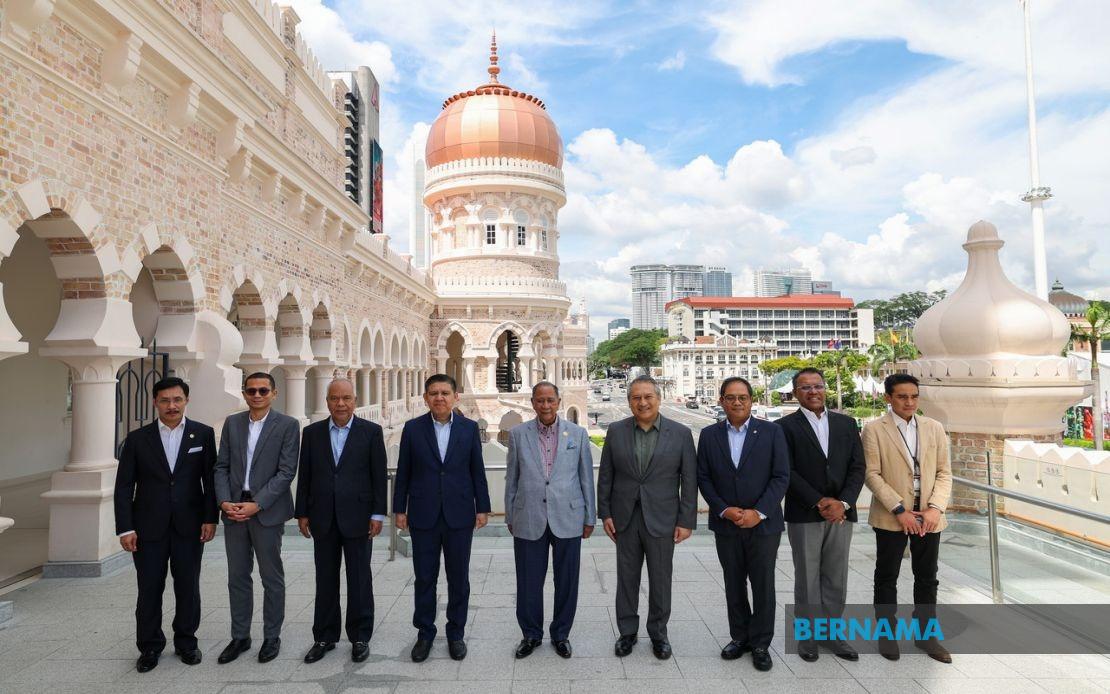
The Sultan of Kedah, Al Aminul Karim Sultan Sallehuddin Sultan Badlishah, spent Monday morning touring the Sultan Abdul Samad Building in central Kuala Lumpur, reaffirming royal patronage of one of Malaysia's most historically significant structures. Arriving at approximately 10:30 am, His Royal Highness was greeted by Khazanah Nasional managing director Datuk Amirul Feisal Wan Zahir, who oversaw the state investment company's stewardship of the heritage conservation initiative. The visit underscored the continued importance placed by Malaysia's royal institution on preserving the nation's architectural and cultural legacy.
The Sultan's tour encompassed the building's main exhibition spaces, beginning with the Confluence Hall, which contains a comprehensive gallery documenting the origins and development of Kuala Lumpur from its earliest settlement through its emergence as a colonial administrative centre to its modern incarnation as a sprawling metropolis. Think City senior manager Mariana Isa provided detailed briefings on the exhibits, allowing His Royal Highness to understand the curatorial approach taken in presenting the city's complex history to contemporary audiences. This gallery functions not merely as a repository of historical artefacts but as an interpretive space designed to connect visitors with the lived experiences and transformations that shaped the capital across centuries.
Following the Confluence Hall, the Sultan proceeded to the Visionary Hall, a more forward-looking exhibition space featuring architectural models and interactive multimedia displays that illustrate Kuala Lumpur's trajectory and planned development. The contrast between the historically focused Confluence Hall and the future-oriented Visionary Hall reflects a curatorial philosophy that positions heritage preservation as integral to understanding contemporary urban planning and the city's strategic ambitions. After reviewing these exhibitions, His Royal Highness ascended to the balcony overlooking the Porte Cochere, the iconic covered entrance that remains one of the building's most recognizable architectural features.
The building itself carries immense symbolic weight in Malaysia's national narrative. Originally designated the Secretariat Building during the colonial period, it functioned as the administrative epicentre of British Malaya and, following independence, became the seat of the newly formed Federation of Malaya's government. The structure witnessed pivotal moments in Malaysian history, most notably the ceremonial lowering of the Union Jack and the inaugural raising of the Federation of Malaya flag in 1957, marking the formal transition from colonial rule to independent nationhood. For contemporary Malaysians and regional observers, the building represents a physical manifestation of the nation's historical journey and the institutional continuity that has defined the country's political development.
Following the formal tour of the heritage galleries, His Royal Highness visited the School of Hard Knocks, an operational space within the building run by Royal Selangor, before partaking in a light luncheon. The integration of commercial and educational activities within the heritage structure demonstrates an approach to building conservation that emphasises adaptive reuse and sustained economic viability alongside historical preservation. This model allows heritage buildings to remain living, functional spaces rather than becoming inert museums disconnected from contemporary community life. The Sultan's participation in these activities highlighted the multipurpose vision guiding the building's stewardship.
The visit concluded at approximately 1:15 pm, and Datuk Amirul Feisal subsequently articulated Khazanah Nasional's perspective on the significance of royal engagement with heritage preservation efforts. He characterised the visit as a meaningful validation of the organisation's conservation philosophy, which extends substantially beyond the technical restoration of physical structures to encompass the broader responsibility of maintaining and interpreting the historical narratives embedded within heritage buildings. This approach acknowledges that authentic preservation requires sustained attention to how spaces communicate historical meaning to contemporary audiences.
Since the Sultan Abdul Samad Building opened its doors to the public on February 2, it has attracted approximately 200,000 visitors, indicating substantial public interest in engaging with the nation's material heritage. This figure suggests successful positioning of the site as an accessible destination for both domestic tourists and international visitors seeking to understand Malaysia's historical development. The visitation levels validate the investment in restoration and curation, demonstrating that heritage tourism can complement conservation objectives when facilities are designed with public accessibility and educational engagement in mind.
The restoration project itself represented a significant undertaking within Malaysia's broader heritage conservation framework. His Majesty Sultan Ibrahim, King of Malaysia, officiated the completion of Phase One restoration works on January 31 following eleven months of intensive conservation work conducted under the auspices of the Khazanah Heritage Fund programme. This funding mechanism represents a deliberate institutional commitment to identifying and restoring heritage structures of national importance, acknowledging that such projects often exceed what market-driven preservation efforts alone can achieve. The scale and duration of the restoration work underscore the complexity involved in revitalising century-old structures while maintaining architectural integrity and historical authenticity.
For Malaysian policymakers and heritage advocates, the Sultan of Kedah's visit carries implications extending beyond ceremonial royal engagement. It signals sustained high-level attention to heritage preservation at a time when urban development pressures increasingly threaten historic structures across the region. The building's successful reopening and subsequent public reception demonstrate that comprehensive restoration combined with thoughtful curatorial programming can transform heritage sites into vibrant cultural institutions rather than residual relics of colonial periods. This model holds particular relevance for other Southeast Asian nations managing similarly significant but deteriorating historical structures.
The preservation of Sultan Abdul Samad Building also carries symbolic meaning for Malaysia's federal structure and the role of state-level institutions within the national polity. The building's association with constitutional governance, administrative continuity, and the nation's founding moment makes its preservation a matter of concern to all Malaysian states and the royal institution collectively. The Sultan of Kedah's participation in examining the restored structure affirms this sense of shared custodianship of national heritage, suggesting that preservation efforts transcend individual state interests to constitute a broader commitment to maintaining Malaysia's institutional memory.
Looking forward, the building's successful reopening and demonstrated visitor appeal create momentum for similar conservation initiatives across Kuala Lumpur and beyond. The partnership between Khazanah Nasional, Think City, and other stakeholders demonstrates a collaborative approach to heritage preservation that integrates government institutions, private sector expertise, and public engagement. As Malaysia continues navigating tensions between urban modernisation and historical preservation, the Sultan Abdul Samad Building increasingly functions as a proof of concept for heritage-led urban revitalisation that benefits both cultural objectives and economic vitality.