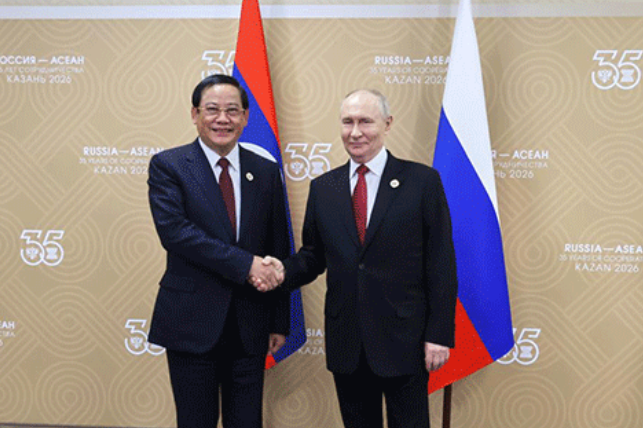
Prime Minister Sonexay Siphandone concluded his first official visit to Russia since taking office by reaffirming the nation's commitment to deepening ties with Moscow, culminating in a direct meeting with President Vladimir Putin on the margins of the Russia-Association of Southeast Asian Nations Summit in Kazan. The June 14–17 visit, undertaken at the invitation of Russian Prime Minister Mikhail Mishustin, marks a significant diplomatic engagement that underscores Laos' efforts to maintain its strategic positioning amid broader regional developments in Southeast Asia.
At the heart of the discussions between the two leaders lay a landmark intergovernmental agreement on cooperation in the peaceful use of nuclear energy—a development with substantial implications for Laos' long-term energy security and infrastructure modernisation. President Putin characterised the accord as a defining achievement, outlining how it establishes the framework for constructing a small nuclear power plant utilising Russian technological expertise within Laos. Such an arrangement aligns with the region's broader pivot towards diversified energy sources, particularly as Southeast Asian nations grapple with rising electricity demand and the imperative to transition away from coal dependency. For Laos, already heavily reliant on hydroelectric generation, nuclear capacity would represent a strategic addition to its power portfolio.
The bilateral relationship rests on foundations established over decades of engagement and shared diplomatic positioning. President Putin acknowledged Russia's esteem for its partnership with Laos, characterising it as consistently grounded in mutual friendship, reciprocal respect, and careful attention to respective national interests. This language reflects the transactional yet genuine nature of Sino-Russian engagement with Southeast Asian nations, where both parties recognise mutual benefit in maintaining stable state-to-state relations despite broader geopolitical tensions. Laos' diplomatic balancing act—maintaining equidistance between major powers—finds expression in such partnerships, which offer both economic incentives and political reassurance.
The two governments identified energy, industrial development, agriculture, extractive industries, digital infrastructure, financial services, transportation, cultural tourism, and educational advancement as priority cooperation domains. This expansive portfolio suggests a comprehensive approach to bilateral engagement rather than narrow commercial interest, reflecting Russia's strategic interest in maintaining influence across Southeast Asia through multifaceted institutional arrangements. For Laos, such diversified partnerships provide access to technical expertise, capital inflows, and market opportunities that might otherwise prove inaccessible given the nation's landlocked geography and developmental constraints.
President Putin specifically recognised Laos' diplomatic contributions to Russia-ASEAN relations, noting that 2026 will mark the 35th anniversary of Russian engagement with the regional bloc. He also thanked President Thongloun Sisoulith for attending Russia's Victory Day commemorations in May and for dispatching a unit of the Lao People's Army to participate in the parade marking the 80th anniversary of Soviet triumph in World War II. These gestures, though ceremonial in appearance, carry symbolic weight within Moscow's framework for measuring partner commitment and understanding of historical narratives important to Russian identity and statecraft.
Educational and capacity-building cooperation emerged as a particularly valued dimension of the relationship. Prime Minister Sonexay expressed gratitude for Russia's ongoing provision of annual scholarships and training programmes for Lao nationals, with particular emphasis on support for government officials. Such human resource development constitutes an often-overlooked yet strategically significant form of soft power, creating networks of individuals with Russian language proficiency, familiarity with Russian institutions, and personal connections to Moscow. The forthcoming completion of the Laos-Russia Friendship School in Vientiane, constructed through coordinated agency efforts, will further institutionalise these educational linkages and provide a physical symbol of bilateral friendship visible to ordinary Laotian citizens.
Coinciding with these substantive discussions, the business forum convened during Prime Minister Sonexay's visit aimed to catalyse commercial relationships and investment flows between the two nations. Such forums, whilst often producing modest immediate results, serve important functions in introducing entrepreneurs and enterprise leaders from both countries and establishing preliminary networks for future collaboration. In the case of Laos-Russia trade, volumes remain comparatively modest, suggesting considerable untapped potential as both nations seek to diversify their economic partnerships.
The presentation of two elephants to Kazan Zoo, offered as gifts from President Thongloun and the Lao people, marked a distinctly cultural component of the diplomatic engagement. The timing coincided with dual commemorations: the 65th anniversary of Laos-Russia diplomatic relations and Russia Day on June 12. Such symbolic gestures, though occasionally dismissed as mere pageantry, carry diplomatic significance within Asian diplomatic traditions, where cultural and ceremonial expressions of goodwill form integral components of statecraft.
For Malaysian observers and Southeast Asian analysts, the Laos-Russia engagement illustrated several broader regional dynamics. First, the persistence of Russian diplomatic and economic engagement across Southeast Asia despite international sanctions and Western pressure suggests Moscow's determination to maintain influence corridors in the region. Second, Laos' active cultivation of ties with Russia demonstrates how smaller Southeast Asian nations navigate great power competition by simultaneously engaging multiple major powers. Third, the nuclear energy agreement signals how technological partnerships and infrastructure development constitute increasingly important vectors for geopolitical positioning, particularly as nations pursue energy transition objectives.
The strategic partnership between Laos and Russia, whilst not commanding the headlines generated by Sino-American competition or ASEAN unity initiatives, represents a consequential dimension of regional geopolitical architecture. Both nations recognise mutual benefit in sustained engagement, whether through energy cooperation, educational exchange, or diplomatic coordination in multilateral forums. For Laos, such partnerships provide crucial economic and technical inputs whilst maintaining strategic autonomy. For Russia, engagement across Southeast Asia preserves influence and prevents complete isolation despite broader international constraints. As regional dynamics continue to shift, the durability of partnerships such as these will significantly influence the trajectory of Southeast Asian development and stability.

