The MADANI administration is reinforcing its commitment to the Ziarah Kasih programme, a grassroots welfare initiative designed to reach disadvantaged Malaysians through direct government support and community engagement. Speaking during a Jiwa@Komuniti MADANI event in Mersing, Abdullah Izhar Mohamed Yusof, political secretary to the Communications Minister, emphasised that the government views sustained assistance to vulnerable populations as integral to realising the Malaysia MADANI vision of placing citizens' well-being at the centre of policy-making.
The Ziarah Kasih scheme operates through a structured identification process managed jointly by the Department of Information and Komuniti MADANI, ensuring aid reaches those facing genuine hardship. Rather than relying on ad hoc charity, the programme systematises the delivery of support to elderly residents, people with disabilities, low-income families, and others experiencing acute financial or health crises. This methodical approach reflects the government's intention to embed welfare assistance into regular governance practice rather than treating it as an occasional gesture.
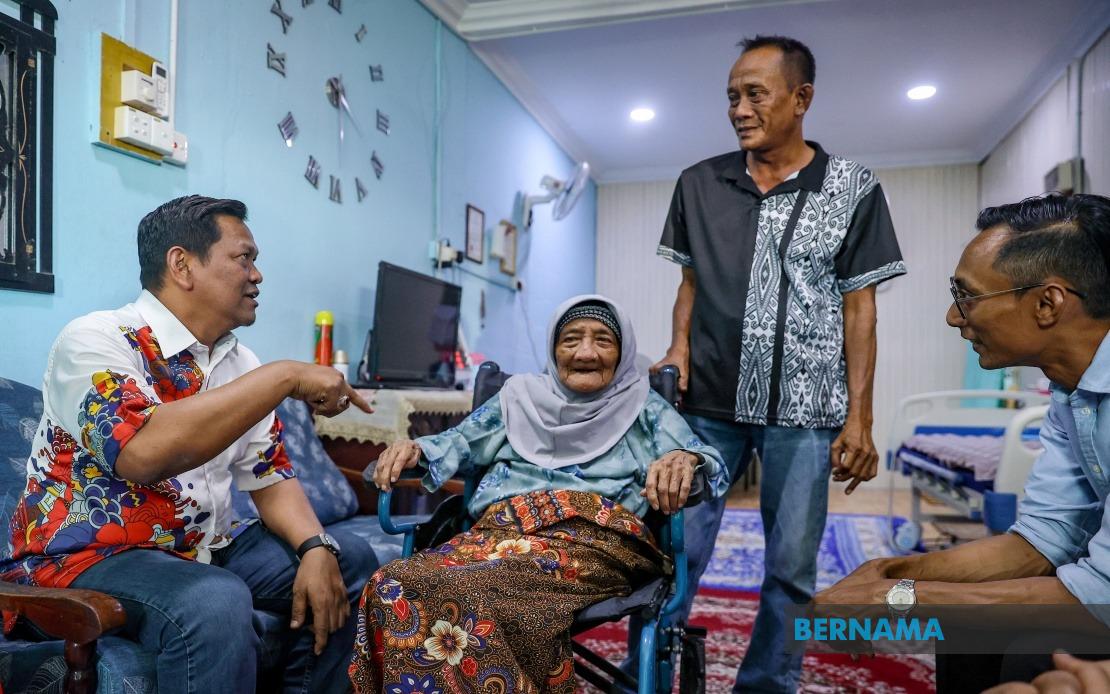
The Mersing outreach exemplified the programme's practical impact. During the event, government representatives visited beneficiary households, delivering not only monetary assistance but also specialised healthcare equipment tailored to individual needs. This dual approach—combining financial support with material resources—acknowledges that vulnerable populations often require targeted interventions beyond cash transfers alone. For families managing chronic illness or disability, equipment donations can reduce long-term expenses and improve quality of life significantly.
Hamdan Abd Latif, a 71-year-old beneficiary, illustrates how cumulative health crises can devastate family finances. A retired firefighter, Hamdan's life trajectory changed dramatically in 2011 when a fishing accident resulted in injury that eventually led to a brain tumour diagnosis requiring surgery. Though initially declared tumour-free, the underlying condition triggered a cascade of health complications culminating in a stroke after a bathroom fall. His wife Meriam, now 66, has become his full-time caregiver, abandoning her own income-generating activities through sewing work. For families in this situation, government assistance represents more than charity—it addresses the genuine collapse of household earning capacity when medical emergencies force one spouse into unpaid caregiving.
The situation facing Zainon Ibrahim, aged 91, reveals another dimension of Malaysia's social support challenges. Her son Jamaluddin Ismail, 64, relinquished his employment two years ago to provide full-time care for his elderly mother. Despite support from siblings, the family faced the fundamental economic reality that maintaining adequate supervision and assistance for a nonagenarian requires dedicated labour that the job market cannot accommodate. When Jamaluddin's formal income disappeared, government interventions became essential to meeting his mother's daily requirements. This pattern—working-age adults withdrawing from the labour force to manage family care responsibilities—represents a hidden but significant economic and social cost of inadequate elderly care infrastructure across Malaysia.
The testimonies of Hamdan and Jamaluddin point to structural vulnerabilities in Malaysia's social safety net. While the country has achieved substantial economic development, gaps persist between formal welfare schemes and the lived reality of families managing catastrophic illness, disability, and extreme old age. The Ziarah Kasih programme appears designed to fill these spaces through regular, direct engagement rather than waiting for applicants to navigate bureaucratic channels. This ground-level approach may increase programme effectiveness by identifying need that remains invisible within standard administrative processes.
For Malaysian policymakers, the Ziarah Kasih model raises important questions about scalability and sustainability. The programme's reliance on regular field visits by government representatives ensures personal contact and dignity for recipients, but labour-intensive approaches cannot easily expand to cover entire districts or states. Questions linger about how the initiative can grow beyond localised efforts in specific constituencies without losing its community-centred character. Regional administrators in Johor and neighbouring states will likely scrutinise whether Mersing's experience provides a replicable template.
The programme also reflects evolving political engagement strategies within Malaysia's system. By coupling welfare provision with direct ministerial-level visibility, the MADANI administration demonstrates responsiveness to constituent needs while building political legitimacy through tangible benefit delivery. This calculus differs markedly from purely transactional approaches, as genuine vulnerability reduction requires sustained attention across electoral cycles. For opposition observers and civil society organisations, the durability of such commitments becomes a meaningful metric of government performance.
More broadly, Ziarah Kasih addresses persistent poverty and vulnerability among elderly Malaysians, a demographic cohort whose numbers will accelerate as the population ages. Current welfare systems predicated on younger age structures may prove inadequate as persons aged 65 and above constitute a growing proportion of the population. The government's emphasis on direct assistance suggests recognition that formal pension schemes and standard benefits cannot always accommodate the complex needs of extremely elderly citizens lacking family financial resources. As Malaysia advances through demographic transition, welfare programmes must evolve beyond static entitlements toward dynamic, responsive mechanisms that address changing needs.
The government's stated intention to implement Ziarah Kasih regularly signals commitment to normalising direct assistance as routine governance practice. This stands in contrast to welfare models that treat poverty alleviation as episodic response to crises. Regular engagement permits more sophisticated targeting, relationship-building with recipients, and adjustment of support based on changing circumstances. For vulnerable Malaysians—whether elderly, disabled, or caring for dependents—the difference between periodic assistance and systematic support fundamentally affects household stability and dignity.