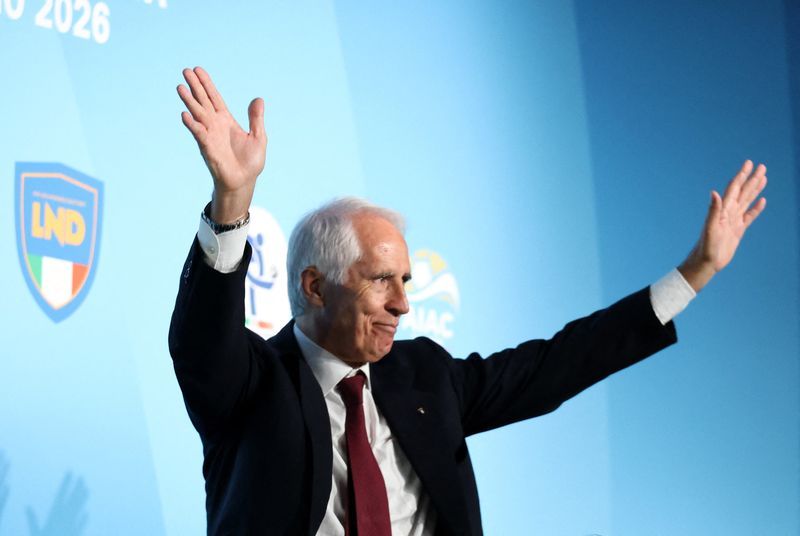
Giovanni Malago has assumed control of Italian football at perhaps its most turbulent juncture in recent memory, following his election as president of the Federazione Italiana Giuoco Calcio (FIGC) on Monday. The 67-year-old businessman inherits an institution in crisis after Italy's stunning inability to secure qualification for the 2022 FIFA World Cup in Qatar, marking an unprecedented third consecutive tournament absence for a nation that boasts four World Cup championships. The magnitude of this appointment cannot be overstated: Malago takes the helm of a federation gripped by institutional paralysis, widespread public anger, and a widespread sense that systemic failures within Italian football have accumulated over years of complacency.
Malago's election triumph at the FIGC assembly in Rome saw him secure 68.58 percent of the vote, decisively defeating fellow candidate Giancarlo Abete. His appointment comes immediately after the resignation of Gabriele Gravina, who stepped down following the April playoff defeat to Bosnia & Herzegovina that eliminated Italy from World Cup contention. The shock of that result reverberated far beyond football circles, triggering political outcry and soul-searching among supporters who had grown accustomed to viewing Italian football as a beacon of European excellence. Gravina himself acknowledged at the assembly that he should have departed earlier, recognising that his prolonged tenure had become untenable given the accumulation of failures.
The incoming president arrives with credentials that extend beyond football administration. The former head of the Italian National Olympic Committee and a former futsal player, Malago recently demonstrated organisational competence by overseeing the Milano Cortina Winter Olympics in February, an event that earned widespread praise for its efficient execution and operational smoothness. This experience in managing large-scale sporting infrastructure and navigating complex stakeholder relationships suggests he may possess the diplomatic skills necessary to navigate the deeply fractured federation and restore confidence among clubs, players, and the Italian public.
The situation awaiting Malago is dire by any measure. Beyond the World Cup catastrophe, Italian clubs have suffered simultaneous elimination from major European competitions, creating a cascade of failures that has left the nation's footballing infrastructure at its weakest point in four decades. The depth of institutional dysfunction extends to youth development systems that respected figures, including legendary striker Roberto Baggio, have publicly condemned as outdated and insufficient to compete with modern football's demands. This systemic rot cannot be addressed through incremental adjustments; rather, it demands comprehensive restructuring beginning with the immediate recruitment of a new men's national team coach and extending into foundational work on talent identification and player development.
During his campaign, Malago articulated a vision of the federation functioning not merely as an administrative apparatus but as an inspirational force capable of energising Italian football. He recognised that Italy's storied footballing heritage, while providing national pride, has become paradoxically constraining if permitted to foster nostalgia rather than ambition. His remarks about transforming historical roots into incentives for a "courageous, victorious, humble yet ambitious" future suggested awareness that Italy must simultaneously respect its traditions whilst embracing necessary modernisation. This philosophical framing indicates he understands that reconstruction requires both psychological and structural interventions.
The immediate agenda confronting Malago encompasses several urgent priorities that will define the early trajectory of his presidency. Chief among these is the appointment of a national team coach who can rebuild tactical coherence and restore the defensive discipline that historically characterised Italian football. Simultaneously, he must initiate comprehensive reviews of youth development pathways, identifying where Italian clubs and the federation's academy systems have fallen behind competitors like Spain, France, and Germany. The impending 2032 European Championship, which Italy will co-host with Turkey, provides a medium-term target that could catalyse the necessary organisational reforms.
The magnitude of expectation surrounding Malago's appointment is extraordinary, perhaps unreasonably so. He has acknowledged the burden of these "absurdly high" expectations whilst maintaining that he approaches the challenge without fear, instead with acute awareness of the responsibilities involved. This tone suggests neither arrogance nor naivety; rather, it conveys recognition that Italian football's restoration demands sustained commitment and that quick fixes will prove insufficient. The federation's internal problems mirror broader structural issues within Italian sport more generally—ageing leadership, inadequate investment in youth infrastructure, and resistance to modernisation of playing philosophies.
For Malaysian and Southeast Asian football observers, Italy's predicament offers instructive lessons regarding the dangers of assuming historical success guarantees future competitiveness. Nations throughout Asia that once dominated regional competitions have experienced similar declines when they failed to systematically refresh their youth development systems and coaching methodologies. The Italian case demonstrates that football excellence requires constant vigilance and adaptation; previous tournament victories become liabilities if they breed organisational complacency rather than driving improvement.
Malago's election statement emphasising collective action—"Alone I can do nothing, together we can do everything"—signals his understanding that personal leadership capability, whilst necessary, remains insufficient without securing buy-in from clubs, players, coaches, and administrators throughout the federation. This cooperative imperative is particularly acute given Italian football's factionalised nature, where competing interests among Serie A clubs, regional associations, and institutional offices have historically hindered unified policy implementation.
The international football community will watch closely as Malago embarks on rebuilding Italian football. Precedents exist for recovery from comparable crises—France underwent significant restructuring following early exits from European competitions before resurging to World Cup success—but Italian football's particular challenges, including an ageing population, economic pressures on clubs, and limited domestic television revenue compared to Premier League rivals, create structural headwinds that extend beyond administrative solutions.
Malago's task, ultimately, is not merely to restore Italy to World Cup participation but to establish sustainable competitive structures ensuring the nation remains among international football's elite. This requires patience, strategic vision, and willingness to implement unpopular decisions regarding player selection, coaching appointments, and academy investment. Whether the federation proves capable of such fundamental transformation under new leadership remains the defining question as Italian football enters this critical chapter.