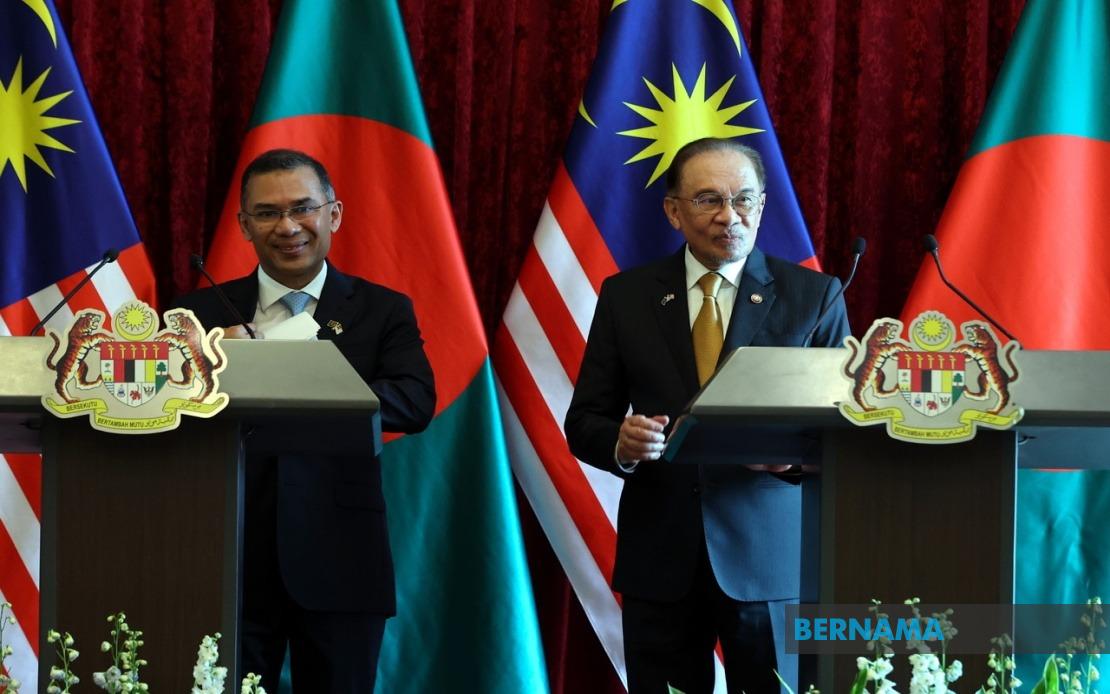
Prime Minister Datuk Seri Anwar Ibrahim has underscored the convergence between Malaysia and Bangladesh on pressing global geopolitical matters, signalling that both nations will maintain their collaborative diplomatic approach to international challenges. Speaking at a joint press conference in Putrajaya on Monday, Anwar highlighted the shared commitment of Malaysia and Bangladesh to addressing the Palestinian question, the humanitarian crisis in Gaza, and broader efforts to stabilise relations in the Gulf region and with Iran. The remarks came during the official visit of Bangladesh Prime Minister Tarique Rahman, who arrived in Malaysia on Sunday to strengthen bilateral ties and explore expanded cooperation across sectors of mutual benefit.
The convergence on these sensitive foreign policy issues reflects a deepening alignment between two significant Muslim-majority nations in Asia, both of which have articulated principled positions on Middle Eastern affairs. Anwar's emphasis on solidarity with Palestinian causes and his criticism of what he termed "Zionist Israeli regime" atrocities represent Malaysia's established diplomatic stance, reinforced now through bilateral partnership with Bangladesh. This alignment carries particular weight given Bangladesh's own regional influence as one of South Asia's largest economies and a nation with substantial geopolitical significance in the Indian Ocean region. The joint positioning demonstrates that despite geographic separation, Malaysia and Bangladesh find common ground on values-driven foreign policy that resonates with their respective constituencies and broader Islamic world perspectives.
The timing of Rahman's visit holds symbolic importance, marking his maiden official journey abroad since assuming office in February 2024. This deliberate choice to visit Malaysia underscores the strategic importance both governments place on their relationship and suggests Bangladesh's confidence in Malaysia as a key partner for advancing shared diplomatic objectives. Rahman's prioritisation of Malaysia among potential first destinations signals the depth of bilateral engagement and the mutual recognition of complementary national interests in regional and international forums. For Malaysia, receiving the Bangladesh Prime Minister during his inaugural foreign tour provides an opportunity to position the country as a trusted voice within South Asian and broader Muslim-majority nation circles.
Anwar's framing of the relationship as one of familial bonds and "brotherly relations" reflects the emotional and ideological dimensions that underpin Malaysia-Bangladesh ties. Beyond commercial and diplomatic protocols, the language employed suggests recognition of shared cultural, religious and historical experiences that bind the two nations. This rhetorical approach serves to deepen public and parliamentary support for closer integration while also signalling to international audiences that the partnership transcends transactional diplomacy. The Prime Minister's expression of gratitude for Bangladesh's support and his reciprocal pledges of strengthened cooperation indicate a relationship that operates across multiple dimensions simultaneously.
The stated commitment to engaging international partners collectively to advance peace initiatives demonstrates Malaysia and Bangladesh's intention to amplify their voices within multilateral forums. By coordinating positions on contentious issues such as Palestine and Iran, both nations can leverage their combined diplomatic weight to influence regional stability narratives and potentially shape outcomes in international organisations where they hold membership. This collaborative approach to multilateral engagement reflects a sophisticated understanding that smaller and medium-sized powers can exercise meaningful influence through coordinated action on shared priorities. For Malaysian readers, this suggests that their government is actively building coalitions to advance its stated principles rather than operating in isolation.
The emphasis on Gaza's humanitarian situation and the plight of its civilian population reflects evolving international discourse that increasingly centres on civilian casualties and humanitarian law compliance rather than purely political or territorial framings. Both Prime Ministers' focus on documented suffering signals an attempt to ground the Malaysia-Bangladesh partnership in humanitarian concerns alongside political positions. This approach acknowledges that while territorial and political disputes remain central, the human dimension of conflicts increasingly commands attention in international forums and among populations worldwide. For Malaysia's diverse society, positioning the country as a voice for humanitarian principles offers a unifying diplomatic narrative that can transcend partisan domestic divisions.
The bilateral engagement also encompasses areas beyond foreign policy, with both leaders presumably discussing trade, investment, cultural exchange and people-to-people connections during their meetings. Bangladesh, as a significant garment manufacturing hub and emerging economy, represents both a commercial partner and a potential source of manufactured goods for Malaysian consumers and businesses. Conversely, Malaysia's advanced services sector, financial expertise and technological capabilities offer value propositions for Bangladesh's development aspirations. The expansion of cooperation across these practical domains complements the foreign policy alignment, creating a comprehensive partnership architecture that serves mutual economic and strategic interests.
Rahman's visit occurs within a broader context of intensifying international engagement by Bangladesh following its recent political transition. The country's new administration appears committed to strengthening relationships with key Asian partners while recalibrating certain international alignments. Malaysia's strategic positioning as a bridge between South Asia and Southeast Asia, combined with its influence within Islamic cooperation structures, makes it an ideal partner for Bangladesh's diplomatic reorientation. The visit thus reflects Bangladesh's broader strategy of diversifying and deepening its international partnerships while maintaining traditional relationships with countries such as India and China.
For Southeast Asia more broadly, the Malaysia-Bangladesh alignment on Middle Eastern issues carries implications for regional positioning on global conflicts. As ASEAN nations increasingly navigate great power competition and contested international norms, bilateral partnerships like those between Malaysia and Bangladesh help establish networks of countries committed to specific principles of international conduct. These networks can prove influential in forums such as the United Nations where bloc voting and coordinated positions substantially affect outcomes. Malaysia's ability to maintain close partnerships with South Asian Muslim-majority nations strengthens its voice within both Islamic and Southeast Asian forums, enhancing its diplomatic relevance and policy influence.
The joint commitment to continued engagement with international partners reflects both countries' understanding that meaningful peace and stability require sustained multilateral diplomacy rather than unilateral action or isolated positions. By pledging to work with diverse international actors, Malaysia and Bangladesh signal openness to dialogue while maintaining their principled stances on substantive issues. This approach acknowledges that international problems rarely yield to single-nation solutions and that sustainable outcomes require coalition-building, consensus-seeking and patient diplomatic engagement. For Malaysia's foreign policy establishment, this framing justifies continued investment in multilateral institutions and diplomatic channels even when immediate tangible outcomes remain elusive.