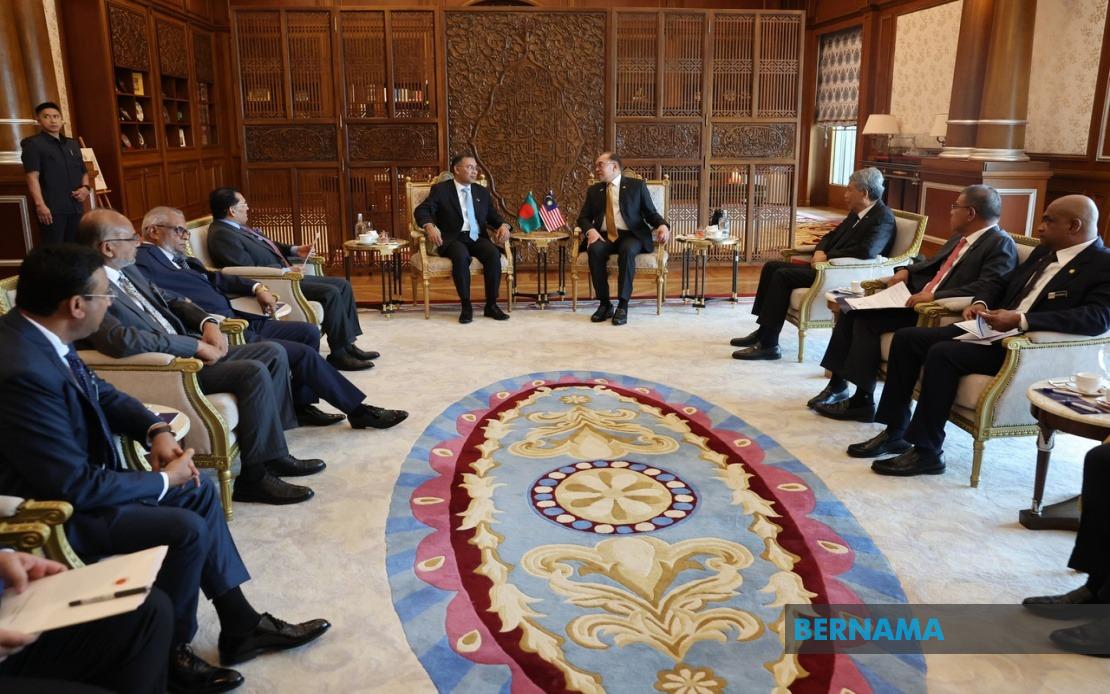
Prime Minister Datuk Seri Anwar Ibrahim has committed Malaysia to deepening coordination with Bangladesh through ASEAN frameworks to resolve the ongoing Rohingya refugee crisis, during bilateral talks with Bangladesh Prime Minister Tarique Rahman in Putrajaya. The two leaders acknowledged their shared responsibility in addressing the humanitarian challenges posed by hundreds of thousands of displaced Rohingya currently sheltered across their borders, with Bangladesh hosting the vast majority in overcrowded camps while Malaysia maintains a significant refugee population. Anwar's assurance reflects Malaysia's diplomatic pivot toward leveraging regional mechanisms rather than pursuing unilateral solutions, underscoring the complexity of the issue and the necessity for Myanmar's cooperation in any meaningful repatriation efforts.
The Rohingya crisis has festered since Myanmar's military crackdown in Rakhine State in 2017, which triggered mass displacement and allegations of ethnic cleansing against the Muslim minority. Bangladesh has borne the primary burden, hosting over 900,000 Rohingya in sprawling camps in Cox's Bazar, creating substantial infrastructure and social pressures on local communities. Malaysia, as a non-signatory to the 1951 Refugee Convention, has adopted a pragmatic approach to managing its estimated 180,000 registered Rohingya refugees through UNHCR coordination, though legal status and rights remain contested domestically. Both nations face mounting humanitarian demands and limited resources, compelling them to seek regional solutions rather than addressing the crisis in isolation.
Under this renewed commitment, Malaysia and Bangladesh will channel diplomatic efforts through their respective Foreign Ministers and utilize ASEAN's established dialogue mechanisms to engage Myanmar authorities. This approach represents a calculated strategy to bring pressure on Myanmar through multilateral consensus rather than confrontational bilateral negotiations. ASEAN's principle of non-interference has historically constrained regional action on Myanmar's internal affairs, yet the Rohingya issue transcends purely domestic concerns by destabilizing neighboring states. By formalizing this cooperative stance, Malaysia and Bangladesh aim to gradually shift ASEAN's collective position toward recognizing the refugee crisis as a regional security and humanitarian imperative demanding Myanmar's accountability and participation in structured repatriation programmes.
Bangladesh Prime Minister Tarique Rahman, who arrived for his first bilateral official visit abroad since taking office in February 2026, expressed profound concern regarding the deteriorating humanitarian conditions facing Rohingya populations under his country's care. He specifically acknowledged Malaysia's material and diplomatic support in advocating for safe, dignified, and sustainable pathways for Rohingya return to Myanmar. Rahman's emphasis on sustainability signals Bangladesh's recognition that temporary hosting arrangements have become untenable, necessitating permanent solutions through either voluntary repatriation to Myanmar or third-country resettlement. This positioning reflects domestic political pressures within Bangladesh, where hosting such large populations has strained resources and created inter-communal tensions with local populations.
Beyond the Rohingya question, the bilateral engagement demonstrates Malaysia's broader strategic interest in strengthening ties with South Asian economies. The two countries explored expanded cooperation across multiple sectors including trade and investment, human resources, semiconductor manufacturing, energy infrastructure, agricultural development, and educational exchanges. These discussions reflect Malaysia's economic diversification strategy and efforts to reduce dependency on traditional trading partners by cultivating deeper engagement with emerging South Asian markets. Bangladesh, as a rapidly industrializing nation with a youthful demographic dividend, represents significant potential for Malaysian technology transfer and investment, particularly in labour-intensive manufacturing sectors where Bangladesh maintains competitive advantages.
Trade relations between the two countries have shown positive momentum, with bilateral commerce reaching RM12.18 billion in 2025, comprising RM10.08 billion in Malaysian exports and RM2.10 billion in imports from Bangladesh. Malaysia's export profile to Bangladesh centres predominantly on petroleum and energy products, reflecting the latter's expanding manufacturing base and energy requirements. Conversely, Bangladesh supplies Malaysia with textiles, apparel, and footwear, sectors where Bangladeshi producers have established competitive manufacturing capabilities. Within the broader South Asian context, Bangladesh ranks as Malaysia's second most significant trading partner and export destination after India, underscoring the bilateral relationship's economic importance within regional commerce patterns.
The formal agreements signed during the bilateral meeting—a Memorandum of Understanding on Cultural Cooperation and two Exchanges of Notes addressing counter-terrorism research and investment promotion—demonstrate commitment to institutionalizing collaboration across diverse domains. The counter-terrorism cooperation component carries particular relevance given both nations' concerns regarding transnational extremist networks operating across South Asia and Southeast Asia. Enhanced intelligence sharing and coordinated research on counterinsurgency strategies can bolster both countries' security apparatus while addressing shared vulnerabilities. Similarly, the investment facilitation framework aims to reduce bureaucratic barriers and create predictable environments for Malaysian and Bangladeshi enterprises seeking to expand operations across borders.
For Malaysian policymakers and regional observers, this diplomatic engagement signals a recalibration of Malaysia's role within ASEAN's broader engagement with South Asia. Rather than positioning itself primarily as a humanitarian sanctuary, Malaysia increasingly frames itself as a catalyst for regional coordination and problem-solving. This approach acknowledges the structural limitations of unilateral action while leveraging Malaysia's diplomatic capital and ASEAN membership to influence outcomes. The emphasis on multilateral mechanisms rather than bilateral arrangements also provides political cover domestically, where public opinion regarding refugee populations remains sensitive and contested among different constituencies.
The timing of Rahman's visit also carries significance in the broader geopolitical context of Southeast Asian relations. Bangladesh's increasing integration into regional security dialogues and economic frameworks reflects its strategic importance as a gateway between South Asia and Southeast Asia. Malaysia's cultivation of this relationship supports its pivot toward greater South Asian engagement, complementing existing partnerships with India and Pakistan while expanding influence in a region of growing economic dynamism. This engagement pattern aligns with Malaysia's broader foreign policy objective of positioning itself as a bridge between civilizations and a neutral mediator in regional disputes.
Moving forward, the success of Malaysia-Bangladesh cooperation on the Rohingya issue depends substantially on Myanmar's willingness to engage constructively and accept repatriated populations. Previous repatriation attempts have foundered on Myanmar's reluctance to guarantee citizenship rights and safety assurances for returnees, with international monitors reporting limited progress. The ASEAN mechanism, while providing diplomatic legitimacy, carries inherent constraints given the regional bloc's consensus-based decision-making and stated reluctance to impose sanctions or isolate member states. Consequently, Malaysia and Bangladesh must balance multilateral coordination with realistic assessments of what regional mechanisms can achieve without addressing Myanmar's fundamental security concerns regarding the Rohingya population.
For Malaysian readers and regional stakeholders, this development underscores the enduring nature of the Rohingya crisis and the necessity for sustained diplomatic engagement despite limited immediate prospects for resolution. Malaysia's recommitment to working through ASEAN channels, rather than pursuing unilateral humanitarian gestures, reflects pragmatic recognition that comprehensive solutions require coordinated regional approaches. Simultaneously, the expansion of Malaysia-Bangladesh cooperation across economic and security domains creates additional incentives for sustained dialogue beyond the refugee issue itself. This multifaceted engagement strategy positions Malaysia as an active problem-solver within its regional neighborhood while addressing domestic sensitivities regarding refugee populations through emphasis on eventual resolution rather than indefinite hosting arrangements.