A marked reduction in the number of human trafficking and labour exploitation victims rescued in Malaysia since 2023 suggests that government interventions are gaining traction, according to Datuk Khairul Firdaus Akbar Khan, the Deputy Human Resources Minister. The trend reflects mounting pressure on trafficking networks through coordinated enforcement and prevention strategies implemented across the nation. However, the decline may also indicate that many victims remain hidden from authorities, prompting officials to maintain vigilant monitoring despite the encouraging statistics.
Data compiled by the Peninsular Malaysia Manpower Department reveals a striking downward trajectory over recent years. In 2023, 70 victims of trafficking and labour exploitation were rescued, a figure that contracted to just 10 in 2024. The numbers then climbed to 17 in 2025 before settling at only four rescues recorded through May of this year. While Khairul Firdaus acknowledged satisfaction with the overall downward pattern, he cautioned that official rescue statistics represent only cases that have come to the attention of authorities, leaving considerable room for unreported victims suffering in silence.
The distinction between reported and concealed cases carries profound implications for Malaysia's anti-trafficking efforts. Victims of human trafficking often operate under conditions of extreme duress, isolation, and fear, making them unlikely to seek help or report their circumstances to government agencies. The gap between official rescue figures and the actual prevalence of trafficking suggests that enforcement agencies may be disrupting trafficking operations at higher rates than the rescue numbers alone indicate. However, it also means that substantial numbers of exploited individuals may continue suffering without intervention, representing a significant gap in the government's protective capacity.
Enforcement activities have intensified considerably across the country in the opening months of 2025. From January through May, the government conducted 386 labour-related enforcement operations spanning the nation, resulting in the initiation of 311 investigation papers. These operations represent the enforcement arm of Malaysia's multi-pronged strategy to combat forced labour and human trafficking. The volume of investigations underway suggests that authorities are actively pursuing suspected trafficking networks and labour exploitation schemes, even as the number of formally documented rescues declines.
Malaysia's commitment to combating forced labour extends beyond domestic enforcement to encompass international obligations. The government has ratified protocols established by the International Labour Organisation, binding the nation to specific standards for identifying, protecting, and assisting trafficking victims. This alignment with international frameworks positions Malaysia within a global network dedicated to eradicating forced labour, enhancing cooperation with other nations and access to specialised resources and expertise. The ratification signals Malaysia's serious intent to address trafficking as a matter of national and regional importance rather than an isolated problem.
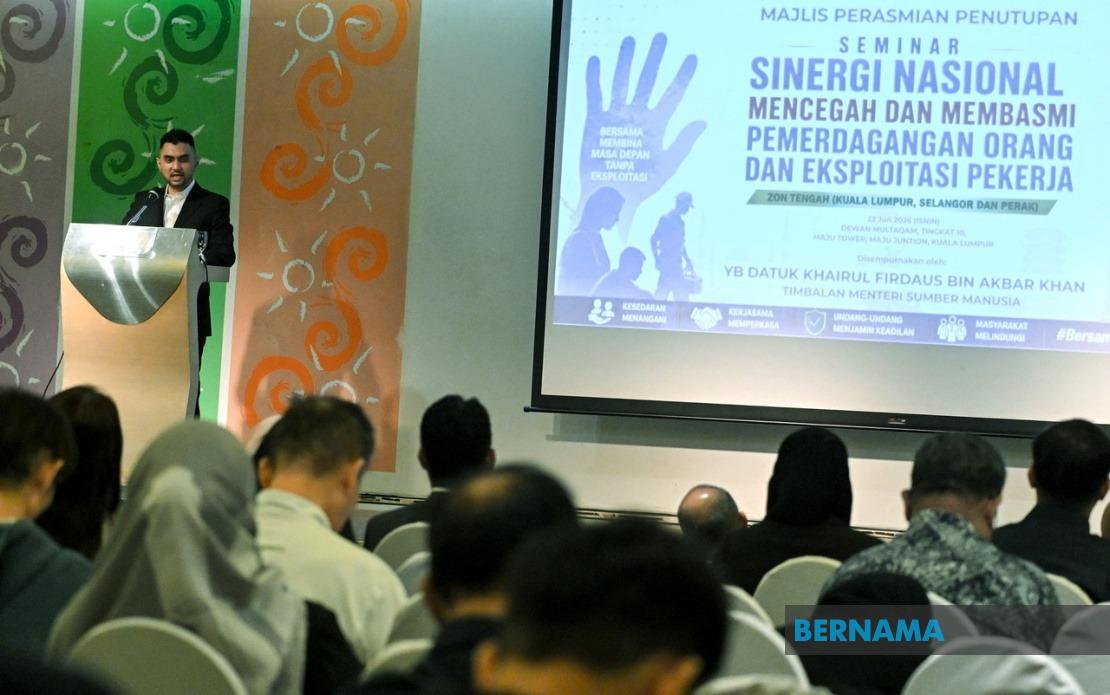
The National Synergy Seminar on Preventing and Eradicating Human Trafficking and Labour Exploitation represents a broader awareness and education initiative designed to mobilise stakeholders across regions. The seminar series, organised by the Peninsular Malaysia Manpower Department, has traversed multiple zones of the country to build understanding among relevant parties. The North Zone seminar convened in Sungai Petani, Kedah on May 18, followed by the South Zone gathering in Kluang, Johor on June 8, with the Central Zone programme held in Kuala Lumpur. This geographical distribution ensures that awareness reaches communities and officials across diverse regions, acknowledging that trafficking patterns and vulnerabilities vary by location.
The seminars have attracted substantial participation, with nearly 1,000 participants engaging across the series to exchange insights and recommendations. The high attendance reflects growing recognition among government agencies, non-governmental organisations, business representatives, and community leaders that human trafficking demands a coordinated response. The forums provide platforms for stakeholders to share evidence of effective practices, discuss emerging challenges, and identify gaps in current approaches. Such collaborative spaces prove essential for developing cohesive strategies that transcend departmental and geographical boundaries.
The declining rescue figures must be contextualised within the broader landscape of labour migration in Malaysia and Southeast Asia. Malaysia's economy depends substantially on migrant workers who fill labour shortages in construction, manufacturing, domestic service, and agriculture. While most migrant workers are protected by employment frameworks, vulnerable subgroups—including undocumented workers, domestic helpers, and trafficked labourers—operate outside formal protections. The reduction in documented rescues could indicate either genuine success in preventing trafficking or increased sophistication in concealment by trafficking networks that adapt to enforcement activities.
The distinction between trafficking for sexual exploitation and trafficking for labour exploitation carries particular relevance in the Malaysian context. Labour trafficking, which often intersects with migrant worker vulnerabilities, constitutes a significant but less visible form of modern slavery. Victims of labour trafficking may not recognise their situation as exploitation, particularly when they face language barriers, cultural displacement, and debt bondage arrangements. Enforcement efforts targeting labour exploitation require specialised knowledge of employment relationships, wage theft, and conditions that cross the threshold into involuntary servitude, demanding capabilities beyond those needed to identify obvious criminal trafficking operations.
The government's willingness to acknowledge the potential for unreported cases demonstrates a degree of institutional humility often absent from official crime statistics. Khairul Firdaus's statement that authorities cannot afford to dismiss the severity of hidden trafficking recognises the limitations of enforcement-based approaches alone. Comprehensive anti-trafficking strategies must incorporate victim support systems, workplace monitoring, migrant worker education, and community awareness to reach individuals who do not formally report their exploitation. The declining rescue figures, while ostensibly positive, mask the persistent demand for trafficked labour within Malaysian industries.
Regional dynamics further complicate Malaysia's anti-trafficking efforts. The country sits within a broader Southeast Asian migration corridor where workers from Cambodia, Myanmar, Laos, and Bangladesh move toward wealthier economies. This regional context creates vulnerabilities that cannot be addressed through domestic enforcement alone. Cross-border coordination with source and transit countries, information sharing on trafficking networks, and harmonised victim protection standards become essential components of comprehensive strategy. Malaysia's position as both a destination country and a transit point for regional migration amplifies the complexity of its anti-trafficking mission.
Looking forward, the sustainability of Malaysia's anti-trafficking efforts depends on institutionalising the enforcement intensity, awareness initiatives, and inter-agency coordination currently demonstrated. The seminar series, enforcement operations, and investigation activities represent active components of a functioning system, but their continuation cannot be assured without sustained political commitment and resource allocation. Building on the recent downward trend in documented rescues requires not only celebrating reduced case numbers but also deepening engagement with the vulnerable populations most at risk of trafficking, particularly migrant workers and undocumented individuals whose exploitation typically remains invisible to authorities.