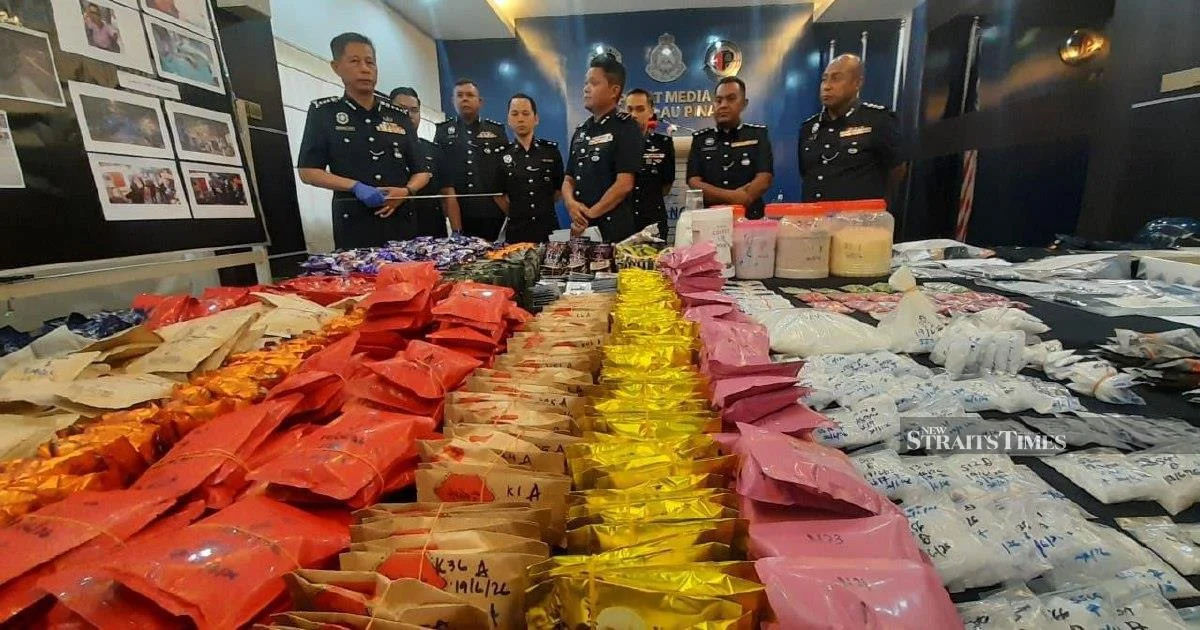
Authorities in Penang have made a significant breakthrough in combating drug trafficking, arresting two individuals in a relationship and confiscating narcotics valued at RM9.7 million following an investigation into an organised drug operation centred at a condominium building in Butterworth. The discovery represents one of the state's largest seizures in recent times and signals renewed enforcement pressure on traffickers operating within the Penang corridor, a known transshipment zone for illicit substances moving through northern Malaysia.
The operation uncovered by police reveals the sophisticated nature of modern drug distribution networks in Malaysia. Rather than relying solely on street-level dealers, the suspects had established what authorities describe as a processing and distribution hub—a model that allows traffickers to refine raw materials, package products for multiple markets, and manage supply chains more efficiently than traditional street-based operations. The choice of a residential condominium as a front demonstrates how organised syndicates exploit the privacy and anonymity offered by multi-unit residential buildings to conceal illegal activities from public view and law enforcement scrutiny.
The Butterworth location is particularly strategic for drug operations. As the primary gateway between Thailand and peninsular Malaysia via the Perlis border, and with proximity to Port Klang and other distribution points, Butterworth has long been identified by narcotics agencies as a critical vulnerability in Malaysia's drug interdiction infrastructure. Traffickers positioned there can access supplies from upstream sources in Southeast Asia's Golden Triangle and efficiently distribute products to markets throughout Malaysia, Singapore, and beyond. The discovery suggests that criminal networks are becoming increasingly confident in establishing permanent, dedicated processing facilities rather than relying on temporary or mobile operations.
The arrest of a couple engaging in this activity together offers insight into the personal dynamics that sometimes characterise trafficking organisations. While romantic relationships between co-conspirators have occasionally been documented in narcotics cases, law enforcement specialists note that intimate partnerships can make these operations simultaneously more resilient—through mutual trust and compartmentalisation—and more vulnerable to investigation once one partner becomes a law enforcement interest. The relationship may have also served a practical purpose, allowing suspects to monitor operations continuously or provide mutual support in managing a labour-intensive enterprise.
The scale of the RM9.7 million seizure positions this incident among Malaysia's notable drug busts. To contextualise the magnitude: at current street prices for heroin, methamphetamine, or cocaine in Southeast Asia, this quantity would represent several years' supply for a mid-sized trafficking organisation, or enough to service thousands of individual users. The recovery demonstrates that despite occasional headlines about drug seizures, substantial inventories remain in circulation within Malaysian supply networks, suggesting that demand continues to fuel trafficking activity and that structural vulnerabilities in border security and domestic interdiction remain unresolved.
For the Penang police force, the operation reflects ongoing efforts to penetrate organised drug networks rather than simply addressing street-level dealing. The Penang police narcotics division has consistently ranked among Malaysia's most active units in large-scale seizure operations, driven partly by the state's geographic position but also by systematic intelligence work targeting distribution hubs. Investigations of this complexity typically require months of surveillance, informant development, and coordination with customs and border authorities before enforcement action occurs, indicating that this case represents the culmination of significant detective work rather than a chance discovery.
The condominium context also highlights an emerging enforcement challenge across Malaysia's major urban centres. As residential developments proliferate in Kuala Lumpur, Penang, Johor Bahru, and other cities, management of security and tenant screening remains inconsistent. Many buildings lack adequate visitor screening protocols or CCTV coverage of common areas—vulnerabilities that trafficking networks actively exploit. While individual condominium management companies have tightened standards in recent years, industry-wide coordination on security best practices remains underdeveloped, creating windows of opportunity for traffickers.
Investigations into the operational scope of this particular syndicate will likely reveal connections to upstream suppliers and downstream distributors, potentially leading to further arrests. Malaysian law enforcement agencies routinely use high-profile seizures as springboards for wider investigations targeting the entire supply chain, from border-level imports to street-level retail distribution. If this case follows that pattern, police may eventually identify additional members of the trafficking network, suppliers in neighbouring countries, and customer bases in multiple Malaysian states, ultimately dismantling a more extensive organisation than the two arrested individuals represent.
The case underscores broader challenges facing Malaysia in combating narcotics trafficking. Despite sustained enforcement efforts, the profitability of the drug trade continues to attract new entrants and investment in increasingly sophisticated operations. Geographic position, porous borders with Thailand, and persistent domestic demand for methamphetamine, heroin, and synthetic drugs all combine to create a persistently challenging operating environment for narcotics agencies. While individual seizures of this magnitude merit recognition as enforcement successes, they typically represent only a fraction of total trafficking volume, suggesting that the underlying supply-demand dynamics driving the trade remain fundamentally intact.