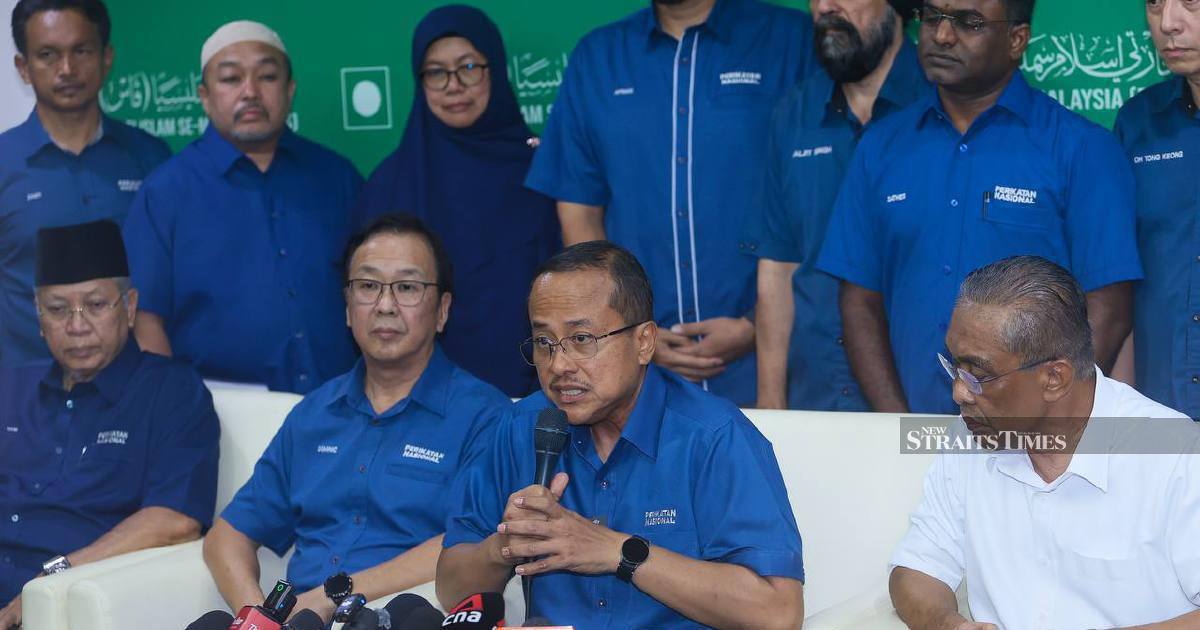
Perikatan Nasional has expanded its political coalition by formally accepting two new parties into its ranks, PN chairman Datuk Seri Dr Ahmad Samsuri Mokhtar confirmed following an emergency Supreme Council session in Kuala Lumpur. The move signals the bloc's continued strategy of broadening its electoral footprint ahead of anticipated electoral contests, though the coalition's handling of deeper structural issues has drawn scrutiny from observers monitoring coalition cohesion.
While the expansion demonstrates PN's capacity to attract smaller political entities, the coalition's decision to defer discussion on more substantive matters has underscored existing tensions. The deferral of negotiations concerning Wawasan—understood to refer to a shared philosophical framework or electoral platform—as well as unresolved questions about party symbolism and visual identity, suggests underlying complexities that merger announcements alone cannot address. These considerations carry particular significance for Malaysian political formations, where symbolic coherence and strategic alignment form crucial elements of long-term coalition stability.
The timing of the emergency gathering itself warrants attention. Emergency sessions typically indicate circumstances demanding urgent deliberation rather than routine administrative proceedings. That PN convened its highest decision-making body to process admissions of new member organisations points to either the strategic importance ascribed to these parties or the need to manage competing interests within the existing membership structure. Malaysian political observers have increasingly recognised that coalition expansion frequently masks underlying disputes about resource allocation, candidate selection, and ideological positioning within broader frameworks.
The absence of discussion regarding the Wawasan question proves particularly illuminating. Within Malaysian coalition politics, such frameworks typically function as foundational documents establishing shared objectives, acceptable behaviour, and common policy positions. When such discussions are deferred, it frequently indicates disagreement about how extensively new members should be expected to conform to existing doctrines, or conversely, whether the coalition's foundational principles require adjustment to accommodate fresh perspectives. This dynamic has historically characterised Malaysian political formations, where the marriage of convenience often precedes ideological reconciliation.
Similarly, the unresolved logo issue suggests aesthetic and symbolic complications extending beyond superficial design considerations. Party logos carry substantial weight in Malaysian electoral contexts, where visual identification assists voters navigating complex ballot structures. The failure to establish unified symbolic representation across coalition membership potentially complicates grassroots mobilisation and public perception of organisational coherence. For coalition partners relying upon brand recognition and established voter loyalty, merging visual identities with newer entrants presents genuine strategic complications.
Peikatan Nasional's recent trajectory has involved consolidating gains from the 2022 general election aftermath, when the coalition emerged as a significant force in Malaysian parliamentary politics. However, subsequent months have exposed the inherent challenges of maintaining disparate elements operating under a common banner. The admission of two additional parties represents both opportunity and potential liability. While expanded membership broadens electoral reach and symbolic importance, each new addition introduces fresh internal dynamics requiring careful management.
For Malaysian voters and political analysts, these developments illuminate fundamental questions about PN's future trajectory. Does the coalition represent a stable, enduring political formation capable of articulating coherent governance platforms, or does it function primarily as a convenience alliance lacking deeper ideological foundations? The treatment of structural questions such as shared vision and symbolic identity will substantially influence perceptions of PN's seriousness and sustainability as a governing alternative.
The broader Southeast Asian context provides useful perspective. Coalition politics across the region frequently encounter difficulties reconciling member autonomy with unified action. Thailand's recent political formations, Indonesia's coalition experiences, and the Philippines' alliance structures have all demonstrated that rapid expansion without concurrent philosophical alignment frequently generates instability. PN's apparent willingness to expand membership while deferring philosophical clarification may therefore carry longer-term consequences extending beyond Malaysian political calculations.
Moving forward, observers should monitor whether deferred discussions regarding Wawasan and logo issues subsequently reach resolution or fade into permanent limbo. The former scenario suggests substantive coalition development, whilst the latter indicates continued prioritisation of electoral positioning over institutional cohesion. For stakeholders attempting to evaluate PN's capacity for stable governance or sustained political relevance, such developments will prove increasingly significant in coming months.