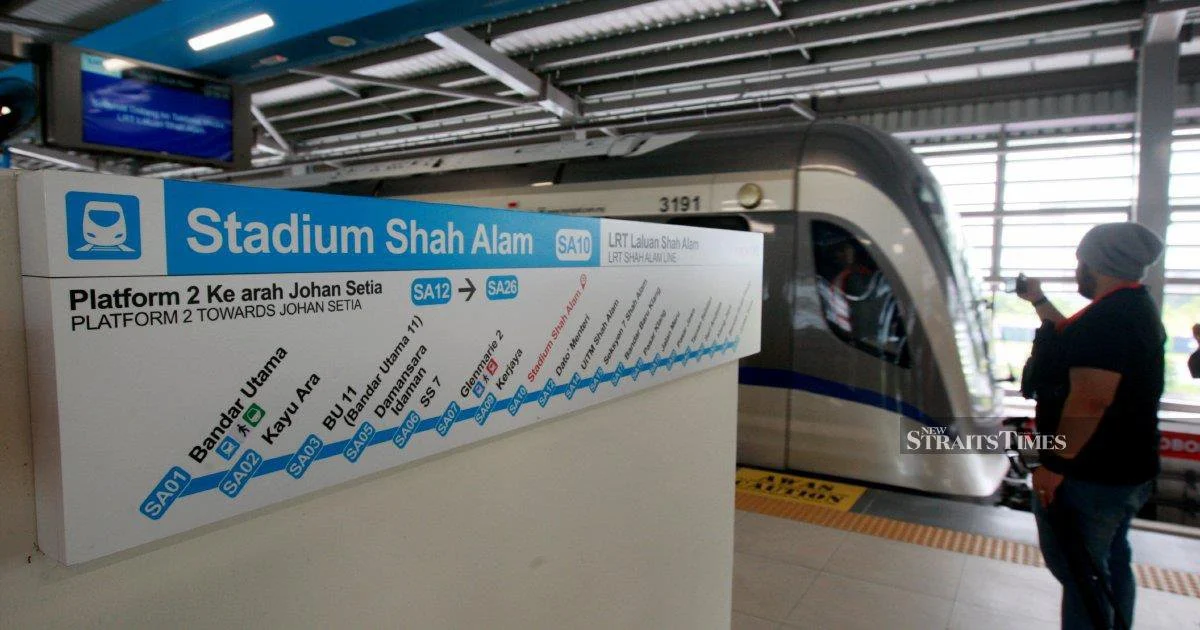
Prime Minister Datuk Seri Anwar Ibrahim will conduct the official inauguration of the Light Rail Transit Line 3 (LRT3) Shah Alam extension this Sunday, ahead of the line's commercial debut scheduled for Monday. The launch marks a significant milestone in Malaysia's ongoing effort to expand the public transportation network serving the Klang Valley region, as the new corridor is expected to ease congestion and provide commuters with a viable rail alternative across Selangor's busy industrial and residential areas.
The timing of the inauguration reflects the government's commitment to delivering infrastructure projects that improve mobility for millions of workers and residents dependent on daily commuting within the metropolitan area. By positioning the formal launch just before operations begin, authorities aim to generate public awareness and encourage uptake among potential users who may still be unfamiliar with the route and its stations. This phased approach—formal ceremony followed immediately by service commencement—has become standard practice for major transport infrastructure openings in the region.
The LRT3 Shah Alam line represents the latest phase of expansion for Malaysia's Light Rail Transit system, which has undergone substantial growth since the original Ampang Line opened in 1996. Each new extension reflects evolving urban planning priorities and demographic shifts, as development has progressively extended outward from Kuala Lumpur's core into surrounding municipalities. The Shah Alam corridor specifically addresses connectivity gaps that have long plagued the municipality, which sits as Selangor's administrative centre but has historically been somewhat underserved by rapid transit infrastructure relative to other parts of the greater Klang Valley.
Infrastructure investments of this magnitude carry particular significance for Malaysia's economic competitiveness and quality of life metrics. When properly integrated with supporting services such as feeder bus routes and park-and-ride facilities, rail extensions can catalyse land-use development, boost commercial activity at station precincts, and reduce individual vehicle dependency. The Shah Alam line's strategic positioning makes it especially valuable for connecting employment nodes and commercial clusters that have emerged throughout the municipality over the past two decades.
For commuters already navigating congested roads during peak hours, the new line offers tangible relief. Travel times between destinations that previously required 45 minutes or longer by car might be substantially reduced via rail, though success ultimately depends on service frequency, reliability, and integration with the broader transit ecosystem. The Malaysian government has invested considerably in such infrastructure partly to meet climate commitments and partly to manage the unsustainable growth in vehicular traffic that has characterised the Klang Valley for years.
The launch event serves a broader political function as well. Major infrastructure openings allow political leaders to demonstrate tangible progress on developmental pledges and showcase government capacity in delivering long-anticipated projects. For the Prime Minister's office, the inauguration represents a concrete accomplishment that resonates with voters who depend on improved transportation options in their daily lives, particularly among urban and suburban constituencies that dominate national electoral mathematics.
From an operational standpoint, the transition from inauguration to commercial service requires careful coordination among transport authorities, safety regulators, and the rail operator. Procedures must be in place to handle anticipated passenger volumes, staff must be positioned throughout the system, and contingency arrangements must address potential disruptions. The close temporal spacing between formal launch and operations commencement suggests confidence in the system's readiness, though experienced observers note that initial weeks often reveal minor issues that require fine-tuning.
The Shah Alam extension also carries implications for regional integration within Selangor and the broader Klang Valley. As rail networks expand, they create new patterns of accessibility that influence residential location choices, business site selection, and property valuation. Developments near new stations typically command premiums, and this economic reorientation can reshape urban form over years and decades. For strategic planners, each new line represents an opportunity to guide growth toward transit-oriented development patterns rather than sprawling, car-dependent configurations.
Communication surrounding the new line's opening will be critical to ensuring successful adoption. Many potential users require information about routes, fare structures, operating hours, and integration with other transport modes. The official launch provides a platform to disseminate such details and build initial momentum among early adopters who can subsequently influence broader community attitudes toward the system. Transport authorities typically invest significantly in public education campaigns during this phase to maximise early ridership.
Looking forward, the Shah Alam line's performance will likely inform decisions about future extensions and priorities within Malaysia's broader public transportation development agenda. Ridership figures, user satisfaction metrics, and operational efficiency data collected during the initial months will offer insights into demand patterns and service quality benchmarks. This information becomes increasingly valuable as planners consider where to allocate limited resources for next-phase expansions that may extend rail coverage to other underserved areas across the Klang Valley and beyond.
The inauguration ultimately symbolises more than a single infrastructure asset; it represents ongoing institutional capacity to plan, finance, and execute transportation projects that reshape how millions of people move through metropolitan space. Success in delivering this extension builds momentum and credibility for additional planned initiatives, while delays or performance shortfalls erode public confidence in government's ability to manage similar endeavours. For commuters and planners alike, Sunday's launch event marks the beginning of a new chapter in how the Klang Valley's urban transport landscape continues to evolve.