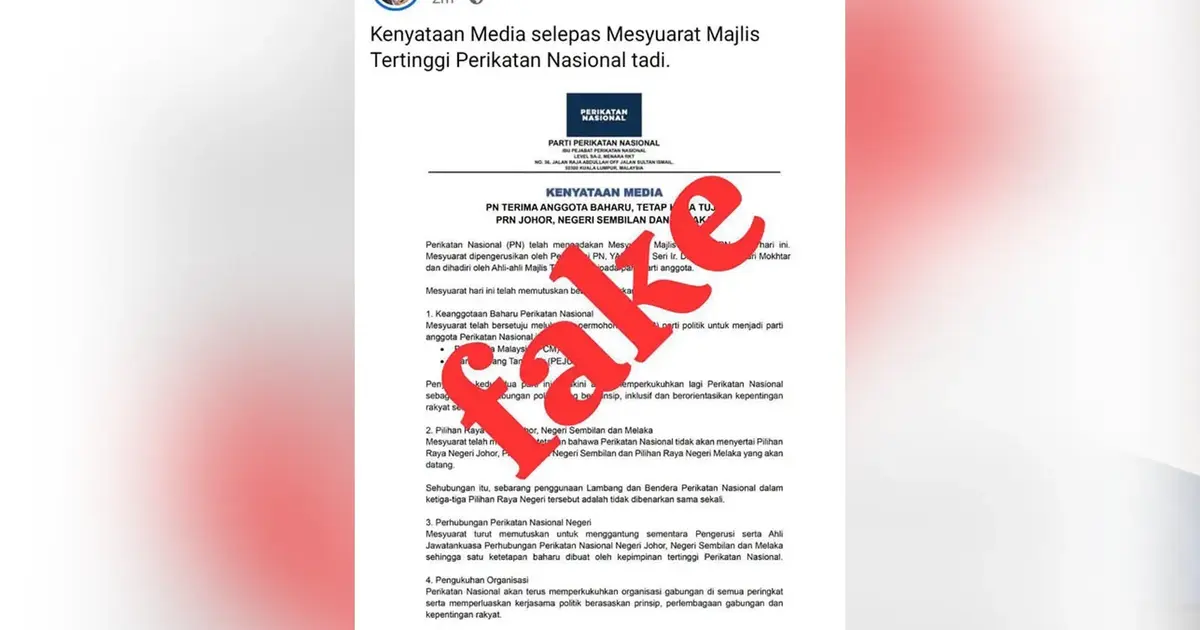
Perikatan Nasional moved swiftly to dismiss widespread social media claims that the opposition coalition would decline to contest in three upcoming state elections, declaring the statement both false and inaccurate. The coalition's response highlights growing concerns about misinformation during Malaysia's active political calendar, when state-level contests increasingly shape the nation's electoral landscape and influence calculations in federal politics.
The fake statement, which gained traction across multiple platforms, suggested that PN would deliberately abstain from competing in the three state contests. Such claims carry significant weight in Malaysian politics, where coalition positioning and participation decisions often signal strategic shifts or internal disagreements. By explicitly rejecting the assertion, PN sought to prevent the false narrative from undermining party unity or confusing voters about its electoral intentions.
This incident reflects the broader challenge Malaysian political actors face in combating deliberate falsehoods that spread rapidly through social media channels. Unlike traditional media, digital platforms allow unverified claims to circulate without editorial gatekeeping, making it increasingly difficult for parties to control their own narratives. The speed at which fabricated statements gain credibility demonstrates how easily electoral politics can be disrupted by coordinated or opportunistic disinformation campaigns.
PN's firmness in rejecting the claim underscores the strategic importance these state elections hold for the coalition. As a relatively newer political alliance, PN depends heavily on demonstrating electoral viability and broad-based support across Malaysia's diverse states. Withdrawing from any major contest would signal weakness, invite internal recriminations, and potentially encourage defections among component parties or allies questioning the coalition's long-term prospects.
For Malaysian voters, distinguishing fact from fabrication has become an essential political skill. The circulation of false claims about major electoral decisions creates real confusion at the grassroots level, where many citizens depend on informal networks and social media for political information. Without strong verification habits, voters risk making decisions based on outdated or completely inaccurate information about party positions and intentions.
The timing of such false statements often coincides with periods of heightened political tension or approaching electoral contests. Opportunistic actors—whether rival political factions, foreign agents, or simple trolls—recognise that sowing confusion during campaign periods generates maximum disruption. By releasing inflammatory claims just as states gear up for elections, those behind the misinformation maximise the damage before corrections can take hold in public consciousness.
PN's response mechanism also reveals how Malaysian political parties are adapting to digital-age challenges. Rather than ignoring online falsehoods and hoping they disappear, modern coalitions increasingly deploy rapid rebuttals and public denials to protect their reputations and messaging. This reactive approach, while necessary, nonetheless consumes political energy and attention that could otherwise focus on substantive policy discussions and campaign platforms.
The incident raises questions about platform responsibility and government oversight of electoral misinformation. While social media companies have introduced fact-checking tools and warning labels on contested claims, enforcement remains inconsistent and often occurs only after false information has already spread widely. Malaysian authorities face pressure to balance protecting electoral integrity against risks of government overreach in regulating speech.
For Southeast Asia more broadly, Malaysia's experience with political misinformation offers cautionary lessons. Countries across the region grapple with similar challenges as digital adoption accelerates and political polarisation intensifies. The sophistication of disinformation campaigns—from deepfakes to coordinated bot networks—continues evolving faster than institutional responses can match, creating structural advantages for those willing to spread lies.
Moving forward, PN and other Malaysian political actors must invest in proactive digital literacy initiatives and transparent communication strategies that build public trust before false narratives take root. While no party can completely prevent misinformation, consistent engagement with voters through authentic channels and prompt corrections of specific falsehoods can help reduce the relative impact of coordinated disinformation efforts. The effectiveness of these measures will significantly influence not only PN's electoral performance but also the broader health of Malaysia's democratic process during an intensely competitive political period.