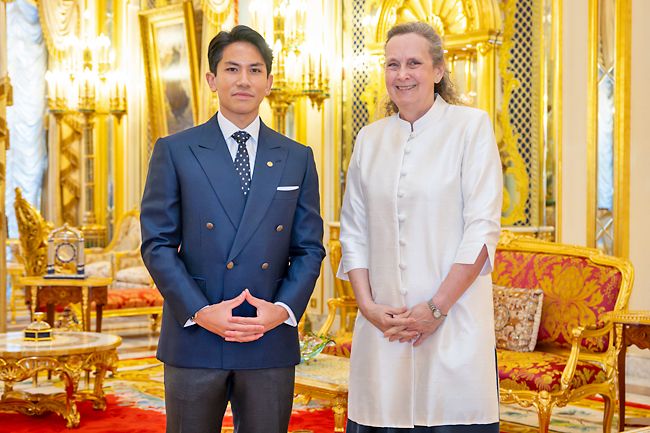
Prince 'Abdul Mateen, who serves as Brunei Darussalam's Minister of Foreign Affairs, held a formal farewell meeting with the departing United States Ambassador Caryn R McClelland on Saturday at Istana Nurul Izzah in Bandar Seri Begawan. The audience marked the conclusion of McClelland's diplomatic posting to the sultanate and provided an occasion to reflect on the progress achieved between the two nations during her time in office.
At the meeting, the Prince acknowledged McClelland's meaningful contributions to advancing relations between Brunei and Washington. The discussion centred on recognising how her ambassadorial efforts had contributed to sustaining and deepening the historically rooted friendship between the two countries, a relationship that has evolved significantly over recent decades as both nations have worked to expand their strategic engagement in Southeast Asia.
Throughout McClelland's tenure, Brunei and the United States pursued collaborative initiatives across multiple sectors that reflect the breadth of their contemporary partnership. The defence sphere has emerged as a particularly significant area of cooperation, with both countries engaging in military exchanges and security dialogues that underscore shared interests in regional stability and maritime security in Southeast Asia. This dimension has grown increasingly important given the geopolitical dynamics of the region and the strategic considerations that drive both Brunei's and America's foreign policy frameworks.
Educational cooperation has similarly strengthened, with programmes facilitating academic and cultural exchanges between institutions in both countries. Such initiatives build understanding at the grassroots level and create professional networks that endure long after individuals return to their home countries. For Malaysian readers, this regional pattern of enhanced US educational engagement with Southeast Asian nations reflects a broader American strategy to deepen influence and soft power across the region.
Trade and investment ties have likewise expanded, reflecting mutual economic interests and the complementary nature of the two economies. American companies have found opportunities within Brunei's energy sector and service industries, whilst Bruneian enterprises have explored markets and partnerships in the United States. These commercial connections generate employment and prosperity on both sides whilst fostering business relationships that transcend government-to-government diplomacy.
People-to-people exchanges form another pillar of the bilateral relationship that McClelland's tenure helped solidify. Tourism, cultural events, and professional networking opportunities have all contributed to familiarising citizens of each country with the other's customs, values and aspirations. Such exchanges are often underestimated but prove essential in building genuine friendships between nations rather than mere transactional relationships based solely on strategic calculation.
McClelland's arrival in Brunei was formally marked when she presented her Letter of Credence to His Majesty Sultan Hassanal Bolkiah, Sultan and Yang Di-Pertuan of Brunei Darussalam on May 24, 2022. This ceremonial presentation formally established her diplomatic credentials and signified the commencement of her official ambassadorial duties in the sultanate. The transition from her tenure to that of her successor will likely involve a handover period during which institutional knowledge and ongoing diplomatic initiatives are transferred to ensure continuity in bilateral relations.
The timing of this farewell audience reflects diplomatic protocol and courtesy, allowing the outgoing envoy an opportunity to pay respects to the Foreign Minister and to formally close the chapter of her posting. For diplomatic observers in Southeast Asia, such transitions offer moments to assess the health of bilateral relationships and to identify any shifts in emphasis or priority that may emerge under new ambassadorial leadership. The manner in which such farewells are conducted—with apparent warmth and acknowledgement of achievements—typically indicates stability in the underlying relationship.
For Malaysia and the broader Association of Southeast Asian Nations, the continued strengthening of individual member states' relationships with global powers remains strategically significant. Brunei's deepening ties with the United States, whilst modest in scale compared to larger Southeast Asian economies, nonetheless contribute to the regional security architecture and economic ecosystem. The expansion of US engagement with Brunei across defence, education and trade signals Washington's commitment to maintaining presence and influence throughout Southeast Asia, a region that remains central to twenty-first-century geopolitical competition.
The outgoing ambassador's departure also comes at a moment when multilateral regional organisations and bilateral relationships are navigating evolving global dynamics, including supply chain reconfiguration, technological competition between major powers, and shifting security paradigms in Southeast Asia. The investments that McClelland and her team made in strengthening people-to-people and institutional connections between Brunei and America are likely to bear fruit across the coming years, regardless of which specific individuals occupy diplomatic posts at any given time.