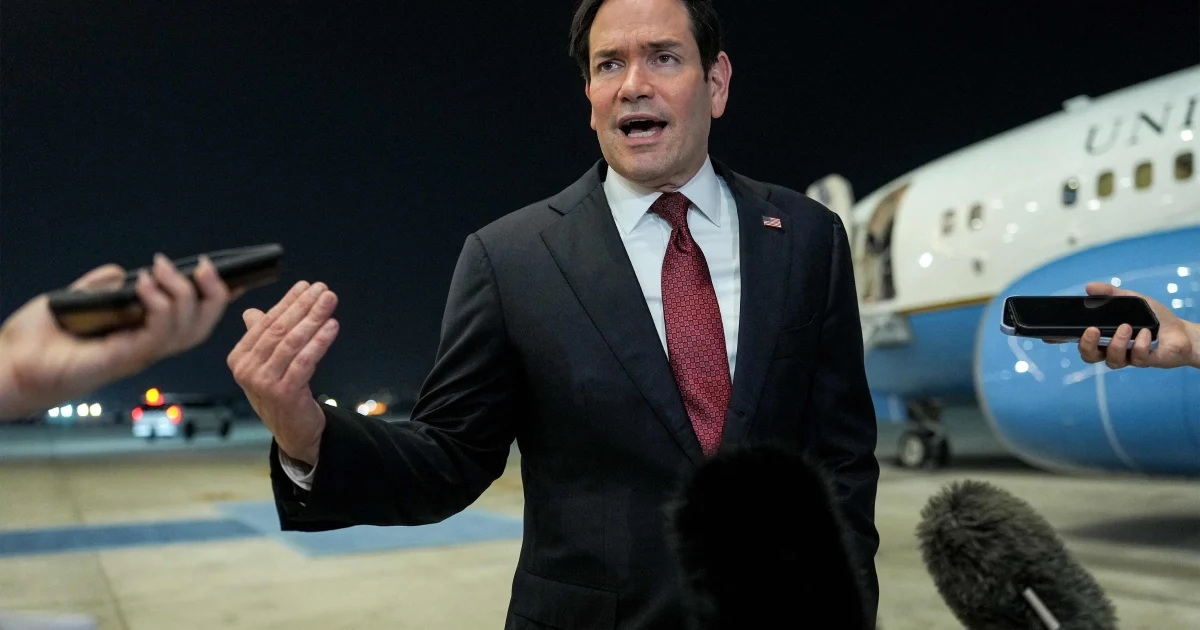
The United States has drawn a firm line in ongoing discussions with Iran, with Secretary of State Marco Rubio declaring that Washington will not tolerate any system of tolls or fees imposed by Tehran on vessels transiting the Strait of Hormuz. The declaration, made on Tuesday, underscores the hardening positions between the two nations as they attempt to navigate a complex array of contentious issues that threaten to derail broader efforts to stabilise the Middle East.
The Strait of Hormuz, a narrow waterway separating Iran from Oman, represents one of the world's most strategically significant maritime passages. Nearly a third of all seaborne trade in energy commodities flows through its waters annually, making it critical infrastructure for global commerce and the economic lifelines of nations far beyond the region itself. For Southeast Asian economies like Malaysia, Singapore, and Indonesia, which depend substantially on energy imports and international trade routes, any disruption to shipping through Hormuz carries immediate and severe consequences. Singapore's position as a major transshipment hub, for instance, means that instability in the Persian Gulf reverberates directly through regional logistics networks.
Rubio's statement reflects the Trump administration's uncompromising stance on issues it deems non-negotiable. The rejection of Hormuz tolls suggests that US officials view any attempt by Iran to monetise control over the strait as an unacceptable assertion of leverage. Such a move would fundamentally alter the current global maritime regime, under which international law guarantees freedom of navigation through strategic waterways. Washington's position essentially reinforces the existing post-World War II international order that the United States has upheld since the establishment of the UN Convention on the Law of the Sea.
Beyond the question of maritime tolls, the emerging fault lines in negotiations span a far wider terrain. Nuclear inspection protocols remain contentious, with both sides apparently clinging to incompatible demands regarding the scope, frequency, and intrusiveness of monitoring arrangements. The 2015 Joint Comprehensive Plan of Action, which several major powers negotiated with Iran, established detailed inspections regimes; however, the Trump administration's earlier withdrawal from that agreement and subsequent reimposition of sanctions created deep mistrust. Current discussions seek to restore some framework for nuclear oversight, but Iranian officials appear reluctant to accept verification mechanisms they view as politically humiliating or technologically invasive.
Missile capabilities constitute another fault line. The United States and its regional allies, particularly Israel and Gulf Arab states, have grown increasingly concerned about Iran's expanding ballistic and cruise missile arsenals. From the Iranian perspective, these programmes represent legitimate deterrence against much better-armed adversaries and are technically permissible under international law. Reconciling these fundamentally divergent threat assessments—one viewing Iranian missiles as destabilising regional aggression, the other as defensive necessity—has proven deeply difficult.
The reference to a Middle East war suggests that negotiators are attempting to broker a settlement to ongoing conflicts in Gaza, Syria, Yemen, or Lebanon, or some combination thereof. Iranian proxies and allied militias operate extensively across these theatres, complicating any comprehensive peace architecture. Regional players including Saudi Arabia, the United Arab Emirates, Turkey, and various non-state armed groups all wield influence that must somehow be accommodated in any durable settlement.
For Malaysia and other Southeast Asian nations, the stakes in these negotiations extend beyond abstract geopolitical principle. Malaysian shipping companies operate extensively through the Strait of Hormuz, and disruptions impose direct costs on national commerce and inflation. Moreover, Malaysia's economic relationships with both the United States and Iran require careful navigation; the country has strategic partnerships with Washington while maintaining substantial energy trade with Tehran. Any escalation in US-Iran tensions risks forcing Malaysian policymakers into uncomfortable positions where neutrality becomes increasingly difficult to maintain.
The multiplication of disputes—tolls, inspections, missiles—suggests that negotiators have not yet identified sufficient common ground to paper over their differences. When multiple issues remain unresolved simultaneously, each can become leverage in others, creating a dynamic where progress on one front appears to require concessions elsewhere. This interconnectedness means that early-stage talks often feel more confrontational than constructive, as each side signals resolve by staking out maximalist positions.
Rubio's Tuesday statement must be understood within the broader context of the Trump administration's approach to Iran, which has historically favoured economic pressure and confrontation over diplomatic accommodation. This rhetorical hardline may signal negotiating strategy rather than inflexible doctrine, or it may reflect genuine doubts about whether meaningful compromise is achievable. Either way, the rejection of Hormuz tolls has been publicly recorded, limiting Washington's ability to backtrack without appearing weak domestically.
Observers tracking these discussions warn that without significant diplomatic breakthrough soon, the risk of unintended escalation rises substantially. Previous cycles of US-Iran confrontation have repeatedly surprised observers with their speed and intensity. Should talks collapse entirely, pressure would mount for military posturing or proxy actions that could quickly destabilise the region. For Malaysia's trade-dependent economy and the broader Southeast Asian region, such an outcome would represent a tangible threat to prosperity and security.