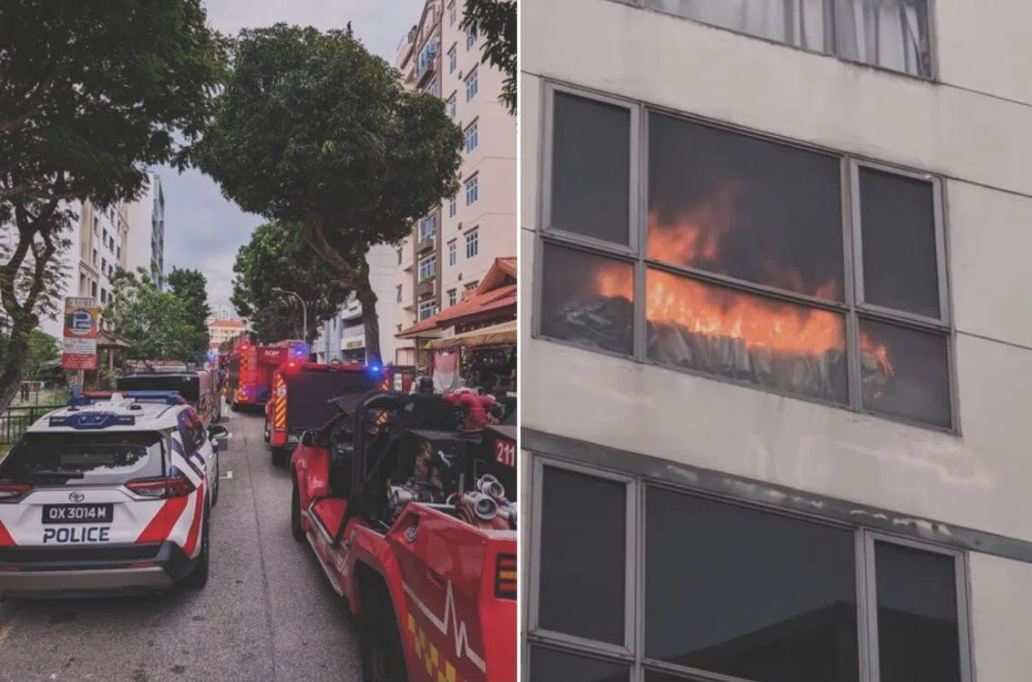
A fire triggered by an unattended power-assisted bicycle battery has forced the evacuation of five people from a residential condominium in Singapore's Geylang district, renewing concerns about safety hazards posed by charging active mobility devices in high-rise residential buildings. The Singapore Civil Defence Force responded to the incident at Casa Aerata on Lorong 26 Geylang on Sunday, June 21, arriving at the scene at 5.35pm after receiving an alert. Residents from neighbouring units were promptly cleared from the building by emergency services and police as a precautionary measure, though no injuries resulted from the incident.
The fire originated in the living room of a seventh-floor unit where the power-assisted bicycle battery had been left to charge without supervision. Investigators determined that the blaze was electrical in origin, stemming directly from the malfunctioning battery of the power-assisted bicycle. Emergency responders extinguished the flames using a hosereel and a compressed air foam backpack, preventing the fire from spreading to adjacent units or causing structural damage to the condominium. The incident underscores the potential dangers of storing and charging high-energy devices in densely populated residential settings where evacuation procedures must be executed swiftly to protect multiple households.
The response by emergency personnel was swift and coordinated, with Member of Parliament for Bishan-Toa Payoh GRC Cai Yinzhou personally arriving at the scene after observing smoke and hearing sirens in the vicinity. Recognising the immediate threat to residents below the burning unit, the MP took the precaution of clearing the area beneath the affected apartment in anticipation of falling debris. His concern proved justified when the intense heat from the fire eventually caused a window in the unit to shatter, sending glass and potentially other fragments plummeting to the ground below. This incident demonstrates how multi-storey residential fires pose cascading risks to occupants across multiple levels and how emergency management extends beyond simply extinguishing flames.
The Singapore Civil Defence Force has seized the opportunity presented by this incident to reinforce public safety messaging regarding active mobility devices. The agency explicitly cautioned residents against purchasing or using non-original batteries for these devices, warning that counterfeit or incompatible power sources significantly increase fire risk through unpredictable electrical behaviour and degraded safety mechanisms. This guidance is particularly relevant for users who may attempt to save costs by sourcing cheaper replacement batteries from unauthorised vendors or third-party suppliers lacking proper quality certification.
Beyond battery selection, the SCDF advised against prolonged or overnight charging of power-assisted bicycles and personal mobility devices. These recommendations reflect the cumulative thermal stress that occurs when batteries remain connected to charging systems for extended periods, potentially causing internal degradation and thermal runaway conditions. Overnight charging is particularly risky because occupants are asleep and unable to detect early warning signs such as overheating, unusual odours, or smoke, thereby delaying emergency response and allowing fires to gain momentum before discovery.
Statistical data from the SCDF reveals the magnitude of the broader problem within Singapore's residential sector. Throughout 2025, electrical fires at residential premises totalled 304 cases, with 34 of these incidents directly involving active mobility devices such as power-assisted bicycles, personal mobility devices, and mobility aids. While the total number of active mobility device fires declined from 67 cases in 2024 to 49 in 2025, a decrease of approximately 27 percent, the composition of these incidents has shifted concerning. The number of personal mobility device fires specifically increased from 25 to 31 cases year-on-year, suggesting that safety improvements in some device categories have not translated across the entire active mobility ecosystem.
For Malaysian readers and Southeast Asian residents, this incident carries particular relevance given the rapid proliferation of e-bikes, e-scooters, and personal mobility devices across the region's urban centres. Countries including Malaysia have witnessed exponential growth in the adoption of such devices for last-mile transportation and leisure purposes, yet regulatory frameworks and public awareness regarding safe charging practices have not necessarily kept pace with market expansion. The Geylang incident serves as a cautionary case study demonstrating that even developed nations with sophisticated safety infrastructure and enforcement mechanisms continue to experience preventable fires stemming from user behaviour and device management.
The prevalence of counterfeit and non-certified batteries in Southeast Asian markets represents a particular vulnerability. Price-sensitive consumers often purchase replacement batteries from informal retail channels lacking proper quality assurance, creating a diffuse supply chain where safety standards cannot be verified. This pattern is especially pronounced in Malaysia, where e-bike adoption has surged among urban commuters and delivery workers, yet public awareness of battery safety remains limited. The absence of mandatory safety labelling and standardised charging protocols across the region means that knowledge transfer regarding proper device management occurs sporadically through incident-driven publicity rather than through proactive education campaigns.
Residential fire safety in high-rise apartments, which are prevalent across Malaysian cities including Kuala Lumpur, Petaling Jaya, and George Town, faces distinctive challenges when active mobility devices are involved. The concentration of multiple units within close proximity means that a single unit fire can rapidly threaten neighbouring residences, while evacuation procedures become more complex as residents must navigate shared stairwells and common areas. Building management authorities and property developers in Malaysia should consider implementing dedicated charging stations located outside residential units or in specially ventilated areas, similar to recommendations being advanced in Singapore and other developed markets.
The incident also highlights the importance of building codes and management policies that address emerging technologies and their associated risks. Many residential buildings in Malaysia were constructed before e-bikes and personal mobility devices became mainstream, meaning their electrical infrastructure and fire safety systems may not have been designed with these devices in mind. Property managers and condominium authorities would benefit from developing clear policies regarding where and how residents may charge these devices, incorporating guidance from fire safety authorities and manufacturers regarding appropriate charging locations and duration limits.
Consumer behaviour and awareness represent the critical variable in preventing future incidents of this nature. Users must understand that active mobility devices require the same attention to charging safety as other household appliances, with precautions including avoiding overnight charging, using only manufacturer-approved batteries and chargers, and immediately discontinuing use of any device showing signs of battery degradation or overheating. Educational initiatives targeting e-bike and e-scooter users in Malaysia, potentially through delivery service platforms and e-commerce sites where these devices are commonly purchased, could significantly reduce preventable incidents.
The Geylang condominium fire ultimately underscores a principle applicable across Southeast Asia: rapid adoption of new technologies must be accompanied by equally rapid development of safety culture and regulatory responses. As millions of residents across Malaysia and the region increasingly rely on active mobility devices for transportation, the incident serves as both a warning and a call to action for authorities, manufacturers, retailers, and users to prioritise safety alongside convenience and cost considerations in this emerging transportation sector.