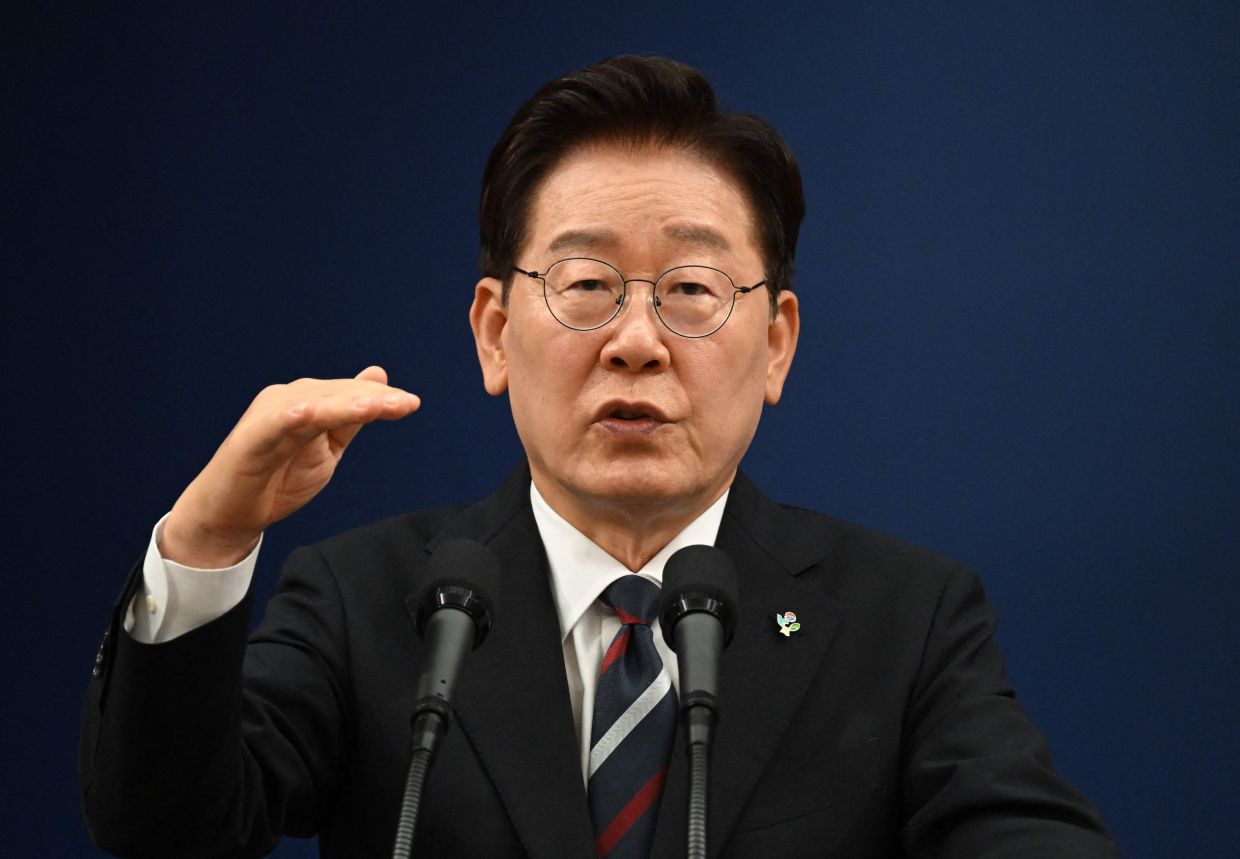
South Korea's political landscape has shifted markedly as President Lee Jae Myung confronts his first real crisis since his inauguration on June 4, 2025. According to polling data released on June 22, the president's approval rating has dipped to 46.7%, representing a dramatic reversal of his initial public mandate. For the first time since assuming office, negative assessments of his performance now exceed positive ones, a symbolic threshold that historically signals deeper political trouble for any sitting head of state in the country.
The erosion of presidential support has occurred with stunning speed. Realmeter's tracking data shows Lee commanding 60.5% approval in mid-May, a commanding position that evaporated over the subsequent five weeks. The most recent poll marks the fifth consecutive week of decline, with the president's standing collapsing by more than thirteen percentage points in just over a month. Critically, the margin separating approval from disapproval—now 46.7% positive versus 49.7% negative—sits within the survey's statistical margin of error, suggesting that public opinion has become genuinely fractured rather than merely soft.
Context matters considerably when evaluating this reversal. Lee's predecessors have experienced similar trajectories of declining support, but the timing of his downturn is notably swift. Former President Yoon Suk Yeol reached this crossover point six weeks into his term, while Park Geun-hye and Moon Jae-in took substantially longer—approximately 16 and 19 months respectively—before disapproval ratings surpassed approval. Lee has achieved this dubious distinction within three weeks of his initial sub-50% approval reading, suggesting either exceptionally volatile public sentiment or a series of governance missteps that have crystallized public dissatisfaction more rapidly than historical precedent.
Two specific catalysts drove this collapse. The June 3 local elections produced significant administrative failures, with widespread ballot shortages creating a sense of governmental incompetence precisely when public confidence matters most. Simultaneously, the ruling Democratic Party of Korea descended into visible factional warfare as internal constituencies jockeyed for position ahead of an August 17 convention to select a new party chair. These twin crises—one reflecting systemic governance failure and the other exposing the party's internal dysfunction—created a perfect political storm that has eroded both the presidential office's credibility and the party's broader electoral prospects.
The polling data reveals a geography of discontent with telling patterns. Conservative strongholds of Daegu and North Gyeongsang Province, traditionally Lee's base, experienced the steepest collapse, with approval plunging 9.9 percentage points to just 34.6%. This represents a catastrophic loss of backing in regions that should provide any conservative leader with reliable support. Greater Seoul—encompassing Seoul proper, Incheon, and Gyeonggi Province—similarly showed substantial erosion, with declines ranging from 7.6 percentage points, suggesting that urban, more educated voters have particularly soured on the administration. These are not peripheral constituencies but rather the demographic and geographic anchors of conservative electoral success in South Korea.
Analysis by demographic and ideological grouping further illuminates the nature of this political realignment. Moderate voters, typically the crucial swing constituency in South Korean elections, saw their approval drop 4.9 percentage points to 47.5%. Liberal voters, despite being the opposition's natural constituency, retained substantial approval at 80.4%, though even this cohort showed measurable softening. Conservative voters exhibited the most resilience to the downward pressure, with approval declining only 0.7 percentage points to 19.8%, suggesting that ideological opponents have already priced in their opposition while the administration's actual base has fragmented.
Beyond the presidential approval metrics, party-level support data reveals ongoing structural vulnerabilities for the conservative movement. The Democratic Party of Korea closed the gap with the ruling People Power Party in a separate Realmeter survey, with the opposition rising 2.1 percentage points to 40.1% while the governing party declined 2 percentage points to 42.3%. The margin, now just 2.2 percentage points, represents a narrowing that threatens governing party prospects for forthcoming contests. Critically, the People Power Party suffered a devastating collapse among younger voters, losing 10.5 percentage points among those in their 20s and 5.1 percentage points among those in their 30s, demographic groups essential to long-term conservative competitiveness.
The Democratic Party's relative resilience, despite internal divisions, stems partly from what Realmeter characterized as a crisis-management phase following a bipartisan agreement to investigate election administration failures. By emphasizing unity around institutional accountability rather than factional advantage, the opposition capitalized on public frustration with governmental mismanagement. This suggests that in South Korea's current political moment, the party that most effectively addresses public expectations for responsible governance and administrative competence gains tactical advantage, even when facing internal organizational challenges.
Specific policy concerns have also undercut presidential support in ways that transcend typical partisan alignments. Growing asset market disparities have particularly eroded confidence among moderate voters and Greater Seoul residents, constituencies that ordinarily respond to economic growth messaging. The seemingly positive factors—Lee's successful European trip and the Kospi's breakthrough above the 9,000-point mark—have proven insufficient to overcome the visceral public reaction to institutional failure and intra-party chaos. This suggests that in mature democracies like South Korea, symbolic economic achievements do not automatically translate into political capital when governance appears compromised.
The presidential office's response, characterized by humble acknowledgment and promises of greater attentiveness to public concerns, represents standard crisis management rhetoric but may prove insufficient given the structural nature of the underlying problems. Neither improved communication nor marginal policy adjustments can rapidly restore public confidence when citizens perceive systemic administrative failure and leadership division. The administration faces the difficult challenge of simultaneously managing legitimate concerns about electoral administration while projecting confidence in governance—a balance that has historically proven elusive for embattled leaders.
For regional observers, particularly those in Southeast Asia managing their own democratic transitions and governance challenges, South Korea's current moment offers important lessons. The speed with which initial political capital can evaporate when administrations mishandle logistical governance tasks suggests that competence in executing routine functions carries disproportionate weight in shaping public confidence. Furthermore, the particular vulnerability of younger voters to disillusionment with conservative parties navigating internal factional disputes indicates that demographic groups increasingly evaluate political movements on institutional performance rather than ideological affiliation alone, a trend likely to shape electoral dynamics across the region.