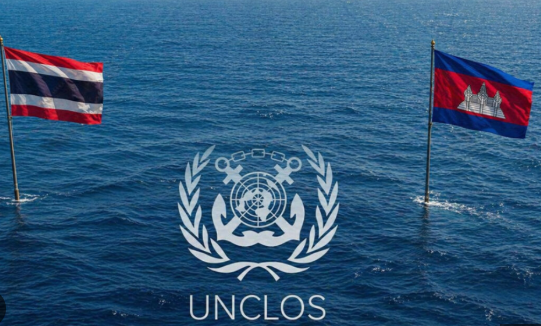
Thailand has formally accepted Cambodia's request to pursue compulsory conciliation under the 1982 United Nations Convention on the Law of the Sea regarding their long-standing dispute over maritime boundaries in the Gulf of Thailand. However, Bangkok has made its position on the process unmistakably clear: the conciliation will produce recommendations only, which will carry no legal force and cannot compel either nation to adopt particular terms. This measured acceptance reflects Thailand's strategy to engage with international dispute resolution mechanisms while preserving its negotiating flexibility and ultimate decision-making authority.
Thailand submitted its formal response to Cambodia on June 19, some two and a half weeks after Cambodia transmitted its initial notification on June 2. The timing reveals a deliberate pace by Thailand's Ministry of Foreign Affairs, suggesting careful legal and diplomatic preparation before formal acceptance. In its response, Thailand appointed Deputy Prime Minister and Foreign Minister Sihasak Phuangketkeow to serve as the nation's Agent in the conciliation proceedings, with Songchai Chaipatiyut, Thailand's ambassador to Kuwait and former senior official at the Department of Treaties and Legal Affairs, designated as Deputy Agent. This selection underscores the political importance Thailand attaches to the process, despite its public messaging that conciliation is merely exploratory.
To guide the conciliation process, Thailand named Judge Albert J Hoffmann of South Africa and Judge Rudiger Wolfrum of Germany as its appointed conciliators. Both individuals carry substantial credentials in international maritime law, a deliberate choice by Bangkok to ensure robust expertise in navigating complex law-of-the-sea principles. The conciliation commission will expand to five members once the four conciliators appointed by both Thailand and Cambodia jointly select a fifth member to chair proceedings. This selection must occur within 30 days of Thailand's formal response, establishing a tight procedural timeline that will propel the process forward regardless of either party's hesitations.
According to the established framework, the full conciliation commission should produce a comprehensive report containing recommendations within approximately 12 months, provided neither country requests an extension. This timeline matters significantly for regional stability and commercial interests, as the overlapping maritime claims in the Gulf of Thailand are believed to contain substantial reserves of natural gas and other hydrocarbon resources. Multiple stakeholders—including energy companies, coastal communities, and regional powers—have vested interests in how quickly and effectively these competing claims might be resolved.
Thailand's repeated insistence that the conciliation outcome will be non-binding distinguishes this diplomatic posture from binding arbitration or formal litigation. Thai officials have clarified that the conciliators are not advocates for either side but rather neutral experts tasked with comprehending the historical context of the dispute, listening carefully to both nations' positions, and working toward identifying solutions acceptable to all parties involved. This characterisation aligns precisely with Unclos Annex V, which explicitly states that a conciliation commission's report and recommendations carry no binding force on the parties concerned. By grounding its messaging in the legal text of the convention itself, Thailand has attempted to manage expectations and potential criticism from either those favouring swift resolution or those opposing any surrender of claimed maritime zones.
Bangkok has consistently maintained that bilateral negotiations between Thailand and Cambodia represent the appropriate ultimate forum for resolving outstanding maritime questions. The Foreign Ministry has framed conciliation not as a substitute for direct talks but rather as a framework through which both countries might organise their discussions, develop shared understandings, and potentially identify common ground. This strategic positioning allows Thailand to participate in an internationally legitimate process without appearing to delegate sovereignty or decision-making authority to external bodies.
A significant point of contention between the two countries concerns the scope of conciliation proceedings. Thailand has argued strenuously that discussions should address only maritime boundary delimitation—the technical and legal drawing of boundary lines. Cambodia's notification, however, appeared to encompass not merely delimitation but also provisional arrangements for joint development of resources and mechanisms for equitable resource sharing. This interpretive difference carries enormous practical consequences, as resource-sharing frameworks would necessarily constrain Thailand's future options regarding hydrocarbon exploitation in disputed waters.
The broader context involves Thailand's May decision to terminate the 2001 memorandum of understanding with Cambodia, sometimes referred to locally as MoU 44. This accord had previously established the framework for managing overlapping continental shelf claims for 25 years. Prime Minister Anutin Charnvirakul characterised the termination not as a hostile act but rather as a pragmatic response to the absence of meaningful progress over two decades. By cancelling this agreement, Thailand signalled its frustration with the status quo while simultaneously resetting the negotiating landscape. Officials stressed that terminating the 2001 MoU aimed to recalibrate the cooperation framework itself, not to halt engagement or sever diplomatic relations with Cambodia.
Thailand's stated intention to employ Unclos as the common reference point for future maritime discussions represents a subtle shift in approach. Both nations have now ratified the convention, giving them shared legal ground and mutual obligations under international maritime law. This development theoretically constrains both parties equally, though Thailand clearly believes its geographic and legal position aligns favourably with Unclos principles. By anchoring discussions in the convention rather than in bilateral agreements or historical practices, Thailand may gain leverage in asserting its interpretations of how maritime boundaries should be delimited according to established international standards.
Cambodia's decision to invoke compulsory conciliation followed Thailand's termination of the 2001 MoU, and the timing reveals Phnom Penh's determination to prevent unilateral Thai action from undermining its maritime claims. By initiating conciliation, Cambodia has seized the initiative and forced Thailand into a reactive posture. Cambodia justified this step by emphasising its commitment to peaceful resolution through international law rather than confrontation. Thailand's acceptance, while carefully qualified, demonstrates its preference for managing the dispute through structured international processes rather than allowing tensions to escalate or permitting Cambodia's claims to proceed unchallenged.
For Malaysian observers and policymakers, this dispute carries important regional implications. Overlapping maritime claims in Southeast Asia remain endemic, touching upon trade routes, fishing zones, resource deposits, and strategic positioning. How Thailand and Cambodia navigate conciliation may establish precedents affecting dispute resolution approaches across the region. Malaysia itself contends with maritime boundary questions with neighbours including Thailand, Singapore, Brunei, and others. The outcome of Thai-Cambodian conciliation—and particularly whether non-binding recommendations eventually facilitate bilateral agreement—could either encourage regional reliance on structured international processes or demonstrate the limitations of mechanisms lacking enforcement capacity.
The coming months will reveal whether conciliation successfully bridges Thai and Cambodian positions or merely postpones more difficult negotiations. Thailand's measured acceptance, combined with its emphatic insistence on non-binding outcomes and the return to bilateral talks, reflects a government unwilling to permit external processes to constrain future flexibility. Cambodia, having initiated the formal process, now bears responsibility for demonstrating that conciliation produces tangible movement toward resolving claims that have festered for decades. The conciliators' role in bringing these positions into productive dialogue will ultimately determine whether the Gulf of Thailand's maritime future emerges through cooperative framework or continued disagreement.