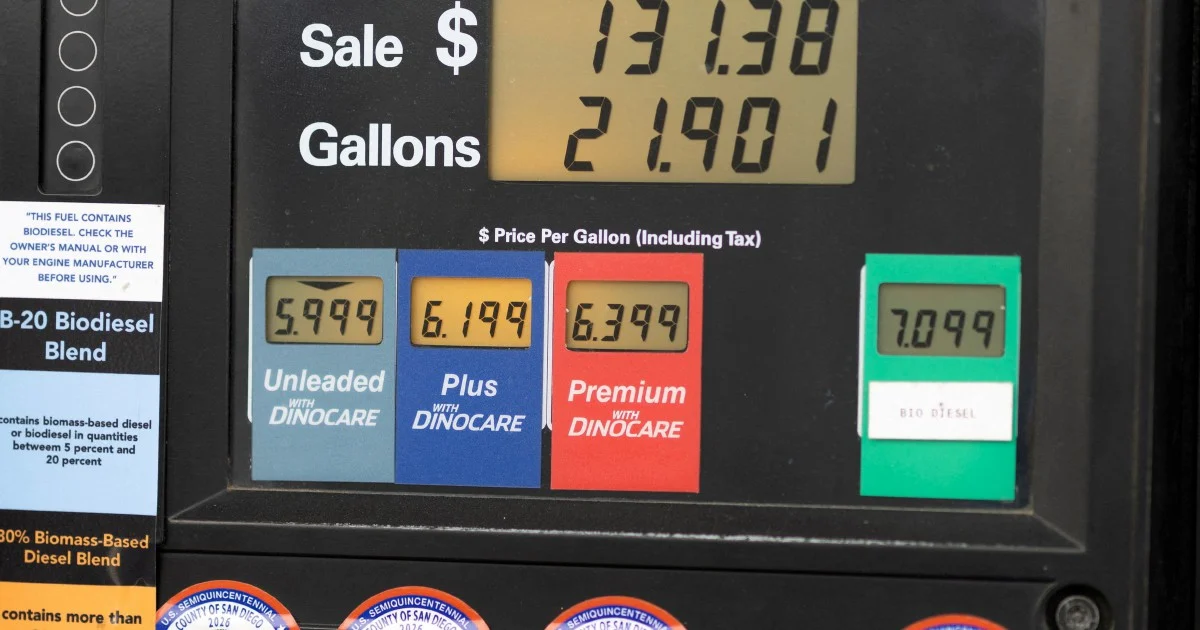
President Donald Trump announced on Wednesday that he has directed authorities to investigate the nation's largest oil companies, citing frustration that retail petrol prices have not declined as rapidly as market conditions would suggest. The move reflects growing domestic political pressure on the administration regarding energy costs, particularly as geopolitical tensions in the Middle East continue to weigh on consumer sentiment and economic performance across the United States.
The investigation signals Trump's determination to address what many Americans perceive as unfair pricing at the pump, a perennial concern during periods of global uncertainty. By ordering a formal probe, the administration is essentially challenging oil majors to explain the lag between wholesale crude cost reductions and what consumers ultimately pay at service stations. This approach mirrors historical precedent in US politics, where executives of energy firms have frequently found themselves under legislative and executive scrutiny during times of elevated fuel prices.
The timing of Trump's directive arrives as the broader Middle Eastern conflict continues to create market volatility and investor anxiety. While oil production disruptions have not materialised at the scale some feared, the mere possibility of supply interruptions keeps crude prices elevated relative to fundamentals. This regional instability indirectly affects Malaysian consumers and businesses, as global energy benchmarks influence domestic fuel pricing mechanisms throughout Southeast Asia, including Malaysia's managed petrol pricing framework.
Oil companies typically defend pricing structures by pointing to refining costs, transportation expenses, and retail margins that exist between the wellhead and the pump. However, critics argue that during periods when crude prices fall sharply, retail adjustments often lag by weeks or months, effectively allowing producers and distributors to capture windfall margins. The gap between wholesale and retail movements is particularly pronounced when prices are declining, creating the perception of pricing manipulation among consumers already burdened by high living costs.
For Malaysian readers, this development carries indirect implications. As a significant oil and gas producer with its own downstream refining and retail operations, Malaysia's energy sector closely monitors US regulatory trends and international best practices. Petronas, Malaysia's national energy company, operates within competitive global markets where pricing transparency and consumer perception significantly influence corporate reputation and operating environment. Regulatory scrutiny in major economies like the United States often sets precedents that eventually influence policy discussions in other jurisdictions.
The investigation also reflects broader consumer frustration that extends beyond energy. Inflation concerns remain elevated in the United States despite recent monetary policy adjustments, and energy costs occupy an outsized share of household budgets and transportation expenses for businesses. By targeting oil companies specifically, Trump addresses a constituency that views energy pricing as a control lever available to corporate decision-makers, even though global commodity markets operate with substantial constraints on individual firm actions.
Market analysts note that investigations into oil company pricing rarely yield dramatic results or legal consequences, given that companies generally operate within regulatory frameworks and competitive markets. Nevertheless, the public pressure generated by such scrutiny can influence corporate behaviour regarding promotional discounting, refinery utilisation rates, and strategic inventory management. Companies may become more cautious about appearing to profiteer during periods of consumer vulnerability, which can indirectly moderate retail price movements.
The investigation's scope remains undefined at this stage, though typically such probes examine pricing patterns, profit margins, supply decisions, and communications among major competitors. Regulators will likely examine whether crude price declines have been proportionally reflected in finished product pricing, and whether any evidence suggests coordinated behaviour that might violate antitrust provisions. Given modern market transparency, such coordination would be extraordinarily risky and unlikely, though historical precedent demonstrates that energy companies occasionally engage in behaviours that attract regulatory attention.
For Southeast Asian economies including Malaysia, the broader lesson concerns the political economy of energy pricing. Governments throughout the region maintain varying degrees of control over domestic fuel prices through subsidies, taxes, and managed pricing mechanisms specifically to insulate consumers from global volatility. Trump's actions underscore how energy pricing remains a political flashpoint even in sophisticated market economies where price signals theoretically should prevail. This validates the region's continued emphasis on strategic petroleum reserves, refining capacity investments, and price management frameworks as essential policy tools.
The investigation also occurs against a backdrop of transition in global energy markets, with renewable energy adoption accelerating and traditional fossil fuels facing long-term demand uncertainty. Oil companies increasingly face pressure to justify pricing while simultaneously managing shareholder expectations and capital allocation toward energy transition initiatives. This structural tension between maintaining traditional business profitability and navigating toward sustainable operations makes energy firms particularly vulnerable to political scrutiny during periods of elevated consumer sentiment.
Ultimately, Trump's probe represents an attempt to demonstrate responsiveness to consumer concerns about energy costs, a perennially important political issue. Whether the investigation yields meaningful insights or regulatory changes remains uncertain, but the signal sent to energy markets about government attention to pricing practices could subtly influence corporate strategic decisions regarding inventory, refining rates, and margin management in coming months.