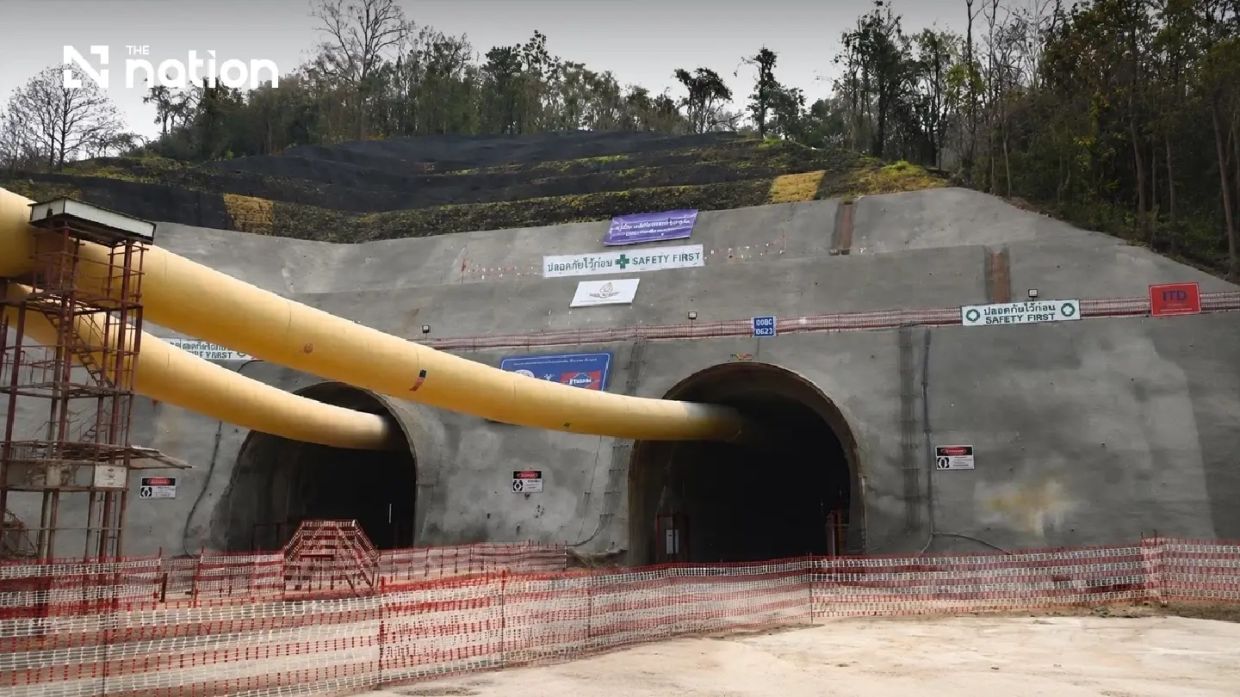
A construction accident at the Doi Luang railway tunnel in Chiang Rai's Chiang Saen district on Saturday evening claimed two lives and left seven workers injured, casting fresh scrutiny on safety protocols within Thailand's ambitious rail expansion programme. The State Railway of Thailand confirmed the incident occurred around 8.35pm when scaffolding collapsed during ongoing work on the Den Chai-Chiang Rai-Chiang Khong railway line, a major infrastructure project intended to enhance rail connectivity across the northern region.
Deputy Transport Minister Siripong Angkasakulkiat provided initial details following emergency response, indicating that preliminary investigations point to falling rocks dislodged from the tunnel wall as the probable cause of the collapse. The accident happened while workers were engaged in installing a waterproofing system—a critical phase in tunnel finishing that requires precise coordination and structural stability. Though earlier accounts suggested the incident involved the shotcrete work area, subsequent assessments refined the understanding of what triggered the structural failure.
The casualty toll from Saturday's disaster comprised two fatalities, three workers sustaining serious injuries, and four others with minor injuries. All affected personnel received immediate medical attention, with authorities transporting them to hospital facilities for treatment and documentation. The swift response prevented the incident from escalating further, though investigators emphasised that detailed examination of the accident site was ongoing to establish a comprehensive timeline and identify any systemic failures in construction management.
Authorities moved quickly to contain potential additional risks, with the Deputy Transport Minister confirming that the immediate vicinity had been secured and the situation stabilised. The project's dedicated safety unit assumed control of the accident site and implemented heightened monitoring protocols to prevent recurrence or secondary incidents. This procedural response reflects standard practices following major construction accidents in Thailand, though the incident underscores recurring concerns about worker protection in large-scale infrastructure projects across Southeast Asia.
The State Railway of Thailand's Special Projects and Construction Department launched an urgent inspection of the scene, commencing forensic analysis of the structural failure. This investigation will examine multiple variables including material quality, installation procedures, worker training, site supervision, and adherence to design specifications. The findings will likely inform recommendations across other active tunnel construction sites within Thailand's rail network, potentially affecting schedules and operational protocols at comparable projects.
The Doi Luang tunnel itself represents a substantial engineering undertaking, stretching 3.4 kilometres through challenging terrain and having already completed the boring phase prior to Saturday's incident. The tunnel forms part of Contract 3 of the Chiang Rai-Chiang Khong rail section, valued at THB19.385 billion and encompassing approximately 87 kilometres of track construction across multiple configurations. This particular contract also includes three stations, three halts, comprehensive signalling and telecommunications infrastructure, and supporting systems essential for modern railway operations.
The project contractor, the CKST-DC3 Joint Venture, comprises three significant construction entities: CH. Karnchang Public Company Limited, Sino-Thai Engineering & Construction Public Company Limited, and Chiangmai Construction Co., Ltd. The involvement of multiple major contractors in this joint venture structure reflects the scale and complexity of the undertaking, though it also distributes responsibility for safety compliance across organisational boundaries. The accident will likely prompt rigorous review of coordination mechanisms and safety accountability within the joint venture framework.
Thailand's Den Chai-Chiang Rai-Chiang Khong railway line forms a critical component of the government's broader northern regional development agenda, promising enhanced goods transport and passenger connectivity between provinces. For Malaysia and other Southeast Asian nations, the project's progress carries implications for regional trade flows and logistics efficiency, particularly given geographical proximity and cross-border economic integration. The incident demonstrates the inherent risks embedded in accelerated infrastructure development, where ambitious timelines occasionally conflict with rigorous safety enforcement.
The construction accident occurs within a context of elevated scrutiny regarding worker welfare across Thai infrastructure projects. International labour standards and domestic regulatory frameworks increasingly demand transparent investigation processes and tangible reforms following fatal incidents. The transparency with which Thai authorities reported preliminary findings suggests institutional commitment to accountability, though definitive lessons will emerge only following completion of detailed forensic analysis.
Beyond immediate casualty concerns, the incident raises operational questions regarding project scheduling and cost implications. Accident investigations typically necessitate temporary work suspensions across affected sections, potentially affecting delivery timelines for the overall Den Chai-Chiang Rai-Chiang Khong programme. The contractor consortium will likely implement enhanced safety measures, additional worker training, and revised installation procedures—interventions that extend project duration and augment expenditure.
For Malaysian readers engaged in construction or infrastructure sectors, Saturday's collapse illustrates universal occupational hazards inherent in underground engineering, regardless of geographic location or contractor nationality. Thai safety protocols and enforcement mechanisms increasingly align with international standards, yet the incident underscores that regulatory compliance does not eliminate all risk. The accident reinforces importance of proactive hazard identification, robust worker training, comprehensive site supervision, and rapid incident response—principles applicable across all regional construction activities.
Thailand's Transport Ministry committed to providing updated information as investigations progressed, indicating institutional intention toward transparent public communication regarding the incident's findings and any resultant policy reforms. The accident's resolution will likely inform construction practices throughout the region, potentially establishing precedents for safety accountability in large-scale infrastructure projects. For regional observers monitoring Thai infrastructure development, the incident serves as a sobering reminder that economic progress and worker safety remain inherently linked objectives requiring constant vigilance and investment.

%22%2F%3E%3C%2Fpattern%3E%3C%2Fdefs%3E%3Crect%20width%3D%22100%25%22%20height%3D%22100%25%22%20fill%3D%22url(%23ph12ncwg)%22%2F%3E%3Crect%20width%3D%22100%25%22%20height%3D%22100%25%22%20fill%3D%22url(%23ph12ncwp)%22%2F%3E%3Ctext%20x%3D%2250%25%22%20y%3D%2250%25%22%20text-anchor%3D%22middle%22%20dominant-baseline%3D%22central%22%20fill%3D%22rgba(255%2C255%2C255%2C0.95)%22%20font-family%3D%22Georgia%2C%20'Times%20New%20Roman'%2C%20serif%22%20font-weight%3D%22700%22%20font-size%3D%22226%22%20letter-spacing%3D%22-0.02em%22%3EPenang%3C%2Ftext%3E%3C%2Fsvg%3E)