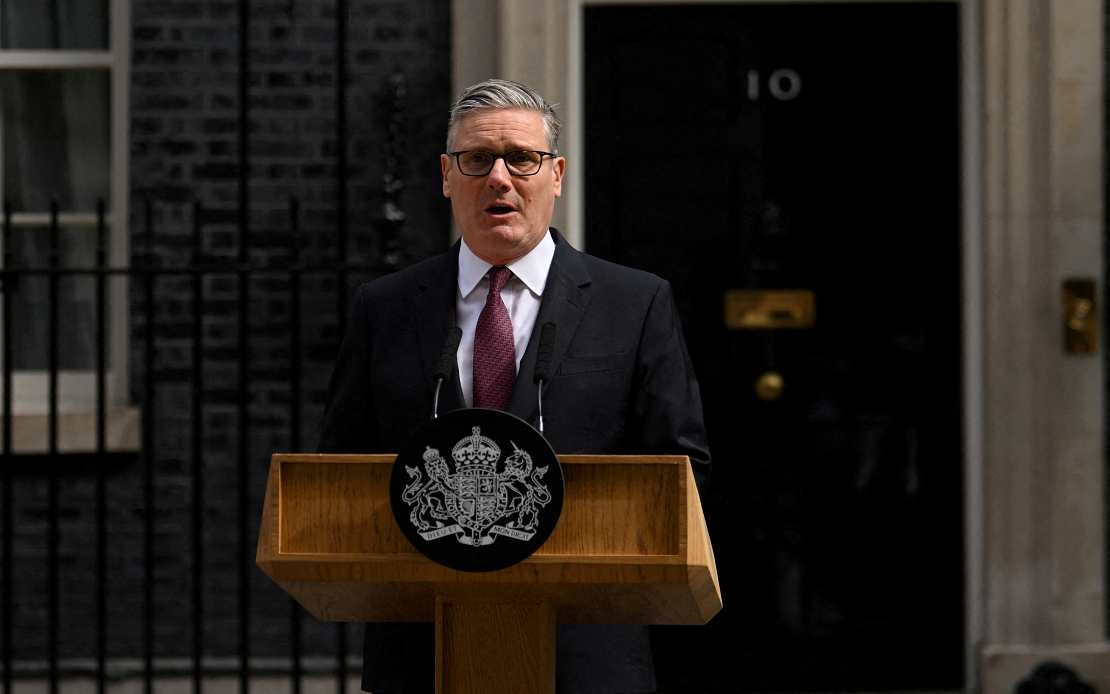
Prime Minister Keir Starmer has announced his intention to resign from his position, signalling that a successor will be in place before Westminster reconvenes in September. The British leader, speaking on Monday, indicated he would back whoever the Labour Party selects as his replacement, marking a significant turning point for a government that won a decisive electoral mandate less than two years ago. The announcement represents a dramatic reversal for a prime minister who entered office promising to restore stability to British politics after years of turmoil.
Starmer's decision to step down follows months of accumulating pressure within his own party, with dissent finally reaching a critical point on Friday when Andy Burnham, the Mayor of Greater Manchester, achieved a decisive victory in a parliamentary by-election. Burnham's win is particularly significant as it came at the expense of a Reform UK candidate, the party led by Nigel Farage that has dominated national opinion polling for over a year. The result provided Labour lawmakers with tangible evidence that their party could recover electoral ground under different leadership, reigniting hopes for a political renaissance.
Burnham's emergence as the likely successor reflects Labour's desperation to reverse its declining fortunes under Starmer's leadership. The Manchester politician, a veteran campaigner known for his ability to communicate effectively with voters, represents a sharp contrast to the prime minister whose personal approval ratings have fallen to historic lows for any British leader in office. Within Labour circles, Burnham is seen as possessing the political skills necessary to reconnect with an electorate that has grown increasingly disillusioned with the government's performance.
Yet Burnham's path to power, should he secure the leadership, will be constrained by substantial structural challenges inherited from the current administration. The candidate has articulated broad aspirations around fundamental economic restructuring and reducing the cost of living burden on households, but has offered limited detail on how his government would approach critical policy areas including foreign relations, economic management, and defence spending. His relative silence on these fronts raises questions about the depth of strategic thinking underpinning his leadership bid.
The incoming prime minister, whoever emerges from the Labour contest, will discover that the room for manoeuvre available to the British government has narrowed considerably. International bond market investors, demonstrating considerable influence over government fiscal decisions, have shown themselves hostile to any proposal involving increased public borrowing. Simultaneously, the electorate has grown deeply frustrated with the state of British public institutions and services, viewing the country as fundamentally broken and resistant to meaningful improvement.
Britain's economic position has deteriorated to the point where it now carries the highest borrowing costs among the Group of Seven industrialised nations, a consequence of elevated public debt levels, mounting interest payment obligations, disappointing economic growth rates over successive years, persistent challenges in reducing public expenditure, and the mounting need for investment in defence capabilities. This constrained fiscal environment will present genuine difficulties for any new government attempting to deliver the transformative change that voters are demanding.
Analysts remain divided about whether Burnham possesses the political will to maintain the market confidence that has become essential for the functioning of British government. The Greater Manchester politician remarked last September that Britain must escape its position as being "in hock to the bond markets," comments that have caused concern among some economists about his commitment to fiscal orthodoxy. Citibank's economic team warned on Friday that "a Burnham premiership would inherit a precarious fiscal situation with few tools to deliver meaningful change," capturing the tension between political expectations and economic realities.
Starmer's initial position, stated on Friday, was that he would participate in any formal Labour leadership contest mounted against him. That stance shifted dramatically over the following weekend, however, with the prime minister appearing to accept the inevitability of his departure without mounting a sustained defence of his tenure. The timing of his announcement, with a transition planned for September, appears designed to maintain government functionality during the interim period and allow Burnham adequate preparation time for assuming the premiership.
The frequency of prime ministerial turnover has become a defining characteristic of post-Brexit British politics. Starmer's successor will become the seventh person to occupy the office since the 2016 referendum that led to Britain's departure from the European Union. This extraordinary level of leadership instability, unprecedented in British politics for nearly two hundred years, reflects the profound difficulty facing successive governments in meeting voter expectations regarding living standards, the quality of public services, and immigration management. The electorate's apparent rejection of each new prime minister in turn suggests that the problem extends beyond personalities or individual competence.
The advisory group Eurasia has suggested that the timing of Starmer's departure actually presents certain advantages for both outgoing and incoming leadership. By announcing his resignation now while committing to remain until September, Starmer can fulfil his remaining international obligations, including participation in a planned UK-European Union reset summit scheduled for July. This arrangement provides Burnham, assuming he wins the leadership race, with several months to prepare his transition to power and develop detailed policy positions on the critical issues he has yet to address comprehensively.
For Malaysia and other Southeast Asian nations, Britain's political turmoil carries implications for regional engagement and trade relations. The UK has sought to expand its diplomatic and economic presence in the Indo-Pacific region in recent years, and ongoing political instability at home could complicate those efforts. The incoming British government will need to balance domestic crisis management with international commitments, potentially affecting the consistency and depth of British engagement with Malaysian and ASEAN partners during a critical period of geopolitical repositioning.