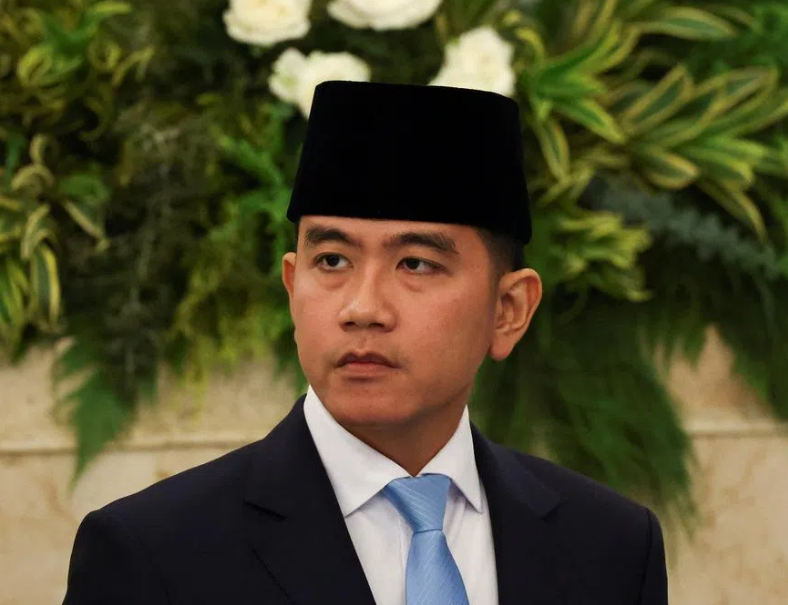
Vice-President Gibran Rakabuming Raka has emerged as the public face of Indonesia's response to growing student activism, inviting university protesters aboard an official aircraft to eastern Indonesia just days after they had demonstrated against the government's flagship free meals and Red and White Cooperative programmes. The 38-year-old vice-president's sudden cultivation of direct dialogue with student critics represents a deliberate attempt to position himself as a communicative leader sympathetic to public concerns—a calculated move observers say is designed to elevate his profile ahead of the 2029 presidential election, even as he continues to grapple with defining a meaningful role within President Prabowo Subianto's administration.
Gibran's engagement began following a three-day closed-door meeting with representatives from Bung Karno University and other institutions who had been conducting research on the two contested initiatives. During that session, according to a statement from his office, the vice-president responded positively to the students' findings and pledged to audit and consolidate their research before briefing President Prabowo Subianto. The carefully orchestrated nature of the subsequent eastern Indonesia trip—which saw five selected student leaders join Gibran on an official government visit—signalled a sophisticated attempt to transform critics into collaborators while maintaining the appearance of genuine public engagement.
However, the reception to Gibran's outreach has proven decidedly mixed. Social media responses to the vice-president's Instagram announcement revealed considerable scepticism about the authenticity of the student engagement. Critics questioned why the invitation had extended only to representatives from less prominent universities rather than students from Indonesia's largest and most influential campuses, suggesting the selection process was designed to showcase manageable dissent rather than genuine dialogue with the country's most vocal activist voices. One commenter aptly described the exercise as theatrical rather than substantive, encapsulating a broader concern that Gibran's manoeuvre prioritised appearance over authentic policy engagement.
These doubts about sincerity intensified when investigative reporting revealed that multiple students who attended the palace meeting had subsequently received cash payments. According to local media outlets in late June, the student leader from Bung Karno University acknowledged receiving 20 million rupiah following the meeting, while other attendees reported receiving sums between 2 million and 2.5 million rupiah. The Presidential Palace announced it was investigating the matter, but the revelation immediately undercut Gibran's narrative of transparent, good-faith engagement with genuine student representatives. Indonesian political analysts interpreted the payments as evidence of orchestrated management rather than organic dialogue, though the source and intended purpose of the funds remained officially unexplained.
Scholar Nicky Fahrizal from Jakarta's Center for Strategic and International Studies characterised Gibran's approach as strategic positioning aimed at cultivating a specific public persona. According to Fahrizal's analysis, the vice-president is deliberately projecting himself as a communicative leader genuinely receptive to ordinary citizens and student activists—an image Fahrizal suggested Gibran was building early in his tenure to establish political capital for potential future electoral ambitions. The 2029 presidential election provides the natural timeframe for assessing whether this early investment in public goodwill translates into tangible political advantage. By positioning himself as a bridge between grassroots concerns and presidential decision-making, Gibran appears to be constructing a distinct political identity separate from his currently ill-defined administrative role.
The timing of Gibran's student engagement proved particularly astute given contemporary controversies surrounding the free meals programme. Earlier in June, corruption allegations had engulfed the National Nutrition Agency, leading to the removal and subsequent arrest of agency chief Dadan Hindayana alongside two former deputies in connection with alleged procurement irregularities. During his subsequent visit to a primary school in East Nusa Tenggara, Gibran publicly acknowledged shortcomings in the programme's governance and called for systematic improvements—positioning himself as responsive to public concern while maintaining distance from direct accountability for the scandal. His instruction to officials to accelerate implementation where infrastructure existed already demonstrated how he could appear constructive while largely deferring substantive remediation decisions.
Yet analysts remain unconvinced that Gibran's engagement with student critics will produce meaningful policy outcomes. Researcher Edbert Gani Suryahudaya of CSIS characterised the vice-president's approach as deliberately designed to appease public anger through relatively low-cost performative gestures rather than facilitate genuine structural reform. The reality, multiple scholars argue, is that Gibran possesses limited actual authority over either programme. The National Nutrition Agency reports directly to President Prabowo Subianto, while the Red and White Cooperative initiatives remain coordinated through multiple ministries and agencies operating as part of the president's centralised priority agenda. Gibran's visibility around these initiatives does not correlate with substantive control over their direction, implementation, or reform.
This structural constraint has defined Gibran's broader challenge since assuming office alongside Prabowo in October 2024. Unlike certain predecessors who inherited substantial policy portfolios, the eldest son of former president Joko Widodo has struggled to establish a distinctive administrative function beyond ceremonial assignments nominally linked to Papua's development and the new capital city Nusantara. He has largely remained peripheral to major policy deliberations, leading observers to question whether his titular position carries commensurate influence or decision-making responsibility. As Gibran himself has not publicly articulated a defined role within the administration, his political standing remains effectively determined through the initiatives he chooses to publicly associate with.
Ultrastructural analysis from Padjadjaran University's Irman Lanti suggests that Gibran's growing rhetorical engagement with controversial programmes may paradoxically indicate his exclusion from their actual governance. All available evidence, according to Lanti, points toward the free meals and cooperative initiatives remaining substantially under the control of military and police officials, with the vice-president attempting to demonstrate relevance by inserting himself into contemporary public debates. This interpretation reframes Gibran's student outreach as a strategic response to his current marginalisation within policy-making circles—an attempt to construct influence and visibility through public engagement where formal institutional channels have remained limited. By riding the momentum of student demonstrations, the theory suggests, Gibran aims to position himself as consequential within government while actually occupying an increasingly circumscribed role.
The broader context of Gibran's positioning within Indonesia's political landscape reveals deeper tensions between formal office and effective authority. As public criticism has mounted against the Prabowo administration and its initiatives, the vice-president appears to have identified student engagement as an accessible vehicle for personal brand cultivation and political positioning. Edbert Gani Suryahudaya characterised this strategy as employing the lowest-cost methods of attracting public attention—leveraging student concerns without requiring substantive policy concessions or demonstrating actual programmatic influence. The performative dimensions of the engagement appear deliberately calculated to generate media attention and favourable public perception with minimal institutional risk or resource commitment.
For Malaysian observers monitoring Indonesian political development, Gibran's manoeuvre illustrates both the opportunities and limitations facing contemporary Southeast Asian vice-presidents navigating complex governance structures. His attempt to cultivate popular legitimacy through direct engagement with critics suggests recognition that formal institutional position alone insufficient to establish political standing, particularly where executive authority remains concentrated in presidential hands. The question of whether Gibran can translate visible activism and student engagement into genuine influence over policy direction, or whether he remains confined to symbolic gestures, will substantially shape the trajectory of his potential future political ambitions and the character of Indonesian governance through 2029 and beyond.

