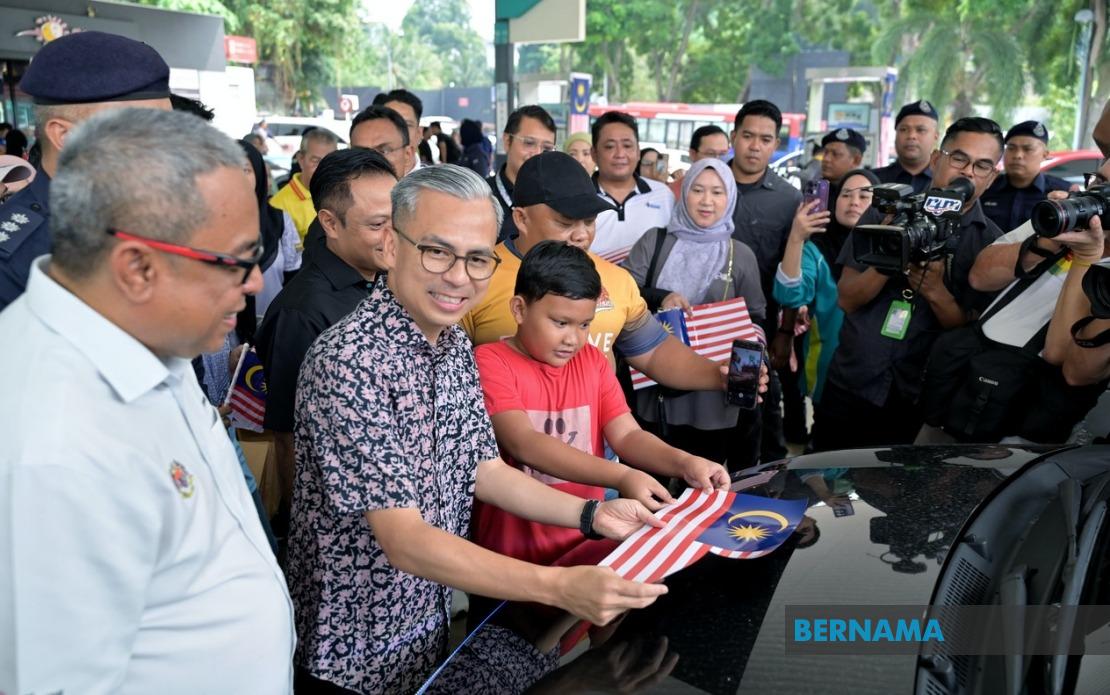
The 1 House 1 Jalur Gemilang (1R1JG) campaign has entered a more intensive phase with the launch of the Ekspresi Jalur Gemilang JAPEN@PETRONAS programme, which activated simultaneously across 15 strategically selected fuel stations throughout Malaysia on August 9. This coordinated approach represents a significant expansion of the national flag promotion initiative, leveraging PETRONAS's extensive network to reach a broad cross-section of the Malaysian public during the crucial National Month celebration period.
Organised jointly by the Department of Information (JAPEN) and PETRONAS, this programme serves a dual purpose: it creates accessible touchpoints for citizens to engage with patriotic messaging while simultaneously establishing a memorable, practical connection between national pride and everyday activities. The decision to utilise the nation's largest fuel station network underscores recognition that national symbols gain traction when integrated into routines and spaces Malaysians frequent regularly, rather than remaining confined to formal civic spaces.
The tactical centrepiece of the campaign involves distributing free magnetic Jalur Gemilang stickers to the first 200 motorists at each participating station. This limited-availability approach incentivises early participation while maintaining manageable logistics across multiple venues. The magnetic sticker format represents a thoughtful refinement based on public feedback collected in previous campaign iterations, addressing practical concerns that had likely emerged from prior distribution efforts.
The adhesive-free magnetic design holds particular significance for Malaysian motorists. Unlike traditional sticker adhesives, magnetic mounting permits straightforward attachment and removal without leaving sticky residue on vehicle surfaces—a consideration that may have deterred previous participation, especially among owners of newer vehicles or those concerned about paint damage. By removing this friction point, the initiative acknowledges that patriotic expression should not require sacrificing vehicle aesthetics or protection.
Communications Minister Datuk Seri Fahmi Fadzil personally participated in the campaign at the PETRONAS station along the New Pantai Expressway in Pantai Dalam, where he affixed magnetic stickers to vehicles as a symbolic endorsement. The minister's direct involvement serves to elevate the campaign's profile and signal government commitment to its success, lending official gravitas to what might otherwise be dismissed as a routine promotional activity.
Beyond the physical distribution mechanism, Fahmi articulated a broader multimedia strategy designed to saturate the information environment with patriotic content during the National Month period. He directed that Aku Berjanji, the official theme song composed by Faizal Tahir for the 2024 National Day and Malaysia Day celebrations, receive increased airplay across multiple platforms. This directive specifically targets government channels including RTM and commercial radio and television stations, creating a coordinated messaging approach that combines visual symbols (the flag stickers) with auditory reinforcement.
The comprehensive scope of the 1R1JG initiative extends far beyond the PETRONAS activation point. According to Fahmi, this year's campaign encompasses 11 distinct programmes organised across nine thematic clusters—education, health, security, community, industry, houses of worship, and sports—operating simultaneously at approximately 2,000 locations nationwide. This breadth suggests an attempt to embed patriotic messaging across the full spectrum of Malaysian institutional and civil society infrastructure.
The multi-cluster approach recognises that patriotism in a diverse, federated nation functions most effectively when it manifests across multiple identity-forming institutions. Rather than concentrating efforts on traditional civic or government spaces, the campaign deliberately reaches into schools and universities where national identity is formally constructed, healthcare settings where citizens experience state institutional care, and religious premises where Malaysians engage in faith-based community formation. This institutional pluralism allows citizens with different priorities and engagement patterns to encounter the campaign within contexts meaningful to them.
The sports, security, and industry clusters particularly warrant attention as vectors for nationalist sentiment in Malaysia's contemporary context. Sports provides a naturally mobilising space where competitive achievement against external rivals creates potent nationalist affect. Security and community initiatives allow the campaign to connect patriotism with tangible government functions affecting daily welfare, while industrial engagement links national symbols to economic identity and livelihood concerns affecting Malaysia's working population.
The timing of this campaign intensification holds strategic significance within Malaysia's annual civic calendar. National Month serves as the designated period for heightened national consciousness and celebration, yet patriotic sentiment requires constant reinforcement to maintain traction in an increasingly globalised, digitally fragmented media environment where competing symbols and narratives constantly compete for attention. The concentrated activation during this window allows the government to establish baseline expectations for visible national expression that ideally persist beyond the formal celebration month.
For Malaysian readers and Southeast Asian observers, the 1R1JG campaign reflects broader patterns in how nation-states attempt to construct and maintain civic identity in contemporary contexts. The programme's emphasis on accessible, practical engagement mechanisms—magnetic stickers distributed at petrol stations rather than ceremonial flag ceremonies—represents a modernised approach to patriotic mobilisation, one adapted to the reality that many Malaysians engage with national symbols most readily through consumer and transportation habits rather than formal civic participation.
The campaign's reliance on private sector partnership with PETRONAS also illustrates contemporary governance trends wherein corporate infrastructure becomes enlisted in service of state patriotic objectives. This public-private collaboration creates operational efficiency while diluting any perception of top-down government coercion, instead framing national pride as a shared commercial and civic venture. For PETRONAS specifically, the association with patriotic programming provides brand alignment with national identity at a moment when Malaysia's state petroleum enterprise faces international and domestic pressures regarding its role in energy transitions and development policy.

