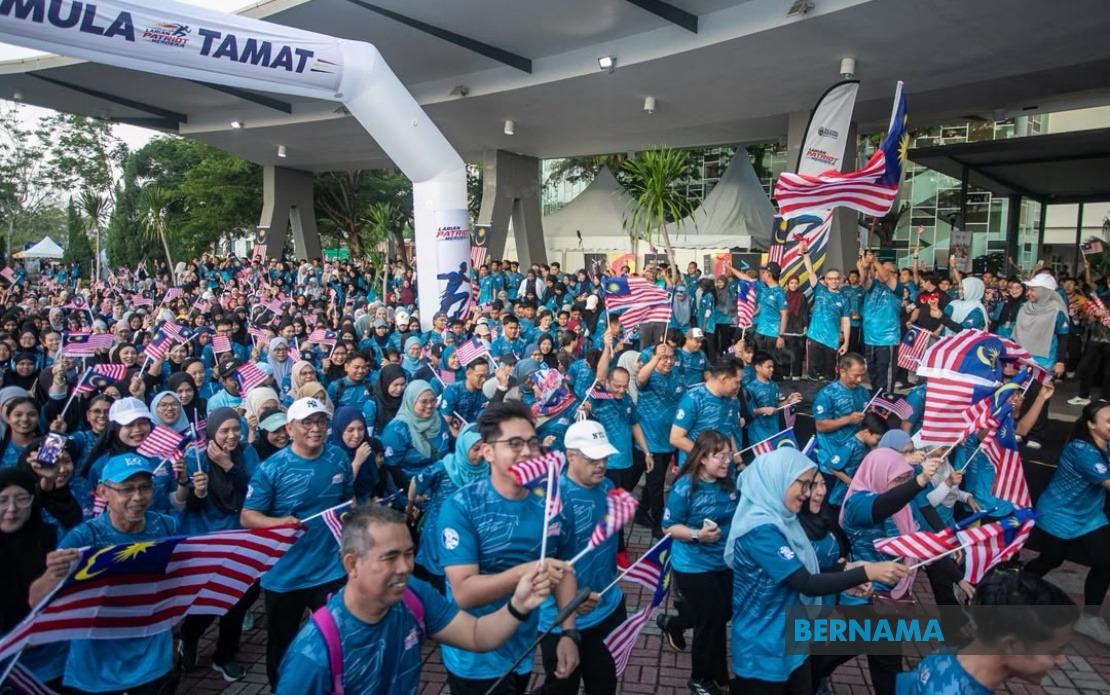
A crisp Friday morning in Ipoh saw the Sultan Azlan Shah Ministry of Health Training Institute transformed into a sea of patriotic fervour as approximately 2,000 community members converged for the Patriot Merdeka Run, an opening salvo in the nation's 2026 National Day and Malaysia Day festivities. The gathering, held in conjunction with the launch of the Fly the Jalur Gemilang Campaign (MPBKKJG 2026), drew participants spanning multiple generations and social backgrounds, with families arriving early to secure prime positions and prepare for the morning's scheduled activities.
The event commenced before dawn broke fully across Perak's state capital, with participants gathering as early as 7 am to participate in a mass aerobics session that served as both a warm-up and a collective expression of community spirit. The synchronized movement of thousands demonstrated the inclusive nature of the celebration, transcending conventional barriers of age, fitness level, or social status. Following the aerobics session, the assembled crowd engaged in a coordinated wave of the Jalur Gemilang, transforming the training institute grounds into a tableau of national pride and collective identity.
Datak Abdul Halim Hamzah, secretary-general of the Communications Ministry, formally flagged off the fun run contingent at 7.30 am, initiating the 2.5-kilometre route that had been decorated with the national flag at regular intervals. This route through Ipoh served not merely as a physical pathway but as a symbolic journey through the nation's commitment to unity and national consciousness. The deliberate placement of the Jalur Gemilang along the entire course reinforced the thematic purpose of the morning's activities, ensuring that patriotism remained visually and conceptually central to the participants' experience.
The atmosphere throughout the run captured the authentic essence of community celebration. Parents shepherded young children through the route, many of whom experienced their first formal participation in a national patriotic event, thus establishing early foundations for civic consciousness. Numerous participants had coordinated their attire to reflect the colours of the Jalur Gemilang—red, white, blue, and yellow—transforming the run into a mobile portrait of national symbolism. The spontaneous encouragement exchanged between runners and walkers created an environment of mutual support rather than competitive athletics, reflecting deeper cultural values of communal harmony.
Organizers positioned the Patriot Merdeka Run as a multifaceted initiative addressing contemporary concerns about public health alongside traditional national observance. The emphasis on a healthy lifestyle through community participation acknowledged Malaysia's ongoing efforts to combat sedentary behaviour while simultaneously leveraging physical activity as a vehicle for social cohesion. By removing barriers related to age, competitive ability, or physical condition, the event ensured that participation became an act of patriotic expression accessible to virtually all community members, from young children to elderly citizens.
The run functioned as more than ceremonial exercise; it represented an intentional strategy to deepen public understanding of independence's significance. Through the tangible experience of collective movement towards a shared objective, participants internalized abstract concepts of national unity in experiential rather than purely rhetorical terms. The gathering reinforced that patriotism need not remain confined to official ceremonies or political rhetoric but could manifest through everyday community engagement and shared civic participation.
The Patriot Merdeka Run occupied a strategic position within the broader calendar of 2026 National Day and Malaysia Day celebrations, serving as an inaugural event that would theoretically generate momentum for subsequent commemorative activities throughout the year. Organizers harboured expectations that such grassroots community initiatives would establish patterns of civic engagement extending beyond single events, cultivating sustained public appreciation for the nation's independence and multicultural heritage. The decision to launch celebrations in Ipoh, rather than exclusively in Kuala Lumpur, demonstrated recognition that national consciousness requires nurturing across all regions and communities.
Prime Minister Datuk Seri Anwar Ibrahim was scheduled to officiate the broader launch ceremony at 10 am on the same day, signalling the national government's formal endorsement of the 2026 celebration programme. This political validation from the highest executive level elevated the community run from local initiative to nationally sanctioned patriotic expression, suggesting that subsequent celebrations would benefit from centralized coordination and resource allocation. The ceremonial structure—beginning with grassroots community participation and culminating in prime ministerial officiation—reflected deliberate messaging about democratic participation spanning from ordinary citizens to government leadership.
For Malaysian readers and Southeast Asian observers, the Patriot Merdeka Run illustrated contemporary approaches to national commemoration in multicultural democracies. Rather than relying exclusively on military parades or formal state ceremonies, Malaysia's celebration strategy increasingly emphasized inclusive community participation that welcomed diverse backgrounds and age groups. This approach resonated particularly with younger generations potentially experiencing diminishing emotional connections to independence narratives, offering experiential engagement that transcended conventional classroom or ceremonial instruction. The event demonstrated how physical activity and communal gathering could serve patriotic purposes beyond mere entertainment, creating embodied national consciousness through shared movement and collective purpose.
The enthusiasm demonstrated by Ipoh's participants suggested broader receptivity to patriotic initiatives framed as community wellness activities rather than obligatory state ceremonies. This shifting paradigm reflected evolving understandings of how contemporary societies maintain national cohesion and intergenerational transmission of civic values. By anchoring celebrations in authentic community participation rather than top-down commemoration, organizers potentially strengthened emotional and psychological investment in national identity among diverse population segments. The Patriot Merdeka Run thus represented not merely a single morning's activity but a pilot model for how Malaysia might sustain and deepen national consciousness throughout 2026 and beyond.

