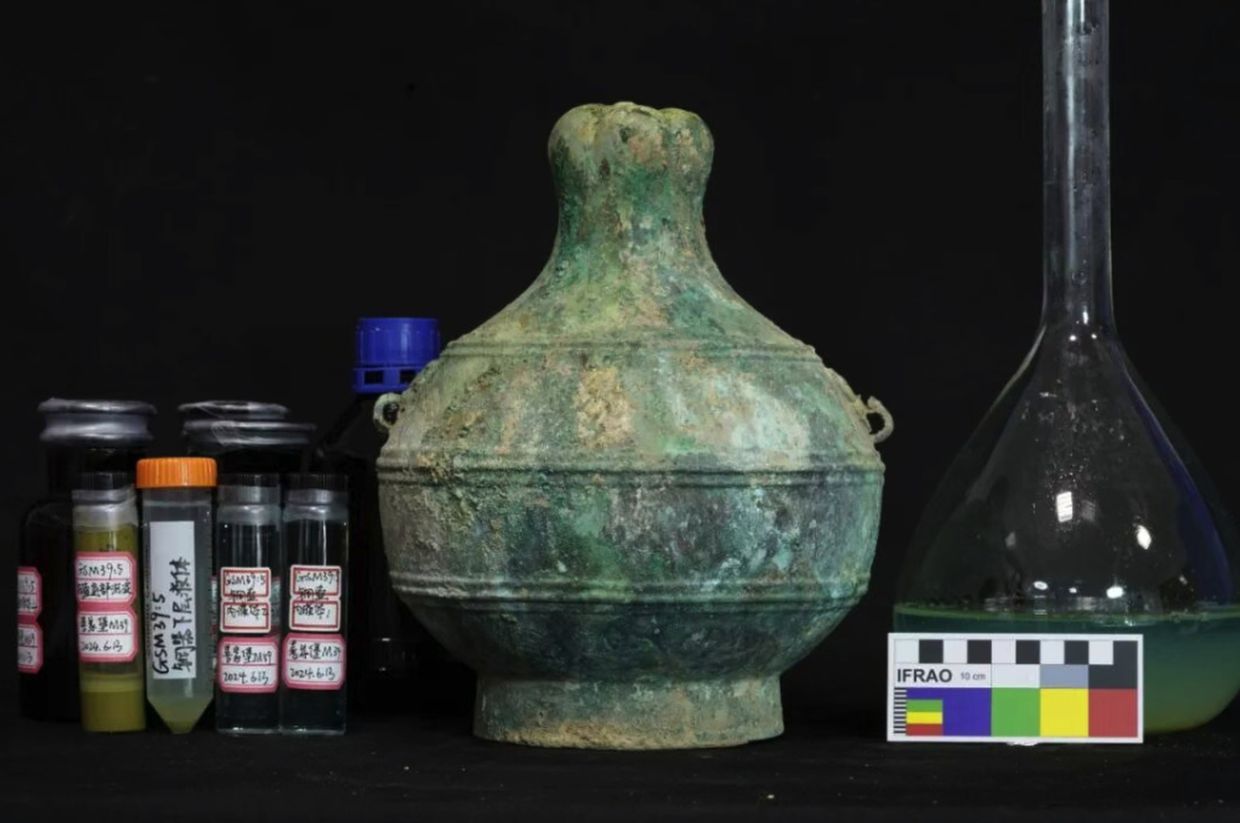
A bronze wine jar sealed for more than two millennia has emerged from an archaeological dig in northwestern China, offering rare insights into the drinking habits and brewing knowledge of ancient border garrison troops. The vessel, discovered at the Shanjiabao cemetery approximately two kilometres from the Warring States-era Qin Great Wall in Guyuan, Gansu, contained 3,740 millilitres of liquid residue that has been confirmed as grain-based wine through comprehensive laboratory analysis. The find, reported in the June issue of the Journal of Archaeological Science, represents the most intact and information-rich wine artefact from the Qin state period yet disclosed to Chinese researchers.
The discovery site occupies strategic importance within the defensive architecture of ancient China. The surrounding region encompasses a 170-kilometre stretch of fortified positions, including forts, castles, and outposts of varying scales that together formed a sophisticated border management system during the Warring States period. Living conditions for military personnel and their families within these fortifications were austere but organised, with evidence suggesting established community structures developed around these strategic locations. The excavation at Shanjiabao uncovered 183 tombs from the Warring States period, with 179 definitively linked to Qin cultural practices, indicating the site functioned as a formal cemetery serving garrison troops and the civilian population stationed along the defensive corridor.
The vessel itself exemplifies the technical sophistication of ancient craftspeople. The bronze pot, shaped distinctively like a garlic bulb—a characteristic marker of Qin material culture—employed an ingenious double-layer sealing mechanism that proved remarkably effective across centuries. The internal surface featured a textile lining that worked in conjunction with an external coating of organic clay, creating an environment sufficiently protective to preserve the wine in largely unaltered condition. Wang Xiaoyang, director of the Shanjiabao cemetery archaeological project at the Ningxia Institute of Cultural Relics and Archaeology, emphasised the exceptional quality of preservation, describing it as representing the pinnacle of known Qin-era wine artefacts disclosed through official archaeological channels.
China occupies a foundational position in the global history of fermented beverages, with archaeological evidence pushing the origins of alcohol consumption back thousands of years. Recent decades have witnessed increasing discoveries of ancient alcoholic residues across Chinese archaeological sites, generating substantial academic interest in understanding the evolution of brewing methodologies and the selection of fermentation raw materials. This expanding body of evidence has allowed researchers to identify clear regional variations in production practices, with distinct patterns emerging between China's agricultural zones. Southern regions traditionally relied upon rice as the primary fermentation substrate, while northern producers, working within different climatic and agricultural contexts, developed their brewing traditions around grain varieties including millet and foxtail millet.
The analytical work conducted on the Shanjiabao sample revealed a complex chemical composition far more intricate than initially anticipated. Researchers identified twenty-four distinct compounds within the liquid, encompassing organic acids and their molecular variants, amino acids and associated derivatives, and carbohydrate residues. This chemical fingerprint provided definitive evidence concerning the beverage's basic character and production methodology. The distribution pattern exhibited by the organic acids aligned closely with reference samples of artificially aged yellow wine, a crucial finding that allowed researchers to distinguish definitively between grain-based fermentation products and fruit-derived wines such as those produced from grapes.
Starch residue analysis proved instrumental in identifying the precise grain employed in the ancient brewing process. Laboratory examination confirmed that more than 92 per cent of the starch content originated from broomcorn millet, demonstrating that ancient Qin brewmasters possessed sophisticated understanding of which grain varieties would produce superior fermentation outcomes. This preference reflected not merely availability but genuine technological knowledge regarding grain properties and their interaction with fermentation processes. The discovery substantiates that northern Chinese brewing traditions, rooted in millet cultivation, possessed considerable antiquity and refinement, extending back to at least the Warring States period.
The research team undertook a collaborative approach to ensure analytical precision, dispatching samples to Northwest University for supplementary investigation beyond the capabilities of field archaeology. This methodological rigor allowed scientists to reconstruct not merely whether wine existed at the site, but to decipher the fundamental recipe and craftsmanship involved in its production. The findings illuminate practical knowledge that ancient brewers applied successfully across generations, suggesting that what might appear as simple fermentation actually involved controlled procedures and ingredient selection informed by accumulated experience.
Beyond the chemical composition and material analysis, the discovery carries profound implications for understanding daily life within border defence installations. The presence of wine within a tomb suggests that such beverages held cultural significance extending beyond mere sustenance, functioning as markers of status, comfort, and social practice. The decision by a deceased individual's family to include a vessel filled with wine in the burial goods reflects the beverage's importance in their society's understanding of proper funeral rites and the material provisions deemed necessary for the afterlife.
This archaeological find fills a significant gap in scholarly understanding of the Ningxia region's winemaking traditions during the Qin state's Warring States period. Previously, evidence regarding production techniques and preferences in this northwestern zone remained fragmentary. The Shanjiabao vessel now provides concrete data demonstrating that sophisticated brewing knowledge existed in frontier regions, not merely in the cultural heartlands. For researchers studying the relationship between environmental constraints, agricultural production, and cultural practice, the discovery illustrates how communities adapted available resources—in this case, locally grown millet—into products of considerable cultural and presumably economic value.
The broader significance of this find extends to contemporary understanding of how ancient societies maintained troop morale and social cohesion in challenging frontier environments. The garrison troops stationed along the Great Wall faced demanding conditions, and the evidence of wine production and consumption suggests that cultural practices providing comfort and reinforcing social bonds received attention even in isolated defensive positions. This discovery of a military family's grave goods—specifically the careful inclusion of a sealed vessel of fine wine—reveals something fundamental about values that transcended the purely utilitarian concerns of frontier defence.
For Malaysian and Southeast Asian scholars, the Shanjiabao discovery offers valuable comparative insights into how ancient agricultural societies across the Asian region developed fermentation technologies independently, each adapting local grain varieties and environmental conditions to produce culturally significant beverages. The methodological approaches employed by Chinese archaeologists—particularly the integration of chemical analysis with cultural context and careful material examination—provide models applicable to understanding similar archaeological questions across Southeast Asia, where ancient brewing practices remain incompletely documented. The sophistication evident in 2,300-year-old Chinese wine-making techniques underscores the technological achievements of early agricultural societies throughout Asia.

