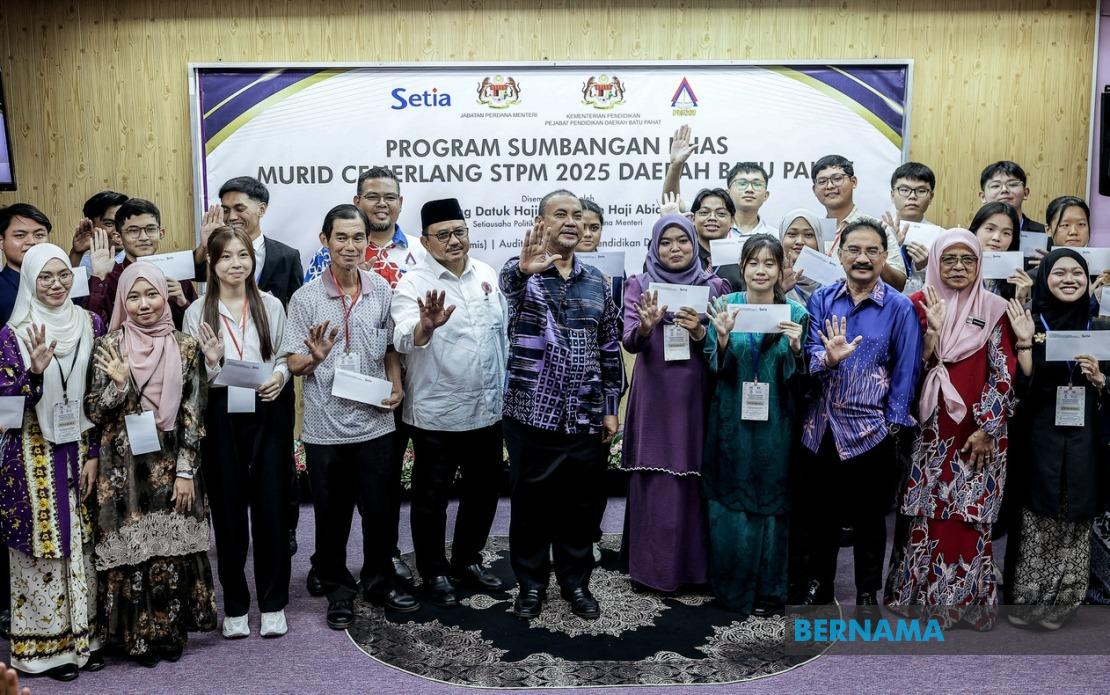
The Prime Minister's Office has recognised the academic achievements of 214 exceptional Sijil Tinggi Persekolahan Malaysia (STPM) students across Batu Pahat district through a special contribution programme unveiled at a ceremony held at the Batu Pahat District Education Office. The initiative, which honours students from 16 secondary schools throughout the district, represents a targeted effort by the federal government to celebrate educational excellence at the pre-university level and bolster student confidence as they transition into higher learning institutions.
Datuk Azman Abidin, Political Secretary to the Prime Minister, presided over the 2025 STPM Top Achievers Award Ceremony and articulated the broader purpose underpinning the programme. Beyond merely acknowledging outstanding academic performance, the contribution scheme aims to motivate recipients to pursue further education with renewed determination and to inspire their peers to elevate their own academic standards. Azman emphasised that such recognition carries symbolic weight, signalling to students that their hard work and dedication do not go unnoticed at the highest levels of government.
The scope of the programme reflects a deliberate geographical strategy within Batu Pahat. By distributing awards across 16 schools in the district, the initiative ensures that excellence is celebrated across multiple educational institutions rather than concentrated in a few high-profile establishments. This approach recognises that outstanding students emerge from diverse school environments and socioeconomic backgrounds, and that broader recognition can reinforce a culture of academic aspiration throughout the district.
According to Azman, the government views this contribution not merely as a financial gesture but as a concrete manifestation of its commitment to educational empowerment and youth development. The contribution scheme serves dual purposes: it provides tangible assistance to students during a critical juncture in their academic journeys, while simultaneously demonstrating government investment in human capital development. Azman noted that programme continuation would depend on available funding allocations, suggesting that budgetary considerations remain central to expanding or sustaining such initiatives across Malaysia's educational landscape.
The government has signalled intentions to broaden this recognition scheme beyond Batu Pahat, contingent upon securing necessary resources. Such expansion plans indicate awareness that high-achieving STPM students exist across multiple districts and states, and that equitable recognition of excellence requires geographically distributed programmes. However, the cautious language regarding funding underscores the finite nature of government resources and the competing priorities that shape education policy implementation at the national level.
Among the award recipients was Afida Auni Airulnizam, a 20-year-old former student of Sekolah Menengah Kebangsaan Tun Sardon in Rengit. For Afida, the recognition held profound personal significance beyond its financial dimensions. She articulated how the award validated her academic efforts and provided meaningful encouragement as she contemplates her tertiary education pathway. As the younger of two siblings, Afida drew inspiration from her older brother's university experience, viewing his trajectory as a blueprint for her own educational aspirations. She expressed interest in pursuing sports science at the tertiary level, provided she secures admission to a suitable institution.
Afida's perspective illuminates how family dynamics often shape educational aspirations among Malaysian students. The presence of an older sibling already navigating university life creates tangible role models and practical insights into higher education, yet the financial realities of tertiary education remain a concern even for high-achieving students. The government contribution, whilst modest in absolute terms, addresses this concern and potentially removes a psychological or practical barrier to educational advancement.
Another recipient, Muhd Ammar Firdaus Mohd Fadzil, a 20-year-old former student of SMK Tun Ismail, similarly emphasised the practical value of the contribution. For Ammar, the financial assistance directly alleviates the mounting expenses associated with preparing for and undertaking tertiary education. The costs of university applications, entrance examinations, accommodation, and initial study materials represent genuine financial burdens for many Malaysian families, even those with academically successful children. By providing targeted financial support to high-achieving students, the programme reduces these barriers and signals that academic merit merits investment.
The timing of this initiative within Malaysia's education calendar carries significance. STPM results determine pathways for hundreds of thousands of students annually, with high achievers eligible for coveted spots in public universities and international scholarship opportunities. Recognition at this stage, coupled with financial support, arrives precisely when students face critical decisions about their educational futures. The psychological impact of government recognition during this transitional period may prove as valuable as the financial component.
The programme also reflects evolving government priorities regarding education funding mechanisms. Rather than concentrating resources on institutional grants or infrastructure, this scheme directs support directly to high-performing individual students. This approach aligns with broader global trends emphasising merit-based recognition and targeted investment in human capital development. For Malaysia, where competition for places in premium university programmes remains fierce and international educational mobility influences brain drain considerations, such initiatives attempt to retain top talent within domestic higher education systems.
The involvement of the Prime Minister's Office in honouring secondary students underscores the political salience of education policy in Malaysian governance. Educational achievement features prominently in government narratives about national development and social mobility. By personalising recognition through Prime Minister's Office awards, the government reinforces messaging that educational excellence constitutes a pathway to advancement and that government actively champions academic achievement.
Looking forward, the scalability of such programmes within Malaysia's education system remains an open question. The current cohort of 214 recipients represents a fraction of Malaysia's annual STPM cohort. Expansion to other districts would require proportionate increases in budget allocations. Nevertheless, the existence of the programme establishes a precedent for government recognition of academic achievement at the secondary level and creates expectations that similar initiatives might proliferate. For high-achieving students throughout the country, the Batu Pahat scheme signals that excellence may attract not only institutional recognition but also direct government support.

