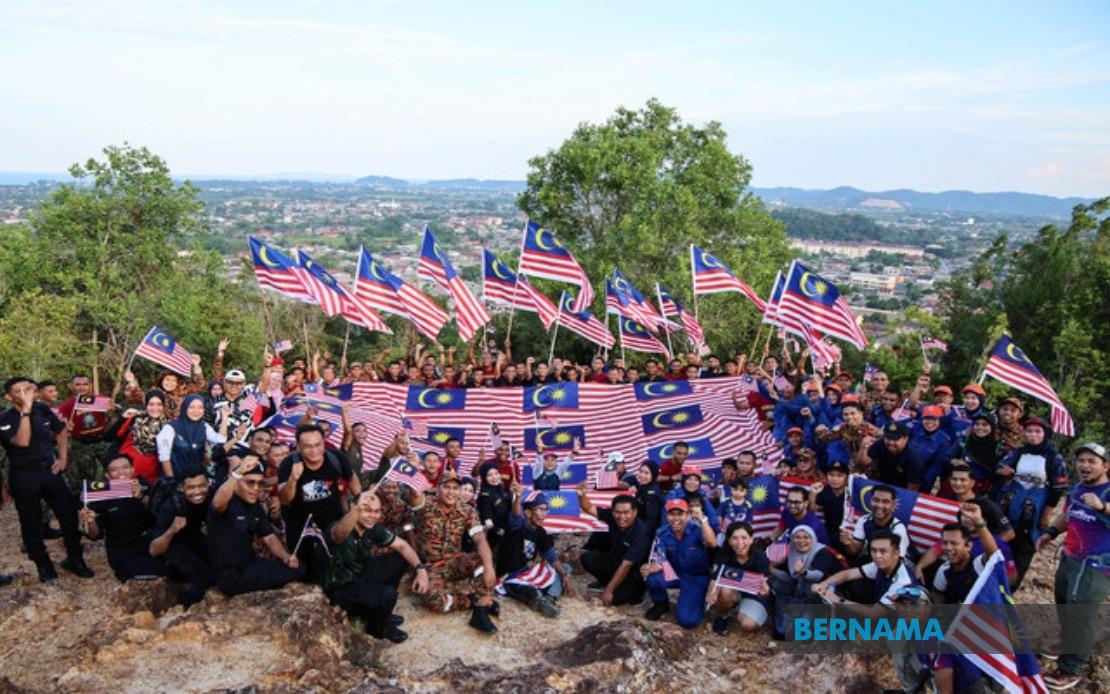
Three hundred participants drawn from Malaysia's security forces, government agencies, and media organisations converged in Kuala Terengganu on August 21 for an inaugural summit hike designed to unite public servants around shared patriotic values. The event represented an uncommon collaboration between journalists and the uniformed services, bringing together personnel from disparate government departments under a singular banner of national pride during the country's most symbolically significant month.
The initiative originated from the Media Practitioners Club, with president Mohd Zaid Mohd Noor explaining the conceptual foundation behind the gathering. He described the hike as an expression of collective love for the nation, whilst simultaneously injecting fresh energy into Terengganu's National Month festivities. The participating agencies reflected the breadth of Malaysia's state administration and security apparatus, encompassing the Terengganu Fire and Rescue Department, Malaysian Armed Forces, Road Transport Department, Malaysian Anti-Corruption Commission, the state ministry responsible for domestic trade and cost of living matters, Royal Malaysian Customs Department, and Malaysia Civil Defence Force.
Mohd Zaid articulated a broader strategic vision underpinning the event, emphasising the media's crucial function in amplifying messages of patriotism across diverse communication channels. He positioned the gathering as a direct expression of this professional responsibility, leveraging the platform to unite not merely journalists but also security personnel and administrative staff in a shared physical and ideological experience. The decision to combine media practitioners with uniformed and civilian government workers represented a deliberate attempt to break down organisational silos that typically characterise Malaysia's sprawling bureaucracy.
Beyond the symbolic dimension, the summit hike served multiple interconnected objectives. Organizers positioned the event as a mechanism for strengthening relationships between agencies that frequently operate in isolation, despite their mutual dependence on operational coordination and information sharing. For institutions like the MACC and Customs Department—whose effectiveness depends partly on inter-agency intelligence cooperation—such informal gatherings create valuable relationship-building opportunities that transcend formal protocols. The elevation of such connections to an explicitly patriotic context imbues routine administrative cooperation with emotional and national significance.
The physical dimension of the hike itself carried considerable symbolic weight. By climbing together toward a summit where participants would unfurl a giant flag, the organisers created a metaphorical journey toward national unity. This approach taps into established traditions of mountaineering as a nation-building exercise, reminiscent of similar patriotic expeditions across Asia. The physical exertion involved in ascending toward the summit provides a shared ordeal that generates camaraderie across hierarchical and departmental boundaries—a journalist and a customs officer, typically occupying vastly different professional worlds, become temporary equals united by the common challenge of the climb.
The timing during National Month amplifies the event's significance within Malaysia's civic calendar. August represents the period when national pride reaches its annual crescendo, with Independence Day celebrations dominating public discourse and government attention. By anchoring this inter-agency initiative within this established seasonal framework, organisers ensured maximum symbolic resonance and likelihood of media coverage. The event becomes not merely a department networking exercise but a visible demonstration of national unity precisely when the nation is most receptive to such messaging.
For media practitioners specifically, the event articulates a particular vision of journalism's social responsibility. Rather than positioning themselves as detached observers reporting on government activities, the participating journalists actively participated in celebrating state institutions and promoting patriotic values. This approach reflects broader regional trends in Southeast Asian media landscapes, where commercial and state-aligned outlets frequently blur the boundaries between news reporting and national advocacy. Whether this represents enhanced civic engagement or compromised editorial independence remains contested among media scholars, yet the participation of three hundred journalists in a government-sponsored patriotic event demonstrates the normalcy of such arrangements within contemporary Malaysian practice.
The emphasis on promoting healthy lifestyles alongside patriotic messaging represents another dimension worthy of attention. Health and fitness narratives have become increasingly prominent in state messaging across Southeast Asia, with governments framing active citizenry as integral to national development. By packaging patriotism within a wellness framework, Malaysian state institutions can appeal to growing urban constituencies concerned with personal fitness whilst simultaneously channelling that concern toward collective national purposes. The hike thus becomes not merely patriotic expression but also an example of lifestyle governance—the state's growing involvement in citizens' personal health and bodily practices.
Terengganu's selection as the venue carries regional significance. As a state with considerable Malay-Muslim demographic dominance and Islamic institutional influence, yet increasingly integrated into Malaysia's national economic and political structures, Terengganu provides an interesting test case for state patriotism initiatives. Events like this summit hike function as mechanisms through which central authority extends its patriotic messaging into regional contexts, ensuring that celebrations of national identity resonate consistently across Malaysia's diverse states and communities. The participation of 300 people suggests successful coordination between Kuala Lumpur-based media organisations and Terengganu state administration.
The broader implications for inter-agency cooperation merit consideration. In a country where turf disputes, bureaucratic compartmentalisation, and unclear lines of authority frequently hamper government effectiveness, events creating informal bonds between officials across departments potentially generate long-term benefits. A customs officer who has climbed a mountain alongside a fire department colleague may subsequently cooperate more readily on matters requiring joint action. These softer relationship-building activities, though less visible than formal memoranda of understanding, often determine whether government agencies can function effectively as an integrated system.
Looking forward, the success of Terengganu's inaugural summit hike may inspire similar initiatives across other Malaysian states, particularly during subsequent National Month celebrations. Government departments perpetually seek cost-effective methods for improving inter-agency relations and bolstering staff morale; patriotically-themed outdoor activities fit this need economically whilst generating positive media coverage. If replicated, such events could establish a new tradition within Malaysia's civic calendar, one where physical exertion and national celebration become increasingly intertwined. However, sustaining such initiatives requires genuine commitment to the patriotic values they nominally celebrate, rather than treating them as mere ceremonial exercises.

