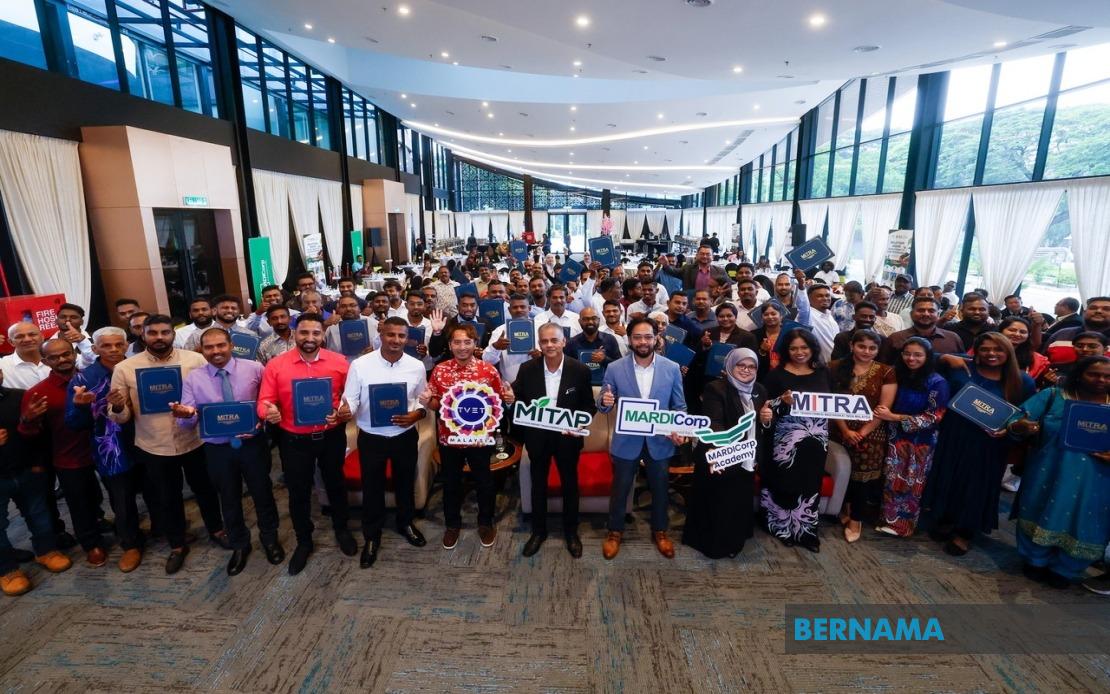
The Malaysian Indian Community Transformation Unit has marked a significant milestone in its agricultural development agenda, distributing RM30,000 grants to 68 young entrepreneurs through its flagship Agricultural Transformation Grants programme. The initiative, unveiled at a ceremony in Putrajaya, represents a concerted push to deepen Indian community involvement in farming and food production—sectors traditionally underrepresented in Malaysia's demographic participation patterns.
MITRA, working in partnership with MARDICorp under the broader Indian Community Socioeconomic Development Programme, has structured its approach around two core pillars designed to meet participants at different stages of entrepreneurial maturity. The QuickWin MITRA component delivers immediate capital support through the RM30,000 grants, enabling recipients to establish or expand agricultural ventures without lengthy bureaucratic delays. Complementing this is the Young Agropreneur Programme, a more intensive 10-month training curriculum that equips aspiring farmers with the technical skills, business acumen, and market knowledge necessary to sustain long-term agricultural enterprises.
According to K. Raveendran Nair, director-general of MITRA, the dual-track model reflects an understanding that access to capital alone cannot guarantee entrepreneurial success in agriculture. The organisation has deliberately integrated structured training alongside financial assistance, recognising that knowledge gaps and operational inexperience often prove more limiting than initial funding shortages. Eight participants have to date completed the Young Agropreneur Programme, with all grant recipients positioned to benefit from ongoing technical support and mentorship from MARDICorp's specialists.
The grants themselves target a diverse range of agricultural sectors, reflecting both market demand and the varied interests of participating entrepreneurs. Food crop production dominates the portfolio, but the scheme also encompasses specialised ventures including dairy cattle management, beekeeping operations, oyster mushroom cultivation, freshwater fish farming, and food processing technology. This sectoral diversity matters significantly for risk mitigation; it prevents over-concentration in any single commodity and allows MITRA to build demonstration effects across multiple agricultural domains within the Indian community.
MARDICorp's role extends well beyond the initial grant disbursement. The corporation's managing director, Mohamad Zamir Ghazali, emphasised that continued guidance will focus on production marketing, downstream value addition, and technology transfer—the exact areas where many smallholder farmers encounter the greatest operational friction. By positioning MARDICorp as a sustained partner rather than a one-time funder, the initiative acknowledges that agribusiness success depends on institutional support systems that persist beyond the start-up phase.
The networking dimension of MITRA warrants particular attention for Malaysian policymakers observing this model. Ghazali explicitly highlighted the platform's role in connecting participants to government-run agricultural entrepreneurship programmes, thereby integrating grassroots entrepreneurs into formal policy ecosystems. Several grant recipients have already secured membership in producer associations, a development that positions them to access bulk purchasing arrangements, collective marketing channels, and shared infrastructure—advantages unavailable to isolated individual operators.
For the broader Southeast Asian context, this initiative illustrates how targeted community-based agricultural development can work at scale. Many countries in the region struggle to incentivise youth participation in farming, often viewing agriculture as a low-status occupation. By deliberately channelling grants and training toward young entrepreneurs from specific communities, MITRA sidesteps the one-size-fits-all agricultural policy approaches that frequently underperform in diverse societies. The scheme recognises that barriers to agricultural participation vary across ethnic and social groups, and that culturally sensitive, community-rooted interventions may achieve higher uptake than generic national programmes.
The financial commitment itself—RM2.04 million across 68 recipients—reflects a modest but meaningful investment in human capital within Malaysian agriculture. These sums, while not transformative in global agribusiness terms, carry substantial purchasing power at the smallholder level, enabling participants to acquire equipment, livestock, seed stock, or initial operating capital that would otherwise require years of savings. The grant structure sidesteps the debt burden that loans would impose, reducing the financial risk to participants operating in a sector historically vulnerable to commodity price volatility and weather-related production shocks.
Looking forward, the scheme's success will depend on retention rates among participants and the demonstrable scaling of grant-funded enterprises. MITRA's continued engagement with MARDICorp suggests institutional commitment to tracking long-term outcomes, though public disclosure of such metrics would strengthen accountability and provide evidence for other community-development initiatives seeking to replicate the model. The integration of young agropeneurs into government agricultural programmes also creates potential feedback loops whereby successful participants might eventually become trainers or mentors for subsequent cohorts, multiplying the initiative's reach beyond direct funding.
For Malaysian Indian communities specifically, the programme signals recognition of agricultural entrepreneurship as a legitimate development pathway. Historically, policy attention on community economic development has concentrated on commerce, small-scale services, and professional employment. This explicit focus on agribusiness suggests a broadening of socioeconomic development frameworks to encompass rural enterprise, which carries particular significance given the geographical distribution of Malaysian Indian populations across rural plantation zones and satellite communities.
The success of MITRA's approach may also inform broader government thinking about targeted agricultural support. Malaysia's overall agricultural sector faces persistent challenges around youth participation, land availability, and competitiveness against regional competitors. Community-specific schemes that build on existing social networks, cultural familiarity with farming practices, and demonstrated community commitment to self-improvement may prove more effective than centralised, non-differentiated agricultural development programmes. The combination of capital injection, skills training, and institutional integration that characterises MITRA offers a template potentially adaptable to other communities seeking to deepen agricultural participation.

