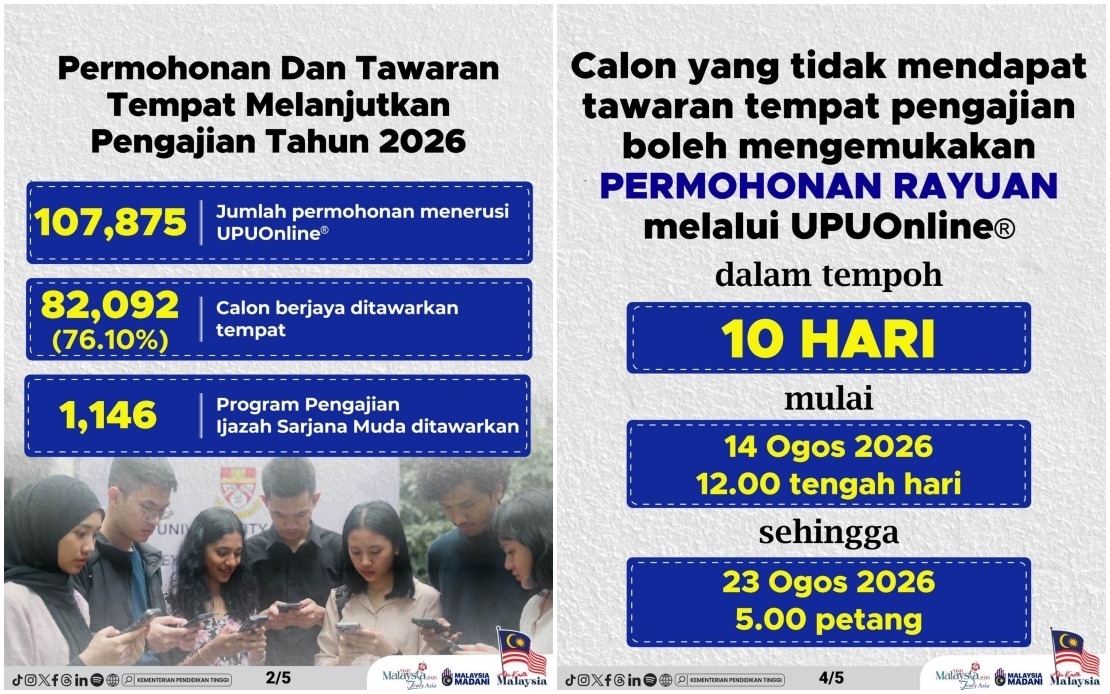
The Ministry of Higher Education announced on Wednesday that 82,092 candidates have been selected to begin undergraduate studies at Malaysia's 20 public universities for the current academic year. This intake, determined through the centralized UPUOnline application system, fills spots across 1,146 bachelor's degree programmes offered by the institutions.
The successful candidates represent approximately three-quarters of the total eligible pool, with 82,092 recipients selected from 107,875 applications that met the ministry's academic requirements. This acceptance rate reflects the competitive nature of university admissions in Malaysia, where demand for tertiary education consistently outpaces the available capacity within the public higher education sector.
University placements have been allocated strictly according to meritocratic principles, the ministry emphasized. Each qualified applicant was ranked according to their individual merit scores, with positions awarded sequentially from the highest-scoring candidates downward. This transparent, performance-based approach aims to ensure that the most academically prepared students secure places at Malaysia's publicly funded institutions.
The intake carries particular significance for Malaysia's education policy landscape. Public universities remain the primary pathway to tertiary education for many Malaysian families, particularly those from middle and lower-income backgrounds. The scale of this year's admissions—representing a substantial national investment in human capital development—underscores the government's commitment to expanding access to degree-level education across the country's diverse population.
However, the fact that nearly one-quarter of eligible applicants remain unsuccessful highlights persistent constraints within the public university system. With over 25,000 qualified candidates unable to secure places, Malaysia continues to face structural capacity limitations in absorbing the full cohort of students who meet academic entry standards. This gap has long driven demand for private university options and overseas education, both of which carry significantly higher financial burdens.
The Ministry of Higher Education has built a safety valve into the admissions process to address disappointed applicants. Beginning immediately after the initial offers were issued, candidates who received no placement may submit appeals through UPUOnline during a ten-day window. This appeal mechanism, running through August 23, provides an additional opportunity for borderline candidates to reapply or seek alternative placements that may become available following initial acceptances or student deferrals.
The appeal process represents a pragmatic acknowledgment that initial placement algorithms, while meritocratic, cannot account for every candidate's circumstances or potential. Recent high school graduates facing rejection often have grounds to pursue reconsideration, and the appeals window creates space for administrative flexibility and second-chance opportunities—an approach increasingly recognized as important for social mobility and equitable access to education.
For successful candidates, the ministry's statement conveyed encouragement to maximize their university years. The phrasing—that the opportunity be "utilised to the fullest"—reflects broader institutional messaging emphasizing that university admission represents not an endpoint but rather the beginning of sustained academic and personal development. This framing is consistent with Malaysia's ongoing efforts to position higher education as foundational to both individual career trajectories and national economic competitiveness.
The 82,092 placements distributed across 20 autonomous public universities reflect Malaysia's decentralized higher education governance structure. Unlike more centralized systems, Malaysian public universities maintain substantial institutional autonomy while operating within the broader framework established by the Ministry of Higher Education. This devolved model allows individual universities to set academic standards, develop specialized programmes, and tailor admissions policies to institutional priorities—within national guidelines.
The scale of undergraduate intake across the public system has significant downstream implications for employment markets and professional pipeline development. Thousands of new graduates will enter Malaysian labor markets within three to four years, potentially intensifying competition for entry-level professional positions. This dynamic creates both opportunity and challenge: while Malaysia requires skilled workers across multiple sectors, the education-to-employment transition remains a persistent policy concern affecting graduate outcomes and skill mismatches.
Regionally, Malaysia's approach to mass university admissions reflects patterns seen across Southeast Asia, where governments balance expanding educational access against fiscal constraints and quality concerns. The meritocratic selection model aligns with international best practices while acknowledging local realities of resource limitation. However, questions persist about whether current intake levels adequately serve national human capital needs or whether further expansion remains necessary to achieve educational targets aligned with high-income nation aspirations.
The introduction of appeals mechanisms alongside merit-based selection suggests institutional learning within Malaysia's higher education administration. Policymakers increasingly recognize that rigid, single-criterion admissions systems may miss talented individuals whose potential extends beyond standardized test scores. This incremental evolution toward more nuanced selection processes reflects global trends in democratizing university access while maintaining academic standards—a delicate balance Malaysia continues to navigate.

