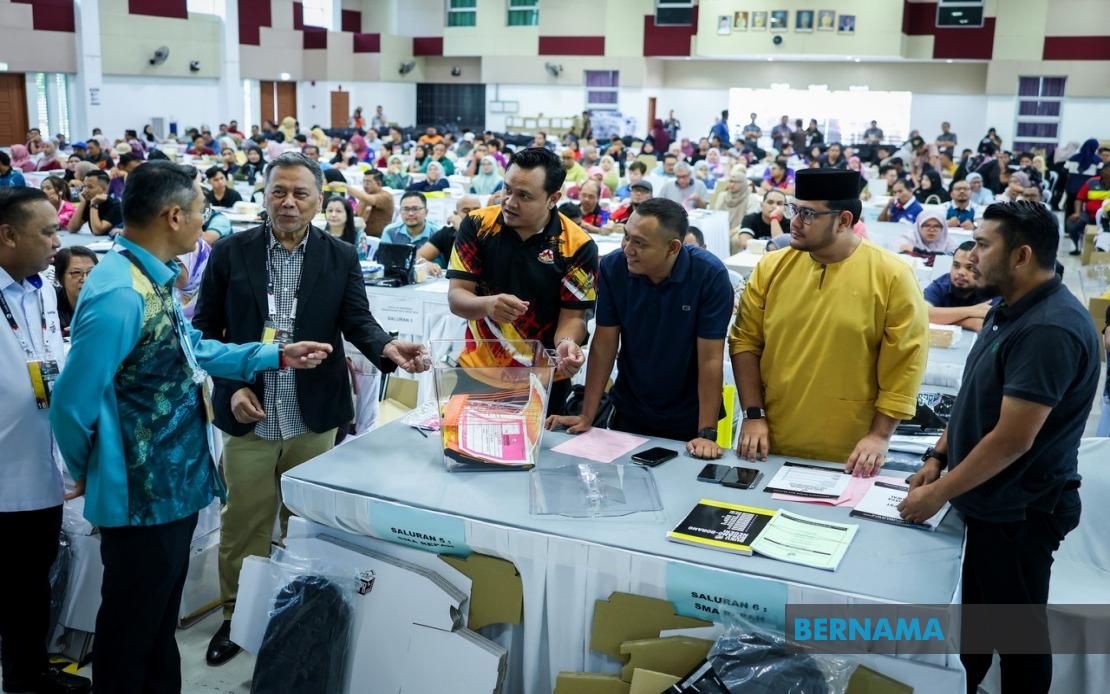
Over 859,000 voters in Negeri Sembilan are preparing to head to the ballot box tomorrow as the state embarks on its 16th electoral cycle to determine representation across 36 State Legislative Assembly constituencies. The Election Commission has mobilised substantial resources to facilitate what promises to be a significant political exercise, with officials confirming that extensive preparations have been completed to accommodate the anticipated voter turnout across the state.
According to Election Commission chairman Datuk Seri Ramlan Harun, the registered voter roll for tomorrow's election comprises 859,760 eligible citizens, of whom 7,391 have applied for postal voting arrangements. This figure underscores the logistical challenge facing electoral authorities, who must coordinate simultaneous balloting across the state while maintaining the integrity and efficiency of the process. The postal voter arrangement reflects contemporary electoral practice, allowing those unable to attend polling stations in person to participate remotely.
The voting infrastructure being deployed tomorrow represents a considerable operational undertaking. The Election Commission will operate 401 polling centres distributed throughout Negeri Sembilan, with voting channels organised into 1,668 separate stations to manage the flow of voters and maintain queue discipline. All stations will open simultaneously at 8 am and close at 6 pm, establishing a unified electoral window across all constituencies. This standardised approach ensures fairness and transparency while simplifying the coordination requirements for election officials managing the process.
Supporting this extensive framework are 15,344 election officers deployed across the state. These officials bear responsibility for verifying voter registration, managing voting procedures, preventing irregularities, and ensuring compliance with electoral protocols. The scale of this workforce deployment reflects the seriousness with which the Election Commission approaches its constitutional mandate. Their presence at each polling centre and voting channel is intended to instil public confidence in the electoral process and to address queries or concerns arising during the voting period.
In Tampin, one of the state's key urban centres, preparations have proceeded with particular focus given the constituency's prominence. The district encompasses three state assembly seats—Gemas, Gemencheh, and Repah—collectively attracting 77,725 registered voters. This concentration of constituencies demonstrates Tampin's electoral significance within the broader state framework and explains the decision to locate the Official Vote Counting Centre at Dewan Perdana in the town.
The Gemas seat has attracted particularly competitive interest, with three candidates contesting for the position. Incumbent Ridzuan Ahmad from WAWASAN faces challenges from Siti Aishah Seman @ Othman representing Pakatan Harapan and Azman Abdullah of Parti Pribumi Bersatu Malaysia. The three-cornered contest reflects the fragmented nature of contemporary Malaysian politics, where traditional binary competitions between government and opposition have given way to multiparty contests reflecting diverse electoral preferences.
Gemencheh presents a more straightforward two-candidate contest. Incumbent Suhaimizan Bizar, representing Barisan Nasional, will defend the seat against Abd Latib A. Tambi standing under the Pakatan Harapan banner. This direct matchup between establishment and opposition forces characterises much of the competitive landscape in Negeri Sembilan, where voters will determine whether to maintain existing representation or effect change.
The Repah constituency similarly features a two-way contest between Koh Kim Swee of MCA and incumbent S. Veerapan from Pakatan Harapan. The participation of MCA, a component party of Barisan Nasional, reflects the coalition's continuing role in Malaysia's electoral politics despite broader shifts in voter sentiment observed in recent electoral cycles.
The Election Commission has set ambitious targets for result compilation, indicating that preliminary results from across Negeri Sembilan should be available by 10 pm tomorrow evening. This timeline reflects improvements in electoral administration and vote-counting procedures implemented in recent years. Full results are anticipated before midnight, allowing the formation of government and commencement of the transition process without undue delay. The compressed timeframe places considerable demands on election officials to verify ballots, process tallies, and transmit results while maintaining absolute accuracy.
The conduct of this election carries significance beyond Negeri Sembilan's borders. State elections function as barometers of political sentiment, often providing early indicators of potential shifts in voter preference that may influence calculations for future federal elections. The results tomorrow will be scrutinised across Malaysia for insights into electoral dynamics, coalition performance, and the efficacy of various political strategies.
Tampin's designation as the location for the Official Vote Counting Centre reflects its position as Negeri Sembilan's administrative centre and the logistical advantages this provides. The venue will serve as the focal point for journalists, observers, and political party representatives monitoring results as votes are tallied throughout the evening. The transparency afforded by centralised counting procedures under public observation reinforces confidence in electoral legitimacy.
Voters heading to polls tomorrow will encounter ballot papers listing candidates across the various constituencies, with voting conducted through the established first-past-the-post system. The simplicity of the voting mechanism belies the complex electoral mathematics underpinning the competition, where even marginal shifts in voter distribution across constituencies can produce substantially different outcomes in terms of seat allocation.
For Malaysian democracy, tomorrow's election represents another iteration of the periodic popular consultation through which governance legitimacy is conferred. The extensive preparations by the Election Commission, the deployment of election personnel, and the logistical arrangements for vote casting and counting all testify to the institutional seriousness with which electoral processes are managed. The outcome will reshape Negeri Sembilan's political landscape and contribute to the broader narratives of Malaysian politics as the nation moves toward its next scheduled federal elections.

