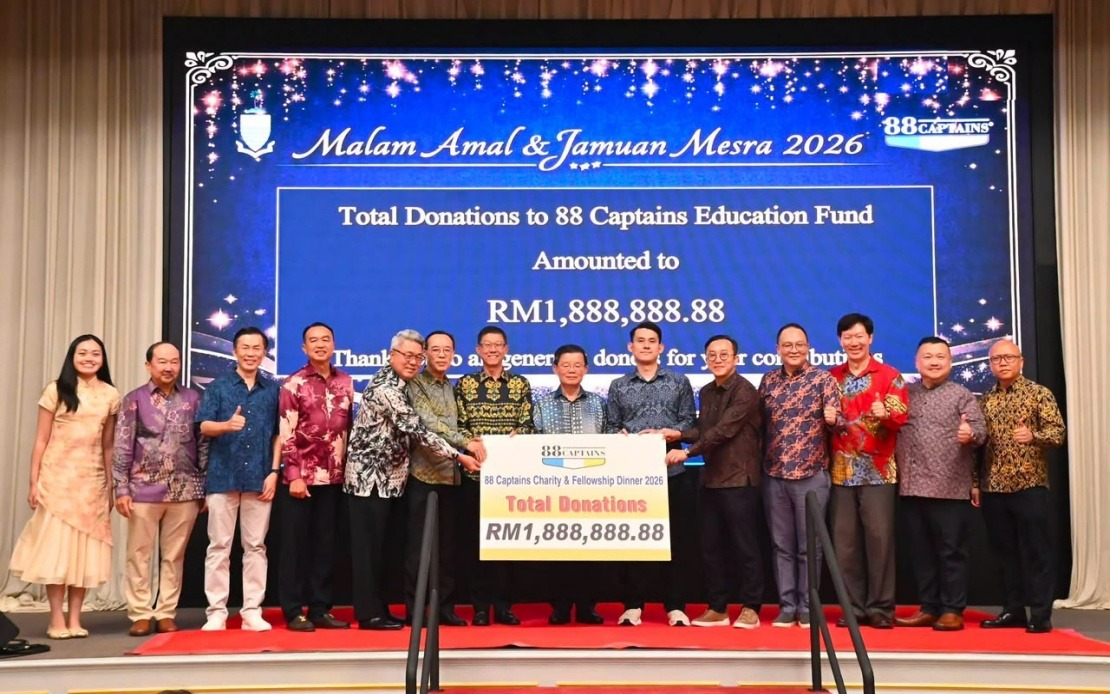
The Persatuan Kebajikan 88 Kapten Pulau Pinang has stepped up its commitment to nurturing young talent in the northern region by channelling over RM1 million in educational support to 44 deserving students from five institutions. The initiative, announced at the organisation's Annual Charity Dinner 2026 in George Town last week, underscores a broader strategy to position education and human capital development as cornerstones of socio-economic progress beyond the island state.
Datuk Seri Dr Ooi Eng Hock, the charity's chairman, framed the scholarship programme as extending far beyond the conventional relief of financial hardship. Rather, he emphasised the transformative role scholarships play in cultivating ambition and resilience among youth, ultimately channelling their talents toward meaningful societal contribution. This philosophy reflects a growing recognition among Malaysian philanthropic bodies that targeted financial support, when coupled with mentorship and clear pathways to employment, yields more sustainable outcomes than charitable distribution alone.
Central to 88 Captains' evolving agenda is the Apprenticeship, Internship, Reskilling and Upskilling (AIRU) programme, which was formally introduced at Universiti Sains Malaysia last year. The initiative represents a deliberate attempt to dissolve traditional barriers between academic institutions and the commercial sector—a persistent challenge across Southeast Asia where graduates often find themselves inadequately prepared for industry demands. By convening a task force of high-achieving scholars from USM, ViTrox College, TAR UMT, and INTI International University, the organisation has created a two-way communication channel through which students articulate expectations while corporate leaders outline market realities and compensation benchmarks, such as the RM4,000 minimum graduate salary threshold currently being flagged.
The financial injection accompanying 88 Captains' activities demonstrates substantial community commitment. The recent charity dinner alone raised RM1.89 million, a figure reflecting broad-based support from both government and private stakeholders, including attendance by Penang Governor Tun Ramli Ngah Talib and Chief Minister Chow Kon Yeow. This convergence of political and philanthropic interests signals recognition at the highest levels that education-driven talent development directly influences Penang's competitive positioning in advanced manufacturing, semiconductor technology, artificial intelligence, and digital economy sectors—industries critical to Malaysia's aspirations as a high-income nation.
Over its four-year operational span since establishment in 2022, 88 Captains has orchestrated over 50 discrete programmes and community interventions, moving beyond scholarship distribution to tangible infrastructure investment in schools. Donations of smart televisions to primary and secondary institutions, coupled with the establishment of 5G Education Digital Libraries across 88 schools, represent efforts to democratise access to contemporary learning resources in lower-income communities. Such initiatives carry particular significance for rural and semi-urban areas throughout Penang and surrounding states where digital divide remains pronounced, directly impacting educational equity and long-term social mobility.
Chief Minister Chow's public commendation of 88 Captains' efforts reflects government alignment with private-sector education initiatives, a trend increasingly visible across Malaysian state administrations seeking to supplement public education budgets. Chow specifically highlighted how the AIRU programme strengthens alignment between curriculum content and employer expectations, thereby reducing the mismatch that historically plagues Malaysian graduate employment markets. His positioning of these efforts within Penang's strategic economic transformation—toward semiconductors, advanced manufacturing, and artificial intelligence—underscores a deliberate policy ecosystem wherein human capital development directly underpins industrial competitiveness.
A particularly timely dimension of 88 Captains' recent expansion involves mental health and responsible artificial intelligence use in educational settings. The organisation has launched a Joint Mental Health Development in Schools initiative paired with AI Early Education for Responsible Adoption, arriving coincidentally with the implementation of the Anti-Bullying Act 2026. This convergence of legal framework and preventive community programming illustrates a maturing understanding that legislative measures, while necessary, require grassroots institutional support to achieve meaningful behavioural change. Teachers, students, and families require concrete tools and guidance to operationalise bullying prevention and navigate the ethical complexities of artificial intelligence adoption in school environments.
For Malaysian readers and regional observers, 88 Captains exemplifies a hybrid philanthropic model wherein private charitable organisations collaborate with government agencies to address systemic education and workforce development challenges. This public-private partnership approach, increasingly common across Southeast Asia, suggests that both state capacity and market-driven efficiency are necessary to achieve education quality and accessibility objectives. The organisation's focus on bridging academia-industry gaps directly speaks to persistent regional challenges wherein graduates possess theoretical knowledge but lack practical competencies demanded by employers, contributing to youth unemployment and underemployment across Malaysia and neighbouring economies.
The scholarship programme's reach across five educational institutions signals 88 Captains' intentional diversification beyond elite universities toward technical colleges and lower-tier institutions, where students frequently lack access to competitive scholarship opportunities. This inclusive approach potentially yields significant social multiplier effects, particularly among first-generation tertiary students whose educational advancement would otherwise depend on family financial capacity. In a Malaysian context where income inequality remains substantial despite decades of development, targeted scholarships to students from disadvantaged backgrounds represent efficient vehicles for expanding meritocratic opportunity and reducing intergenerational poverty transmission.
Looking forward, 88 Captains' expansion of the AIRU programme and mental health initiatives suggests that Malaysian philanthropic organisations increasingly recognise education's multidimensional nature. Technical skill acquisition and career readiness must be accompanied by psychological resilience, ethical reasoning, and responsible technology stewardship—competencies that educational curricula historically under-emphasise. As artificial intelligence and automation reshape labour markets globally, organisations like 88 Captains positioning themselves at the intersection of traditional academic support, industry partnership, and contemporary wellbeing challenges may pioneer models that other Malaysian states and regional jurisdictions seek to replicate.
The RM1.89 million raised at the recent charity dinner, combined with the organisation's demonstrated capacity to operationalise multiple simultaneous programmes, suggests 88 Captains possesses both financial resources and institutional maturity to sustain long-term impact. For Malaysian civil society more broadly, this case study illustrates how philanthropic entities with focused missions, transparent governance, and strategic partnerships can complement government education investment while remaining responsive to emerging societal needs—whether digital access, mental health support, or employment readiness. As Southeast Asia grapples with education quality deficits and skills mismatches that constrain economic growth, such models warrant attention from policymakers, educators, and development practitioners across the region.

