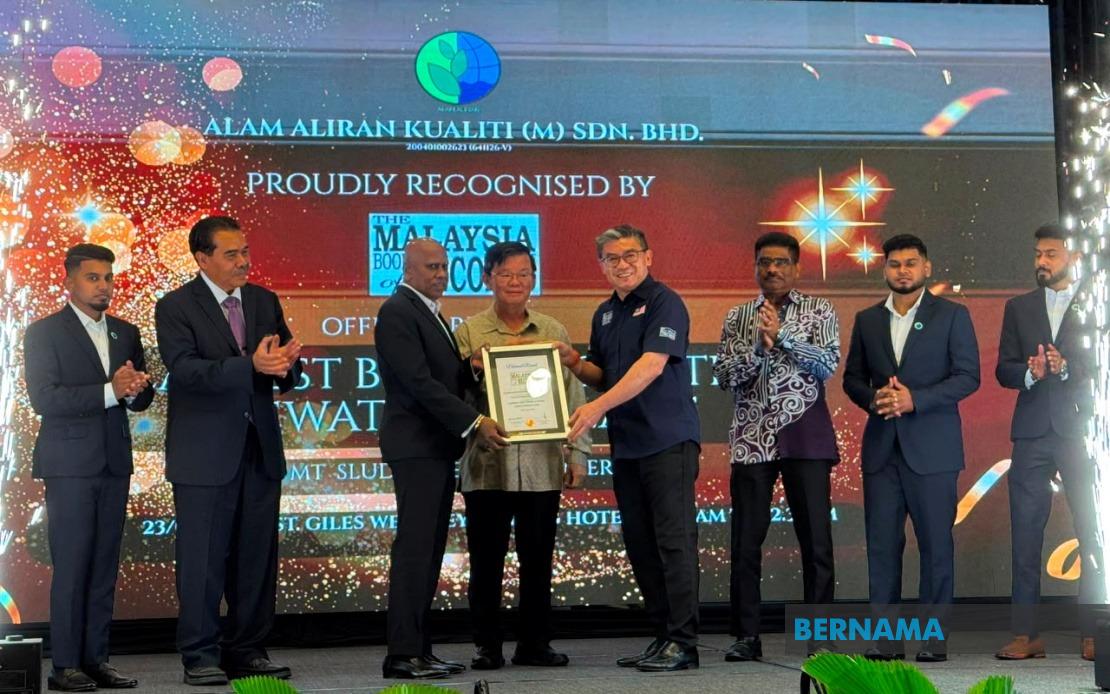
Alam Aliran Kualiti (M) Sdn Bhd (AAK) has secured a landmark acknowledgement from the Malaysian Book of Records for developing and operating the country's largest belt press system dewatering facility at its Sungai Dua installation in Penang. The honour, presented during a ceremony in George Town on July 23, underscores the growing sophistication of domestic water treatment infrastructure and positions Malaysia among nations leveraging advanced engineering for environmental management.
The Sungai Dua Dewatering Plant, developed jointly with Perbadanan Bekalan Air Pulau Pinang (PBAPP), processes 10 million litres of water treatment residuals daily while simultaneously managing approximately 450 tonnes of alum sludge. This scale of operation represents a significant step forward in treating the byproducts of water purification—materials that conventionally became landfill burdens. The facility's belt press technology, which mechanically separates solids from liquids at industrial scale, has attracted regional interest as Southeast Asian cities confront rising pressures on waste management systems.
Accepting the recognition, AAK chief executive officer Datuk Balan Agambram highlighted the company's two-decade track record in environmental engineering and scheduled waste management. Founded in 2004, AAK has positioned itself at the intersection of regulatory compliance and resource innovation, sectors where Malaysia increasingly seeks competitive advantage. The Sungai Dua achievement reflects broader corporate strategy to transform traditionally problematic waste streams into feedstock for secondary industries, a shift aligned with both national sustainability goals and global circular economy frameworks.
Director Gokulaan Balan framed the recognition not as a culmination but as motivation for further advancement. His remarks signalled intent to deepen engineering excellence and explore additional applications for the technology and methodologies employed at Sungai Dua. For Malaysian firms competing internationally in environmental services, such records carry both prestige and practical value—they substantiate claims of technical capability when tendering for regional contracts and attract investment from multinational partners seeking proven local expertise.
Central to the facility's operational logic is its integration with a secondary manufacturing process: the recovered sludge and residuals feed into an Eco Green Brick Manufacturing Plant that converts treated SW204 scheduled waste into construction materials. This closed-loop approach exemplifies circular economy principles gaining traction across Malaysia's manufacturing and construction sectors. Rather than viewing water treatment residuals as waste requiring disposal, the system reframes them as inputs for building products, generating economic value while reducing environmental burden.
Penang Chief Minister Chow Kon Yeow contextualised the project within the state's long-term water security strategy. He emphasised that the facility recovers treated water and returns it to the treatment process, directly reducing losses within Penang's supply network—a critical consideration given the state's historical vulnerability to dry seasons and interstate water dependencies. By recirculating recovered water, the plant simultaneously addresses immediate operational efficiency and medium-term resource scarcity, dual imperatives facing Malaysian water authorities as population growth and industrial demand intensify.
Chow's remarks also highlighted the economic dimensions of sustainability infrastructure. Projects demonstrating environmental responsibility whilst generating commercial returns—such as selling Eco Green Bricks into the construction market—help reframe green initiatives as business opportunities rather than regulatory obligations. This messaging resonates with Malaysian policymakers seeking to attract private capital into environmental infrastructure, where public budgets remain constrained and infrastructure backlogs persist across peninsular and East Malaysian regions.
The recognition ceremony's attendees—including Christopher Wong, MBOR chief executive, and Datuk Seri Jaseni Maidinsa, chairman of Pengurusan Aset Air Berhad (PAAB)—represented alignment across government, industry, and standards-setting bodies. PAAB's involvement signals institutional commitment to advancing asset management practices within Malaysia's water sector, an area where governance and technical efficiency remain priority concerns for both federal regulators and state governments.
For Malaysian water utilities and private operators, the Sungai Dua model offers a template for addressing treatment residuals at scale. Most of Malaysia's water treatment plants generate similar sludges but lack advanced processing infrastructure, leading to landfill disposal or limited recovery. The technology and operational knowledge embedded in AAK's facility could be replicated or adapted across Peninsular Malaysia, Sabah, and Sarawak, each confronting distinct water quality challenges and waste management pressures. Regional utilities monitoring the project may explore partnerships or licensing arrangements to deploy similar systems.
The MBOR recognition also positions Malaysian engineering within regional and global contexts. As Vietnam, Thailand, and Indonesia expand water infrastructure investments, recognition of Malaysian technical achievement in environmental engineering strengthens the nation's competitive positioning in tendering for cross-border projects and technology partnerships. International firms considering joint ventures in Southeast Asia may view proven local capability—substantiated by formal records—as reducing project risk and accelerating implementation timelines.
Looking forward, AAK's emphasis on innovation and continued excellence suggests expansion beyond current operations. The company's integration of treatment, resource recovery, and manufacturing indicates potential for horizontal scaling—applying the model to other waste streams—or vertical integration, such as operating additional brick manufacturing facilities or supplying recycled materials to construction companies. Government incentives for circular economy businesses, including tax considerations and procurement preferences, could further accelerate growth.
The Sungai Dua achievement arrives amid Malaysia's broader policy pivot toward sustainability and resource efficiency. The country's commitment to climate targets, water security, and waste reduction creates demand for precisely the kind of infrastructure AAK operates. As stakeholders from municipalities to federal agencies benchmark performance and set expansion targets, facilities earning international or national recognition serve as reference points and proof-of-concept demonstrations, reducing perceived risk for subsequent investments in similar technologies and management approaches.

