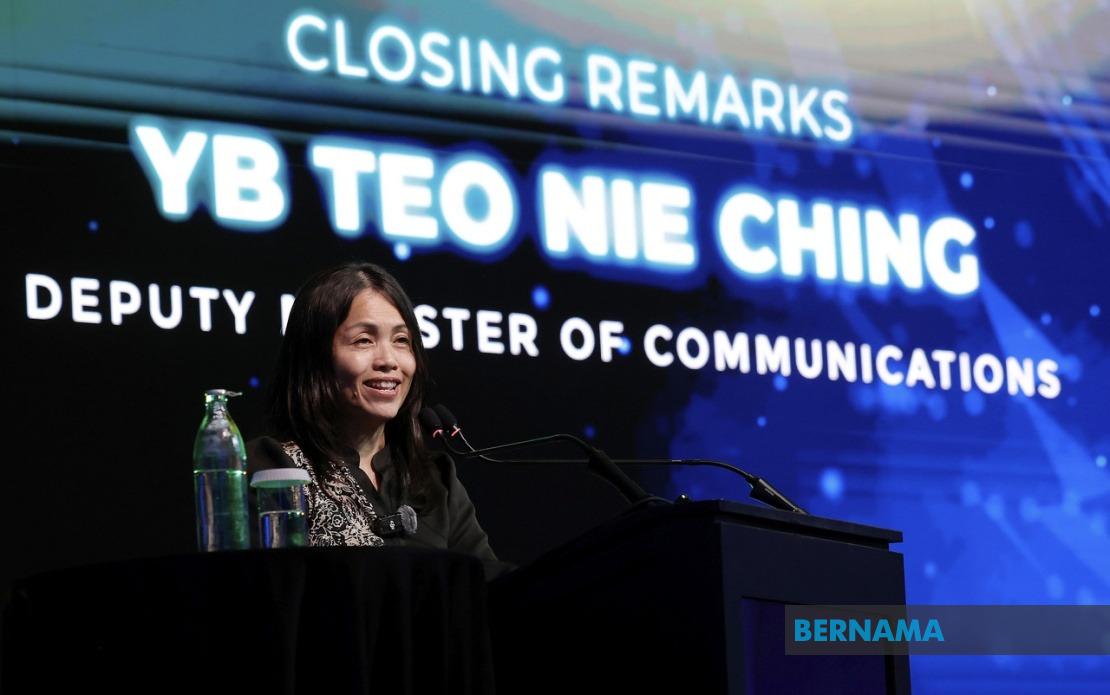
Deputy Communications Minister Teo Nie Ching has called for accountability and a people-centred approach to be positioned as fundamental elements in building a secure and inclusive digital future. Speaking at the conclusion of the two-day International Regulatory Conference 2026 here, Teo framed digital advancement not merely as a technical accomplishment but as a broader societal endeavour that must balance innovation with safeguards and public trust.
The minister articulated a vision where technological progress serves measurable social outcomes. Rather than evaluating digital maturity solely through the sophistication of available tools and infrastructure, Teo argued that societies should assess digital advancement through indicators of safety, fairness and public confidence. This perspective shifts the conversation from capability-focused metrics to impact-focused ones, reflecting growing global concerns about technology's broader implications for citizens and economies.
Central to Teo's message was the concept of co-evolution between technological development and accountability mechanisms. She posited that governance frameworks and regulatory approaches must advance in tandem with innovation itself, preventing situations where new technologies outpace the institutional capacity to manage their risks. This alignment is particularly relevant for Malaysia and Southeast Asia, where rapid digital adoption has often occurred faster than regulatory preparedness, creating enforcement challenges and public safety concerns.
To illustrate the scale of digital challenges facing Malaysia, Teo disclosed concerning figures about harmful online content. The Malaysian Communications and Multimedia Commission (MCMC) has issued 1.2 million content removal requests to social media platforms spanning the period from January 1, 2022 through July 15, 2026. Of these requests, platforms successfully removed 1.138 million items identified as harmful, demonstrating both the prevalence of problematic content and the relative effectiveness of formal removal mechanisms.
The intensity of this challenge has accelerated markedly in 2026. From the start of January through mid-July—a span of just 6.5 months—MCMC issued 377,502 removal requests, representing approximately 78 percent of all requests submitted throughout the entirety of 2025. This trajectory suggests daily submission rates of approximately 1,900 requests, an alarming acceleration that underscores how online harms are proliferating across Malaysian digital spaces. During this same 2026 period, platforms removed 350,332 items, indicating a compliance rate exceeding 92 percent among major social media providers when formally notified of problematic content.
Despite these removal efforts, Teo cautioned that regulatory mandates alone cannot shoulder the entire burden of protecting digital environments. This acknowledgment is crucial, as it recognises the inherent limitations of government enforcement—regulators face resource constraints, jurisdictional challenges with international platforms, and the fundamental difficulty of policing vast volumes of user-generated content in real time. For Malaysia specifically, where the MCMC operates within budgetary and staffing parameters, this reality is particularly pertinent.
Instead, Teo advocated for a multi-stakeholder governance model that distributes responsibility across platforms, regulators, educational institutions, communities and broader industry participants. This collaborative framework operates on the principle that digital safety must be architected into systems from their foundational design stages, rather than addressed reactively after harm has already materialised. In practical terms, this means social media platforms should implement content moderation, age verification and algorithmic safeguards before public deployment, while schools incorporate digital literacy curricula and communities build awareness initiatives.
The emphasis on proactive system design over reactive enforcement reflects international regulatory trends, particularly evident in emerging frameworks like the Digital Services Act in Europe. For Southeast Asian policymakers, this approach offers a middle path between heavy-handed censorship and unrestricted platform autonomy. Malaysia's experience with content proliferation suggests that neither extreme is viable—regulatory action alone struggles to keep pace with harmful content generation, yet complete reliance on platform self-regulation has proven insufficient to protect vulnerable populations, particularly children.
Teo's remarks conclude the third iteration of the International Regulatory Conference, an annual gathering convened by MCMC that brings together communications regulators, technology sector executives and policy experts from multiple countries. This year's theme—"Shaping the Next Digital Era: Regulation, Resilience and Trust"—encapsulates the balancing act at the heart of contemporary digital governance. Resilience speaks to systems' capacity to withstand both accidental disruptions and deliberate attacks; regulation addresses the governance structures needed to maintain order; and trust reflects the fundamental confidence citizens must have in digital institutions.
For Malaysia and the broader Southeast Asian region, these discussions carry particular significance. The zone comprises some of the world's highest social media penetration rates combined with emerging economies rapidly digitising financial services, government functions and commerce. This combination creates acute vulnerabilities—large populations active on platforms with limited media literacy, coupled with high-value digital infrastructure requiring protection from sophisticated threats. Teo's framing of accountability as a shared responsibility rather than a government monopoly may offer pragmatic guidance for nations grappling with similar constraints.
The minister's call for collective action ultimately reflects a maturation in regulatory thinking away from simplistic command-and-control models toward more sophisticated governance approaches. By positioning people-centred values and accountability as central pillars, rather than peripheral considerations, Teo signalled that Malaysia's digital future will be judged not by technological prowess alone but by whether innovations genuinely serve public interests and command citizen confidence. This standard, if consistently applied, would mark a significant evolution in how the nation approaches technology governance.

