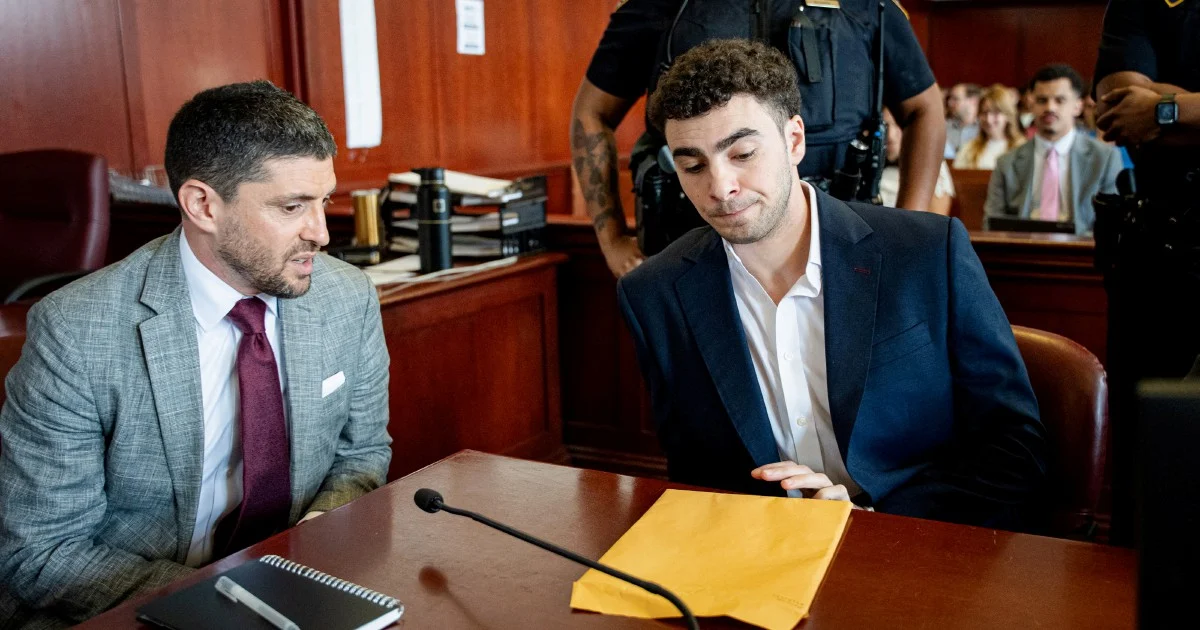
Luigi Mangione, the man charged with the fatal shooting of a prominent health insurance chief on a Manhattan street, has decided to set aside—at least for the moment—a planned legal strategy centred on demonstrating he was experiencing severe psychological distress when the alleged murder took place. A court document filed on Friday revealed the significant tactical shift, signalling a recalibration of his defence approach as the case moves toward trial.
The decision to postpone introducing mental health evidence represents a notable development in a case that has captivated American public attention and sparked broader debate about corporate accountability in the health insurance sector. Mangione's choice to withdraw this component of his defence does not necessarily foreclose its future use; the temporary nature of the withdrawal leaves open the possibility that mental health considerations could resurface at a later stage of proceedings. This flexibility reflects the evolving nature of criminal defence strategy, where lawyers often preserve multiple options as circumstances and legal understanding develop.
The health insurance industry has long been a lightning rod for public criticism, particularly regarding its practices around claim denials and coverage limitations. The killing has reignited scrutiny of corporate leadership in an industry widely perceived by consumers as prioritising profit margins over patient welfare. This context has infused the case with deeper social dimensions that extend well beyond the typical criminal proceedings, transforming it into a flashpoint for broader conversations about systemic inequities in American healthcare delivery.
Mental health considerations in high-profile criminal cases have become increasingly sophisticated in recent years, with defence teams often presenting detailed evidence of psychological deterioration, trauma, or neurological factors that may have influenced a defendant's actions. By withdrawing this evidence for now, Mangione's legal team may be pursuing a different strategic calculus—perhaps calculating that a mental health narrative could undermine other aspects of their defence or that the timing for introducing such evidence would be more advantageous at trial rather than in pretrial filings.
Court filings in criminal cases of this magnitude typically signal broader strategic thinking that goes beyond the immediate procedural moment. The Friday filing suggests that Mangione's legal advisers are closely monitoring evidentiary rules, prosecutorial strategy, and the developing legal landscape to position their client most effectively. This kind of tactical flexibility, while sometimes appearing contradictory, is standard practice among experienced criminal defence attorneys managing complex, high-stakes cases.
The role of mental health evidence in American courtrooms has evolved considerably over recent decades, with increasing acceptance of psychological and psychiatric testimony regarding defendants' cognitive states. However, the introduction of such evidence carries inherent risks; it may invite scrutiny of a defendant's past treatment history, medication records, and psychiatric evaluations that could prove damaging if presented poorly or without adequate contextual framing. Defence teams must weigh these risks carefully against potential benefits.
For Malaysian observers following international criminal cases, this development illustrates key differences between American and Malaysian approaches to mental health defence. While Malaysia's legal system recognizes diminished responsibility and insanity defences, the sophistication and scope of psychological evidence presented in American proceedings often exceeds what is typically introduced in Malaysian courts. Understanding these differences provides valuable context for how international cases are litigated and how defence strategies vary across jurisdictions.
The temporary withdrawal of mental health evidence does not diminish the broader significance of psychological factors in understanding crime and criminal motivation. Rather, it highlights how skilled defence counsel must continually reassess tactical approaches as new information emerges and as trial dates approach. The decision suggests confidence in alternative defence strategies while preserving the option to pivot if circumstances warrant.
Media coverage and public perception inevitably influence the strategic calculations surrounding high-profile cases. The substantial attention this case has received has created a complex environment where defence decisions must account not only for legal considerations but also for how those decisions will be received and interpreted by a public following the proceedings closely. The temporary withdrawal of mental health evidence may reflect an assessment that other narrative approaches might resonate more effectively with jurors.
As the case progresses toward trial, further strategic shifts may well occur. Criminal defence in cases of significant public interest is rarely static; it evolves as discovery proceeds, as expert witness opinions solidify, and as the prosecution's case becomes clearer. Mangione's legal team has signalled that they retain flexibility to reconsider this decision should trial circumstances demand it. This approach underscores the dynamic, adaptive nature of criminal litigation in the modern era.


%22%2F%3E%3C%2Fpattern%3E%3C%2Fdefs%3E%3Crect%20width%3D%22100%25%22%20height%3D%22100%25%22%20fill%3D%22url(%23phhvi2g)%22%2F%3E%3Crect%20width%3D%22100%25%22%20height%3D%22100%25%22%20fill%3D%22url(%23phhvi2p)%22%2F%3E%3Ctext%20x%3D%2250%25%22%20y%3D%2250%25%22%20text-anchor%3D%22middle%22%20dominant-baseline%3D%22central%22%20fill%3D%22rgba(255%2C255%2C255%2C0.95)%22%20font-family%3D%22Georgia%2C%20'Times%20New%20Roman'%2C%20serif%22%20font-weight%3D%22700%22%20font-size%3D%22136%22%20letter-spacing%3D%22-0.02em%22%3EPAS-Bersa%E2%80%A6%3C%2Ftext%3E%3C%2Fsvg%3E)