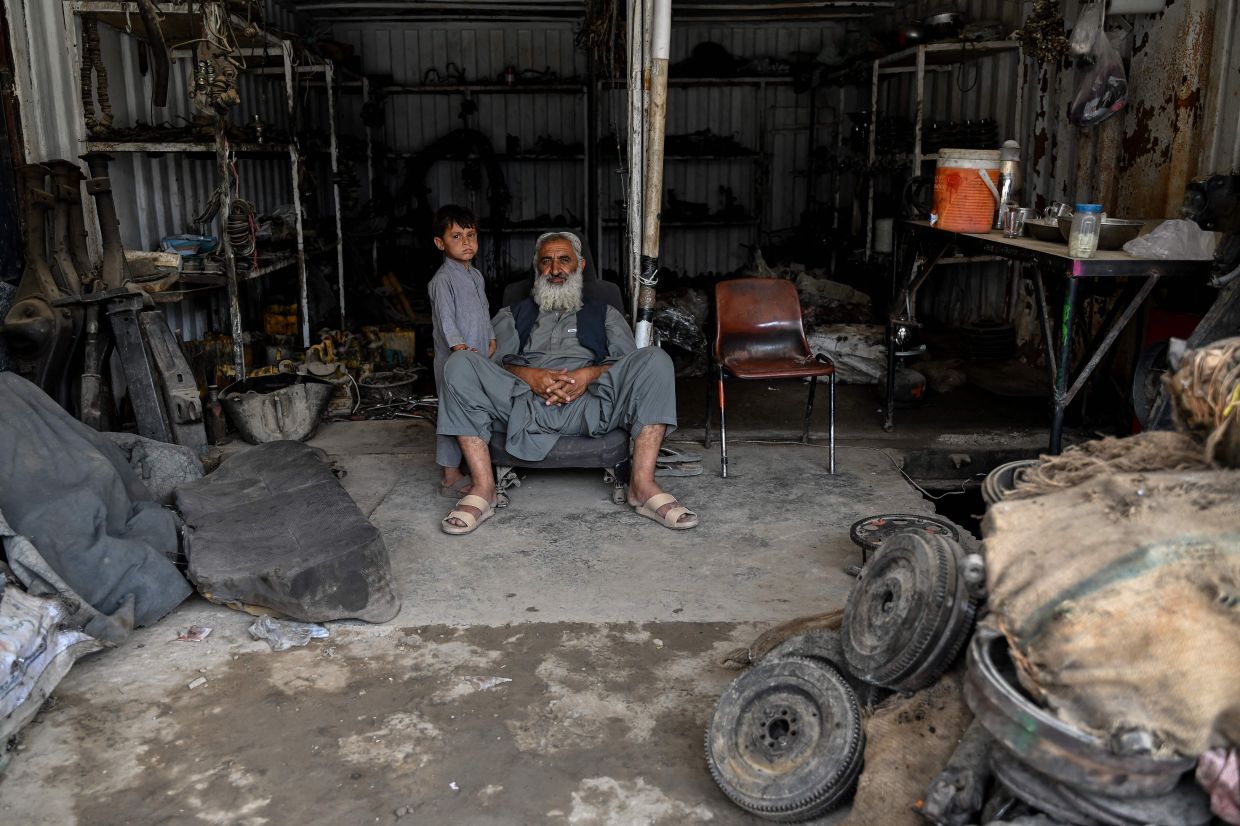
The bustling automotive marketplace in Spin Boldak, nestled in Kandahar province in southern Afghanistan, has transformed into a scene of idleness and economic desperation. Once a regional hub where imported vehicle components arrived daily from distant suppliers, the district now languishes in commercial paralysis brought on by a cascade of regional instability. Cross-border tensions with Pakistan forced the frontier to shut last October, severing the primary overland corridor through which Japanese parts and components historically flowed into this landlocked nation. When that pathway closed, traders attempted to adapt by rerouting shipments through Iran's Bandar Abbas port, a circuitous and expensive alternative that at least maintained a tenuous lifeline. However, the geopolitical upheaval in the Middle East beginning in February effectively severed even this backup route, leaving Afghanistan's automotive sector stranded without viable entry points for the imported parts upon which its entire value chain depends.
The ripple effects of the Middle East instability have proven particularly devastating for Afghanistan's commerce. Disruptions in the Strait of Hormuz, through which much international shipping passes, sent container costs skyrocketing and created logistical bottlenecks at key ports like Dubai's Jebel Ali facility. Importers who once operated with predictable timelines and modest expenses now find themselves navigating a fundamentally altered economic landscape. The cost of shipping a single container ballooned from approximately US$2,000 to US$8,000 following the outbreak of Middle Eastern tensions—a fourfold increase that has rendered many conventional trading operations economically unviable. For merchants like Asadullah, a 40-year-old importer who previously received two containers daily from Dubai and Japan, the situation represents something closer to catastrophe than mere business disruption. He currently has more than 30 containers stranded across Japan and the United Arab Emirates, warehoused at mounting daily costs with little prospect of movement in the foreseeable future.
The human cost of this commercial collapse extends far beyond the offices of individual traders. Spin Boldak's automotive ecosystem employed thousands of people across multiple specializations—crane operators, mechanics, welders, assembly workers, and salespeople—all of whom depended on the steady influx of imported components. Mohammad Naeem, a 21-year-old crane operator, has begun contemplating an exit from the only profession he has known, uncertain whether the market will recover before he exhausts his financial reserves. The workshops that once hummed with activity now sit eerily quiet, their equipment gathering dust as workers idle without materials to process. Samiullah, a workshop owner, recalls the period when his operation could assemble five to seven vehicles weekly, generating reliable income and employment for his team. Today, with no new parts arriving and fixed costs mounting, he faces an untenable situation where he must continue paying staff wages from a shrinking pool of capital while output has collapsed to zero.
The disruption has proven particularly acute because Afghanistan's economy remains heavily dependent on imports relative to its productive capacity. The World Bank characterized Afghanistan as "highly exposed to external shocks" in its May assessment, noting that the nation faces a widening chasm between the value of imports and exports equivalent to 70 percent of gross domestic product in the 2025 fiscal year. This structural vulnerability means that when international supply chains seize up, Afghanistan lacks domestic alternatives to fill the void. Vehicle parts cannot be manufactured locally in the quantities or varieties required, and there are no substitute suppliers who can reliably deliver comparable goods through alternative routes at reasonable costs. This dependency fundamentally constrains Afghanistan's policy options and leaves traders entirely at the mercy of developments occurring thousands of kilometers away in the Middle East and South Asia.
Some importers have begun shipping containers back to their original locations, accepting the financial losses as preferable to accumulating indefinite storage charges. Masoud, another parts importer, has made this painful calculus, recognizing that keeping inventory in foreign warehouses during an indefinite trade suspension merely compounds losses without creating any compensating benefits. He describes the situation with blunt finality: "We have no other option. I don't see any alternative way; it's a total loss." This represents a complete reversal from the recent past, when Masoud's operation could handle dozens or even hundreds of containers monthly, supplying the entire automotive repair and assembly ecosystem across Afghanistan. The magnitude of the contraction—from hundreds of monthly containers to zero—starkly illustrates the totality of the collapse.
Retailers along the supply chain have similarly experienced the commercial equivalent of sudden cardiac arrest. Noor Ali, who operates a showroom displaying vehicles assembled from Japanese parts, has sold nothing in a month despite being surrounded by a dozen completed vehicles awaiting buyers. His customer base has evaporated not due to lack of demand for vehicles, but because potential purchasers recognize that the fundamental economic conditions underlying the automotive market have deteriorated beyond the point where new purchases make financial sense. The absence of spare parts for repairs, the uncertainty surrounding future supplies, and the general economic contraction afflicting Afghanistan have collectively decimated the market for new vehicles. His showroom, once a place of commercial activity and transactions, has become an involuntary museum to Afghanistan's departed prosperity.
The broader implications of this crisis extend well beyond the automotive sector. Kandahar province's experience foreshadows the vulnerabilities facing other Afghan economic activities that similarly depend on imported inputs and regional stability. The textile, construction materials, electronics, and pharmaceutical sectors all face comparable exposure to international supply disruptions. When the foundational business environment becomes this unstable, investment dries up, entrepreneurship retreats, and workers shift their labor to subsistence activities or informal economies. The international financial institutions monitoring Afghanistan have grown increasingly concerned about the nation's economic trajectory, recognizing that external shocks cascading through vulnerable supply chains perpetuate poverty and limit growth prospects.
The immediate outlook appears grim without significant changes to the regional security environment. Masoud's pessimistic assessment—that he sees no alternative pathway forward—reflects the genuine constraints facing Afghan traders. The Pakistan border remains closed due to ongoing tensions, the Strait of Hormuz remains unsettled, and no substitute routes exist that would restore the speed, reliability, and cost-effectiveness of the previous trading system. Until either Pakistan normalizes border relations or Middle Eastern instability subsides, Afghanistan's automotive traders will likely continue operating at a fraction of previous capacity. Some businesses will close entirely, their owners depleting remaining capital before admitting defeat. Workers will migrate to other sectors or accept unemployment. The accumulated technical expertise and organizational structures built over years of stable trade will dissipate as people seek more secure livelihoods elsewhere.
For regional observers and policymakers concerned with Afghan stability, the automotive market's collapse carries broader significance. Economic desperation drives recruitment into informal economies, creates grievances against governments perceived as powerless to restore prosperity, and diminishes the legitimacy of any authority unable to maintain basic commercial functioning. Kandahar's experience demonstrates how regional conflicts in the Middle East and South Asia translate directly into Afghan household economic insecurity, creating feedback loops that undermine long-term development prospects. Unless the security environment improves substantially, Afghanistan's economy will continue contracting, pushing millions further toward destitution and limiting the nation's capacity to address the underlying challenges that perpetuate instability and conflict. The silent workshops and idle crane operators in Spin Boldak represent not merely lost commercial opportunity, but a visible manifestation of Afghanistan's ongoing economic devastation.

