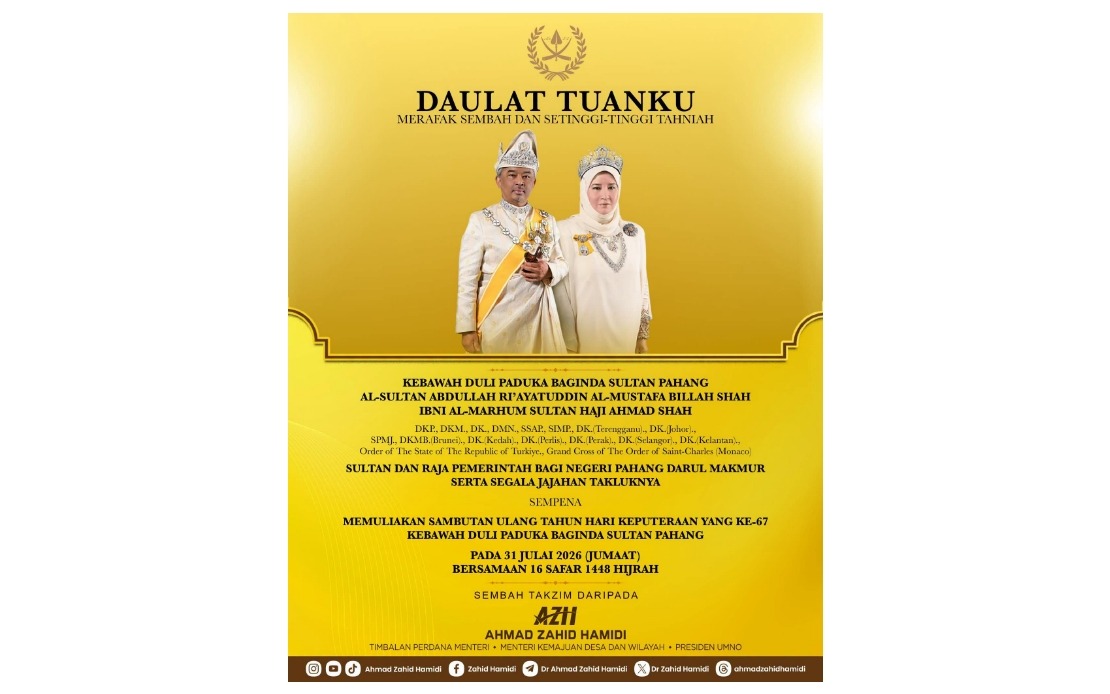
Malaysia's senior government figures have marked the occasion of Sultan of Pahang Al-Sultan Abdullah Ri'ayatuddin Al-Mustafa Billah Shah's 67th birthday with formal congratulations and well-wishes, underscoring the protocol traditionally observed when honouring members of the royal households across the nation. Deputy Prime Minister Datuk Seri Dr Ahmad Zahid Hamidi and Communications Minister Datuk Seri Fahmi Fadzil both issued public statements conveying their greetings and spiritual blessings to the Pahang sovereign on July 31, 2026, marking what corresponds to 16th Safar 1448H in the Islamic calendar.
Ahmad Zahid's tribute, shared through his social media platforms, articulated conventional sentiments befitting such occasions while emphasising the ruler's continued well-being and governance. The Deputy Prime Minister invoked religious blessings, requesting that Al-Sultan Abdullah remain perpetually under divine protection and enjoy robust health as he continues to lead Pahang Darul Makmur. Such expressions reflect the constitutional respect accorded to Malaysia's sultanate system, where the nine hereditary rulers occupy positions of significant ceremonial and cultural importance within the federation's governance structure.
The language employed in Ahmad Zahid's message followed established protocols for addressing the monarchy, incorporating the full formal title and lineage designation, along with the traditional closing phrase "Daulat Tuanku," which denotes loyalty and reverence. This adherence to ceremonial conventions demonstrates the continuing importance placed on maintaining dignified relations between the federal executive branch and the state-level monarchies that constitute an integral dimension of Malaysia's constitutional framework. The specific mention of Pahang's traditional epithet—Darul Makmur, meaning the abundant land—further emphasised the connection between the ruler's stewardship and the state's prosperity and development.
Fahmi Fadzil's separate message, issued in his capacity as Communications Minister, broadened the circle of well-wishers to encompass not merely his own person but the entire staff complement of his ministry and the constituency office of the Lembah Pantai Member of Parliament. This collective approach to offering birthday greetings represented an institutional acknowledgment of the significance of the occasion, extending recognition beyond individual officials to encompass the organisations and constituencies they represent. The inclusion of constituency representation underscores how formal tributes to royalty often transcend purely governmental channels, embedding broader social acknowledgment of the sultanate's role within Malaysian public life.
Both statements incorporated wishes for the extended royal household, with Fahmi explicitly extending his greetings to the entire Pahang Royal Family. This inclusive approach reflects the understanding that a ruler's health, longevity, and continued reign carry implications extending well beyond the individual monarch to encompass the stability and continuity of institutional arrangements that the royal family represents. In Malaysia's constitutional monarchy system, the welfare and succession stability of state rulers carries weight for broader governance frameworks, as the nine sultans collectively constitute the Conference of Rulers, which exercises specified constitutional powers including the election and approval of the federal head of state.
The timing of these public tributes, delivered through digital platforms, exemplifies contemporary practices in Malaysian political communication. Rather than relying solely on formal ceremonial channels, government officials increasingly utilise social media to reach broader audiences while maintaining the formality and respect demanded by such occasions. This democratisation of formal communication allows for wider public participation in acknowledging significant national and state occasions while preserving the essential conventions and dignified tone that such interactions demand.
Sultan Abdullah's accession to the Pahang throne represents a significant chapter in the state's modern political history, and his tenure has encompassed periods of considerable change in Malaysian governance dynamics. The ruler's position within the broader context of Malaysia's nine-state sultanate system grants particular relevance to occasions marking his welfare and continued tenure, as these ripple through institutional arrangements and broader state-level governance. The consistent public recognition of such occasions by high-ranking federal officials reinforces the constitutional importance attached to these relationships.
The practice of extending formal birthday greetings to members of the royal households constitutes an established element of Malaysian political protocol, serving simultaneously as expressions of respect for constitutional arrangements, demonstrations of institutional propriety, and affirmations of the bonds connecting different tiers of governance. For senior figures including the Deputy Prime Minister and cabinet ministers, such gestures carry particular weight, as they represent not merely personal sentiments but institutional positions. The prominence given to these messages through official social media channels ensures their visibility to broader constituencies, reinforcing public understanding of the respect accorded to the sultanate system.
These birthday acknowledgments arrive within a broader context of Malaysian governance where the sultans continue to exercise defined constitutional roles and symbolic authority. While the monarch system in Malaysia operates within particular constitutional limitations compared to absolute monarchies elsewhere, the institution retains significant cultural resonance and institutional importance. The careful observance of protocols surrounding the rulers' significant occasions reflects this enduring importance and the continued commitment of elected officials to maintaining proper relationships with the constitutional pillars of the nation's political system.
The Sultan's continued health and longevity carry implications extending beyond ceremonial considerations, touching upon questions of institutional continuity and succession planning that occupy important positions within Malaysian political discourse. Official prayers and blessings extended by senior government figures, therefore, carry meanings that transcend mere courtesy, encompassing wishes for stable governance and the uninterrupted functioning of constitutional mechanisms. As Malaysia navigates ongoing political and governance challenges, the maintenance of respectful and properly functioning relationships between the federal government and state-level sultanates remains a matter of considerable institutional importance.

