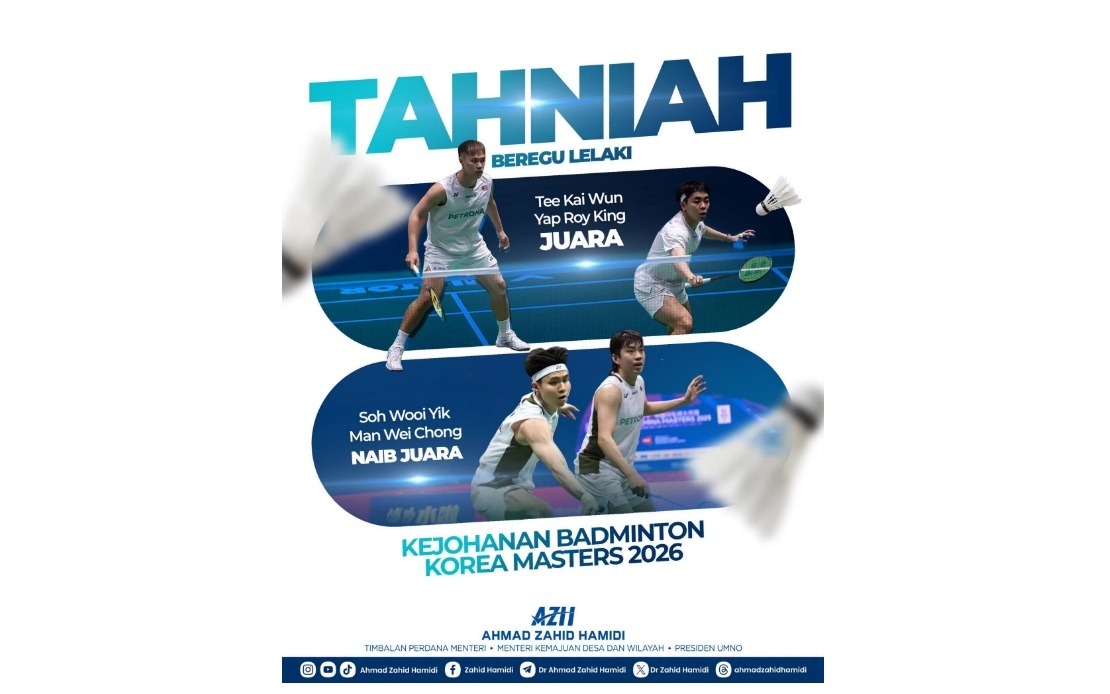
Malaysia has reinforced its standing as a badminton powerhouse in Asia following a commanding performance at the 2026 Korea Masters Badminton Championships, where two homegrown men's doubles pairs captured the tournament's top honours. Deputy Prime Minister Datuk Seri Dr Ahmad Zahid Hamidi moved swiftly to acknowledge the achievement, recognising both the dominant pair of Tee Kai Wun and Yap Roy King, who won the title, and the runners-up combination of Soh Wooi Yik and Man Wei Chong in separate messages of congratulation.
The championship clash at Yi Sun-sin Gymnasium in Asan proved to be a compelling domestic contest that showcased the depth of Malaysian badminton talent. Kai Wun and Roy King's victory proved decisive, with the newly-formed partnership dispatching their compatriots 21-13, 21-18 in a crisp 31-minute encounter that demonstrated superior court control and tactical discipline. The clinical scoreline underscored the Malaysian pairs' technical proficiency and mental fortitude in executing their game plan against a familiar opponent with considerable pedigree.
What makes Malaysia's sweep particularly noteworthy is that it represents a significant milestone in the nation's badminton narrative. The Korea Masters title return to Malaysian shores carries substantial prestige within the international badminton calendar, and Kai Wun and Roy King's triumph marks only the second occasion that Malaysia has secured the men's doubles crown at this prestigious tournament. The previous success came two years earlier, when Wooi Yik partnered with Aaron Chia to claim the 2024 edition, establishing a pattern of competitive excellence that Malaysian badminton has maintained at this venue.
Ahmad Zahid's public commendation carries broader implications for Malaysian sports policy and government backing. By elevating individual athlete achievements to the level of national leadership commentary, the deputy premier signals the political establishment's commitment to recognising badminton as a symbol of national pride and competitive achievement on the world stage. His remarks emphasise that such victories transcend sport itself, functioning as a source of collective inspiration and confidence for the broader population.
The deputy premier articulated his hope that this championship success would serve as a catalyst for continued excellence, positioning the victory as a springboard rather than a terminus for these athletes' careers. His invocation of bringing glory to Malaysia resonates with the traditional framing of sporting achievement as patriotic service, a sentiment that has long underpinned government support for athletic endeavours in the country. This messaging also subtly encourages the pairs to build upon their momentum and maintain their competitive trajectory in the demanding landscape of international badminton.
The emergence of Kai Wun and Roy King as championship winners is particularly significant given that this represents their Korea Masters debut. The pairing had yet to contest at this specific tournament prior to their victorious run, making their immediate success all the more impressive. The ability to perform at such elevated competitive standards on debut suggests extensive preparation and confidence within the partnership, qualities that Malaysian badminton coaching infrastructure appears to have cultivated effectively. This capacity for new partnerships to achieve immediate success at premier tournaments indicates a well-developed talent pipeline within the national badminton system.
Malaysia's strength in men's doubles badminton has long been considered one of the nation's athletic benchmarks. The country has historically produced world-class doubles players whose technical proficiency in formations such as the attacking net play and the interlocking court coverage patterns distinguishes them from competitors. The Korea Masters result provides contemporary evidence that this tradition of excellence remains robust and capable of producing fresh champions.
The Korea Masters occupies an important position within the badminton calendar, attracting elite competitors from across Asia and beyond. The tournament's competitive standard reflects the overall quality of play in the region, making success at this venue particularly meaningful for establishing credentials in international competitions. Malaysian pairs' performance here serves as a barometer of the nation's capability to compete effectively at prestigious tournaments throughout the year.
For Malaysian badminton enthusiasts and stakeholders, the Korea Masters result provides momentum heading into other major competitions on the international calendar. Success breeds confidence, and victories of this calibre often translate into psychological advantages in subsequent tournaments. The Kai Wun-Roy King partnership will enter future competitions as established champions at this venue, a distinction that carries intangible benefits in terms of player confidence and opponent perception.
The recognition from government leadership also underscores the broader ecosystem supporting Malaysian athletes. Beyond the players themselves, success at international tournaments reflects the work of coaching staff, support personnel, and the institutional structures that enable high-performance sport. Ahmad Zahid's acknowledgment extends implicitly to this network of professionals whose expertise and dedication contribute to championship outcomes. This systemic perspective on sporting achievement encourages continued investment in badminton infrastructure and player development programmes.
Looking forward, Malaysia's dominance at the Korea Masters establishes expectations for sustained excellence from both the championship-winning pair and their competitors within the national system. The presence of Wooi Yik and Wei Chong as runners-up suggests a cohort of capable players available for selection in major tournaments, providing strategic flexibility for national team management. The competitive depth evidenced by having two pairs contend for the title indicates that Malaysian badminton benefits from multiple potential gold-medal opportunities at international venues.

