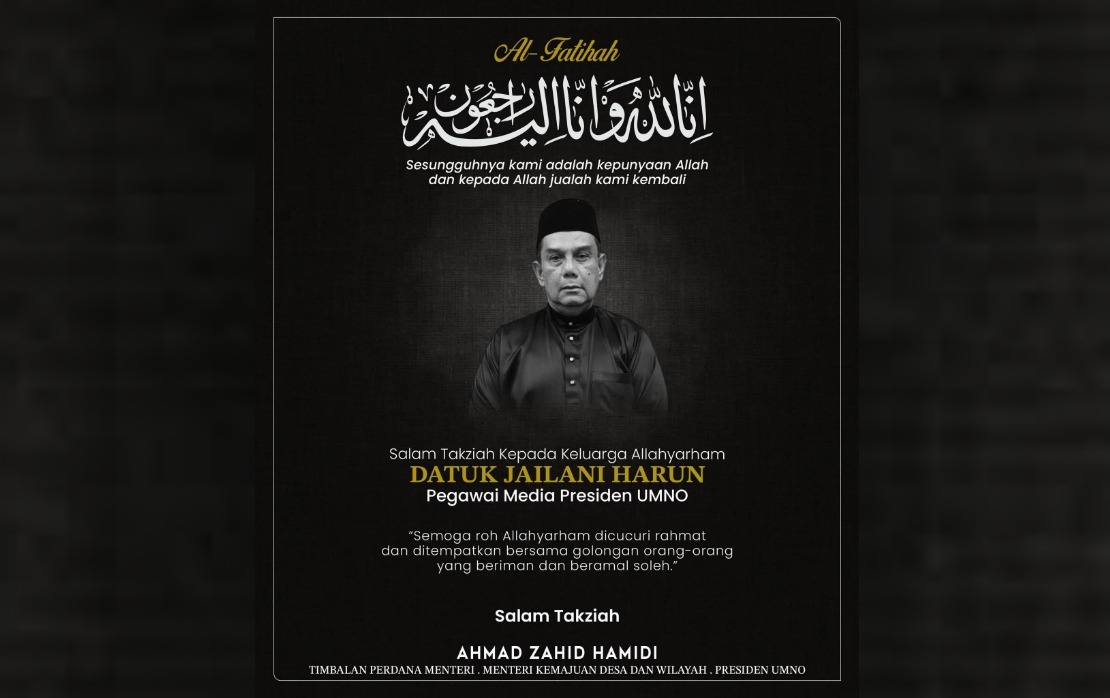
Deputy Prime Minister Datuk Seri Dr Ahmad Zahid Hamidi has extended his condolences following the passing of Datuk Jailani Harun, a respected figure in Malaysia's media landscape and communications sector. Jailani, who served as a media officer at the UMNO President's Office, died at Serdang Hospital on July 7 at 11.34 am, at the age of 66. Ahmad Zahid, who heads UMNO, made the announcement through a Facebook post in which he reflected on his final interaction with the deceased.
The Deputy Prime Minister disclosed that he had visited Jailani at Serdang Hospital in the early hours of the morning before his death, allowing him to witness the veteran communicator's final hours. The visit proved emotionally significant for Ahmad Zahid, who described the experience as deeply affecting. In his remarks, he characterised Jailani as an individual who embodied the qualities of kindness, humility and earned widespread respect throughout his career in journalism and government communications.
Ahmad Zahid's tribute underscores the personal dimension of Jailani's professional legacy. Rather than merely cataloguing achievements, the Deputy Prime Minister chose to emphasise the human qualities that defined the relationship between the two men and Jailani's broader standing within UMNO and the wider media community. His comment that "my heart ached when I saw his condition" conveys the emotional weight of witnessing a colleague's declining health, particularly for someone in Ahmad Zahid's position of leadership within the party.
The Deputy Prime Minister expressed his earlier hope for recovery, though he ultimately accepted the outcome with religious resignation. In his post, Ahmad Zahid invoked Islamic sentiment by noting that "Allah SWT loved him more," a phrase commonly used in Malaysian Muslim discourse to acknowledge divine will in matters of life and death. This framing reflects the predominantly Muslim Malaysian context in which such losses are processed and publicly discussed.
Jailani's contributions to Malaysian journalism and political communications spanned decades. As a former journalist, he would have witnessed significant periods in the nation's media evolution, from print-dominated newsrooms to the gradual digital transition. His subsequent role as a media officer at UMNO's highest levels positioned him as a bridge between the party's leadership and public messaging strategies, a responsibility requiring both technical skill and political acumen.
The funeral arrangements were expedited in accordance with Islamic tradition, with Jailani's burial scheduled for Alam Damai Muslim cemetery in Cheras following the asar prayer. This timing reflects customary practice within Malaysia's Muslim community, where burials typically occur within 24 hours of death. The choice of Alam Damai cemetery, located in the Kuala Lumpur metropolitan area, suggests Jailani maintained deep roots in Malaysia's capital region throughout his life.
Ahmad Zahid's public expression of grief serves multiple functions within Malaysian political culture. Beyond the immediate purpose of acknowledging loss, such statements affirm continuity within party structures and demonstrate the leadership's capacity for measured emotional expression. For UMNO members and the broader Malaysian public, the Deputy Prime Minister's words signal that institutional relationships remain valued and that those who serve the party are remembered with dignity upon their passing.
The passing of figures like Jailani Harun reflects broader transformations within Malaysia's media and political landscape. Journalists and communications professionals of his generation witnessed Malaysia's transition from independence through various phases of political and social development. Their expertise in navigating complex relationships between media institutions, political parties, and public opinion proved crucial during formative periods in the nation's history.
For the Malaysian journalism community specifically, Jailani's death represents the loss of someone who bridged two significant domains—independent journalism and political communications. This dual experience, while sometimes viewed with ambiguity, equipped him with insights into how both sectors functioned and the pressures each faced. Colleagues from both phases of his career likely regard his passing as marking the end of an era in Malaysian media development.
Ahmad Zahid's prayers for the deceased reflect Islamic practice of seeking divine forgiveness and mercy for the departed. His request that Allah place Jailani "among His faithful and righteous servants" extends beyond conventional condolence language to affirm his character from a religious perspective. Within Malaysian public discourse, such language carries significant weight, particularly when expressed by high-ranking government and party officials.
The circumstances of Jailani's death at Serdang Hospital, a major public healthcare facility serving the Kuala Lumpur metropolitan area, underscore the accessibility of Malaysia's healthcare system to individuals across various social strata. That Ahmad Zahid felt able to visit him in his final hours reflects both the geographical proximity of key institutions in Malaysia's capital region and the informality that sometimes characterises interactions between senior political figures and respected long-serving colleagues.
Looking forward, Jailani's passing will likely prompt reflection within UMNO and Malaysian media circles about succession in roles requiring the combination of journalistic credibility and political sensitivity that he embodied. The gap left by his departure extends beyond personnel matters to encompass institutional memory regarding how media relations have evolved within Malaysia's largest political party and the approaches that proved effective across different political and technological environments.

