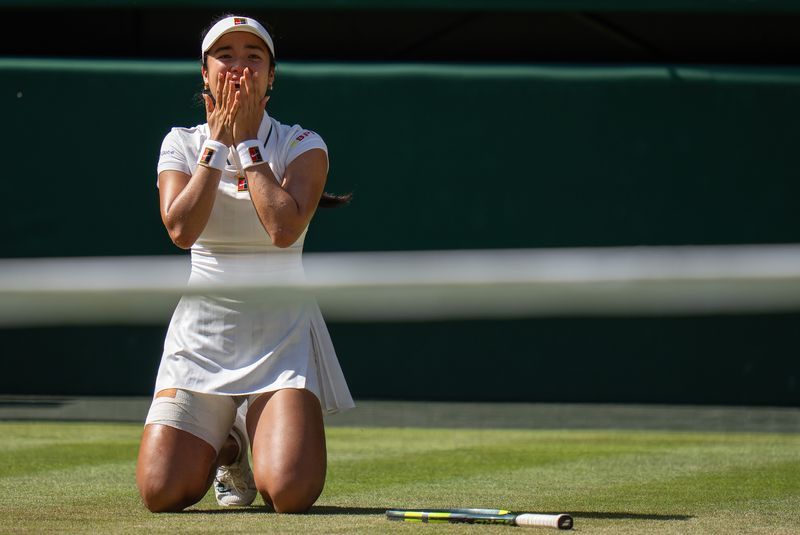
Alexandra Eala's commanding victory over Poland's Iga Swiatek on Saturday at Wimbledon represents far more than a personal triumph for the 21-year-old Filipino player. Her breakthrough into the last 16 of a Grand Slam tournament signals a pivotal shift in tennis development across Southeast Asia and the Philippines specifically, a nation long dominated by boxing's towering presence. Eala's emergence onto the global sporting stage carries with it the weight of expectation and the electricity of possibility, qualities that transform a single match victory into something approaching a cultural moment.
The emotional intensity of Eala's win was immediate and visceral. Upon clinching the decisive point against Swiatek, she collapsed to the ground in tears of joy, her overwhelmed state visible to the thousands in attendance and millions watching remotely. Even during the obligatory on-court interview, she struggled to contain her emotions, fighting back fresh tears as she addressed the crowd. Yet this outpouring of feeling did not reflect a player content with her achievement. Instead, Eala consciously separated the legitimate celebration of an extraordinary victory from the demands of sustained competitive excellence that lay immediately ahead.
The 29th seed's path forward at the tournament proves equally demanding. Her next opponent will be Jasmine Paolini, the 2024 Wimbledon runner-up, a formidable challenge that demands Eala maintain momentum while facing an opponent of considerably higher seeding and experience. Eala acknowledged this reality without hesitation, demonstrating a psychological maturity that distinguishes champions from mere beneficiaries of fortune. She described her capacity to transition from celebration to focused preparation as something approaching an innate skill, though she qualified this by noting that deliberate practice remains essential to refining this crucial mental capability.
Eala's perspective on her platform extends beyond tournament results and ranking points. During her post-match press conference, she articulated a sophisticated understanding of her role as a public figure and potential role model. She expressed a desire to inspire rather than to be emulated wholesale, understanding that authentic inspiration derives from others recognising the possibility of forging their own distinct paths rather than attempting to replicate her specific journey. This nuance reflects a maturity uncommon in athletes barely past adolescence, suggesting an individual conscious of the broader implications of her visibility and success.
Within the Philippine sporting context, Eala's emergence carries particular significance. For generations, Manny Pacquiao's boxing achievements established the benchmark against which all Filipino athletic accomplishment has been measured. His multi-divisional world championships and crossover cultural dominance created a singular standard of sporting celebrity and national pride. Eala possesses the trajectory and appeal to challenge this monopoly, potentially establishing tennis as a credible alternative pathway to sporting prominence within the Filipino consciousness. Her combination of technical excellence, international competition at tennis's highest level, and affable public presentation creates the ingredients for sustained mainstream appeal.
The crowds following Eala at successive Grand Slam tournaments demonstrate her capacity to transcend the traditional tennis audience. Large galleries gathering specifically to witness her matches reflects not merely sporting interest but a broader connection rooted in national pride and identification. Her fearless approach to tennis, characterised by aggressive shot-making rather than conservative baseline play, provides an aesthetic that appeals to casual observers alongside dedicated tennis enthusiasts. Coupled with her evident authenticity and genuine demeanor away from the court, these qualities construct a compelling narrative that extends beyond sporting achievement into broader cultural significance.
Eala's specific message to aspiring young athletes in the Philippines carries pedagogical weight. Rather than positioning herself as a destination point or ultimate aspiration, she explicitly encouraged young girls to develop their own distinctive identities and pursue their own unique ambitions. This philosophy contrasts sharply with typical sports mentorship models, which often implicitly encourage replication of the successful predecessor's path. By inverting this dynamic, Eala suggested that her greatest contribution might derive from her example of autonomous self-development rather than from direct mentorship toward her specific achievements. Such an approach reflects confidence in her own trajectory while simultaneously demonstrating humility about her role in others' development.
The psychological architecture underlying Eala's performance at Wimbledon proves instructive. Her capacity to celebrate meaningfully while simultaneously locking her focus toward upcoming challenges suggests an individual who has internalised both the emotional and tactical dimensions of elite sport. She described this oscillation between celebration and refocus as something that her body recognises automatically, implying that her physical and mental preparation have developed sufficiently integrated responses to the demands of tournament play. This integration typically requires years of development and experience, suggesting that Eala's progress has been shaped by coaching of considerable quality and her own substantial work.
The regional implications of Eala's breakthrough extend beyond the Philippines into the broader Southeast Asian tennis landscape. Her success at the world's most prestigious tournaments demonstrates that players from the region can compete at the highest levels of professional tennis, challenging assumptions about the geographic distribution of tennis excellence. Particularly for Malaysia and other nations in close proximity with similar climates and economic conditions, Eala's example provides evidence that competitive pathways exist. Her breakthrough potentially encourages investment in tennis infrastructure and development programs across Southeast Asia, recognising that world-class talent can emerge from the region's diverse populations.
Eala's approach to managing her newfound visibility reveals a player thoughtfully navigating the psychological complexities of sudden prominence. She described how her exposure and the knowledge that many people look up to her has facilitated self-reflection and personal development. Rather than treating fame as an external burden to be managed, she has reframed it as an opportunity for continuous improvement and authentic expression. This reframing converts the pressure of celebrity into a positive force motivating her toward becoming her best self, suggesting a psychological resilience that will serve her well across a long professional career.
Looking forward, the question animating discussions of Eala's trajectory concerns sustainability. Can a 21-year-old from the Philippines maintain this trajectory against the world's most accomplished players, each possessing years of experience and accumulated tournament victories? Eala's victory over Swiatek and her measured response to it suggests someone equipped with the psychological tools necessary for long-term success. Her combination of technical excellence, mental clarity, and authentic self-awareness positions her advantageously for the challenges ahead. Whether she ultimately becomes a Grand Slam champion, a top-ranked player, or settles into a respected career as a consistent competitor, her impact has already transcended her individual results.

