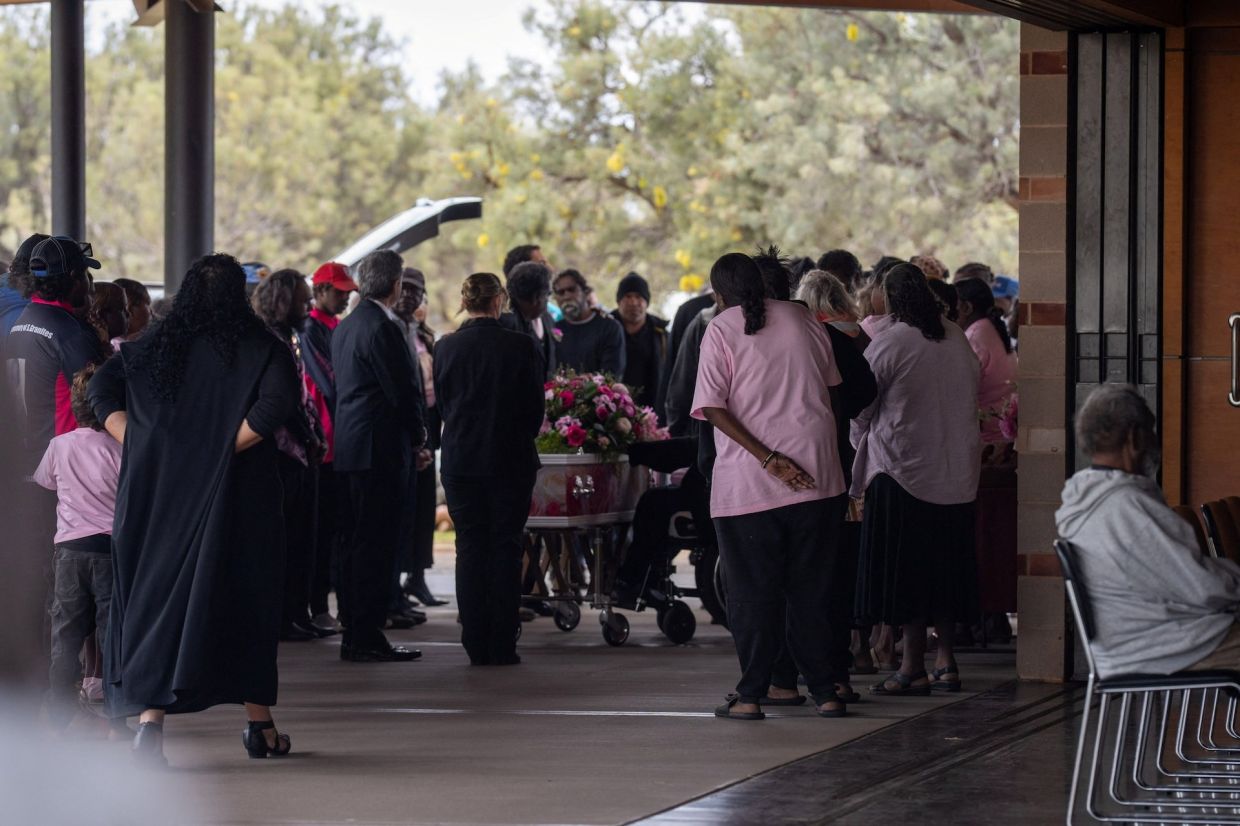
The remote outback town of Alice Springs came to a standstill on Saturday as hundreds of residents converged on the Garden Cemetery to pay final respects to Kumanjayi Little Baby, a five-year-old whose tragic death has become emblematic of deeper tensions and systemic neglect plaguing Australia's remote Northern Territory. Located roughly 1,250 kilometres south of Darwin in a town of 25,000 people, the funeral service marked a solemn moment in a community still grappling with the shock and social upheaval triggered by the child's death in April and the violent riots that followed.
The circumstances surrounding Kumanjayi Little Baby's death set off a chain of events that exposed the fragility of social cohesion in Alice Springs. When the suspect was apprehended by local residents, the arrest itself became violent, with community members beating the detainee—a visceral expression of rage that spilled into broader civil unrest. These clashes served as a watershed moment, forcing uncomfortable national conversations about the underlying grievances that had been simmering in this isolated community for years. The arrest and subsequent legal proceedings have kept the town on edge, with many residents feeling that structural injustices had finally reached a breaking point.
Saturday's funeral reflected the deep cultural traditions of Indigenous mourning, with attendees honouring the girl by wearing pink, her favourite colour, as a visible expression of collective grief and remembrance. The coffin, adorned with flowers and transported in a black hearse, became a focal point for the community's pain. The ceremony embodied what Indigenous Australians refer to as "sorry business"—a sacred period of mourning and the ceremonial practices that follow an Indigenous person's death. These customs, which can extend over weeks or months, are integral to Indigenous spirituality and community cohesion, yet they often occur against a backdrop of inadequate institutional support and recognition from broader Australian society.
The demographic composition of Alice Springs adds another layer to understanding the town's current crisis. With approximately one-fifth of its 25,000 residents identifying as Indigenous, the town sits at the intersection of two worlds: a settler colonial town structure and significant Indigenous populations whose presence predates European settlement by tens of thousands of years. Yet this Indigenous presence remains largely confined to marginalised camp communities on the town's periphery, where housing is chronically insufficient and essential services remain inadequate. These spatial divisions reflect and reinforce economic and social inequalities that have accumulated over decades.
Thousands of Indigenous people, including Kumanjayi Little Baby's extended family, inhabit these camp settlements, which function as de facto reservations despite the absence of formal administrative designation. The conditions in these communities represent some of Australia's most severe examples of poverty and infrastructure deficit. Overcrowded dwellings, limited access to clean water, inadequate sanitation, and scarce healthcare facilities characterise daily life for residents. For many Indigenous Australians, these camps represent not just poor living conditions but a profound disconnection from economic opportunity, educational advancement, and social participation in the broader Australian economy.
The national political establishment has begun to acknowledge the urgency of the situation. Prime Minister Anthony Albanese intervened in the days immediately following Kumanjayi Little Baby's death, publicly calling on Northern Territory authorities to prioritise improvements to camp living conditions. His intervention signalled that the crisis in Alice Springs had transcended local concern and become a matter demanding federal attention. However, Albanese's statements have raised expectations that must now translate into concrete policy action and resource allocation—a challenge that has repeatedly defeated previous governments.
The legal case against Jefferson Lewis, 47, who has been charged with the girl's murder alongside two additional offences, will proceed through Australia's criminal justice system. The specifics of those supplementary charges remain sealed under legal restrictions, reflecting the complexity of the case and procedural safeguards. However, the legal resolution of this particular incident, whatever the outcome, will not address the systemic vulnerabilities that rendered Kumanjayi Little Baby vulnerable in the first place. The trial may provide a measure of justice to her family, but it cannot remediate the profound inequalities embedded in Alice Springs' social structure.
The riots that erupted following the suspect's arrest illuminated the depth of frustration within Alice Springs' Indigenous community. What appeared to outsiders as sporadic violence was, from the perspective of residents living in the camps, an eruption of accumulated resentment—years of unfulfilled promises, chronic underfunding, and the daily experience of being warehoused at the margins of Australian society. The rioting, while condemnable as a form of civic disorder, nonetheless communicated a message that conventional political channels had failed to address grievances.
Moving forward, Alice Springs faces a critical juncture. The funeral service and the national attention it has generated create a narrow window for meaningful intervention. However, addressing the root causes requires sustained commitment to infrastructure investment, employment creation, healthcare expansion, and educational opportunity in Indigenous communities. Previous initiatives have often been characterised by short-term funding, bureaucratic complexity, and insufficient coordination between state and federal authorities. The challenge for Australian policymakers is to move beyond crisis response into genuine long-term structural reform that acknowledges both the historical injustices that created current conditions and the urgent present-day needs of communities like those surrounding Alice Springs.

