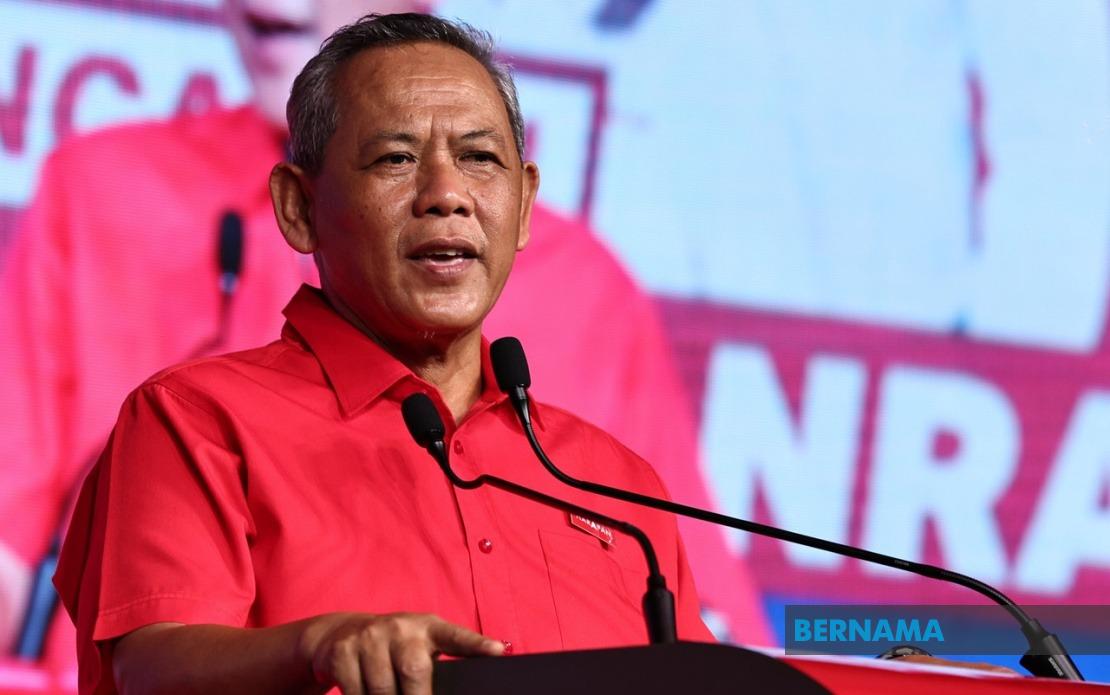
Negeri Sembilan Menteri Besar Datuk Seri Aminuddin Harun has called on voters in the run-up to the 16th Negeri Sembilan state election to evaluate his administration on its tangible work to resolve the Linggi district's entrenched flood problem, rather than allowing the issue to become fodder for political opportunism. Speaking after Friday prayers in Seremban on July 17, the Pakatan Harapan candidate for the Linggi state seat stressed that the government had never dismissed the flooding challenge, which has periodically surfaced on social media with claims that the area experiences inundation following heavy rainfall in the wider Seremban area.
The flooding matter has become increasingly visible in online discourse, prompting Aminuddin to defend the government's record and approach. He pointed to the fact that two dedicated flood mitigation projects affecting the Linggi area have received formal approval and are currently in implementation, undertaken through a collaborative framework between the state government and its federal counterpart. The Menteri Besar acknowledged that infrastructure solutions of this magnitude inevitably require extended periods to deliver results, and that remedying a longstanding hydrological problem cannot be accomplished in days or weeks.
Aminuddin's remarks reflect a broader strategy by the Pakatan Harapan coalition to position itself as the party of pragmatic governance and measurable development outcomes. Rather than engage in the tit-for-tat scoring that characterises much electoral competition, the Negeri Sembilan PH chairman indicated that voters should evaluate all political contenders based on their governance philosophy and demonstrated capacity to deliver. He framed the choice before Negeri Sembilan residents as one between a coalition offering a proven administrative record and substantive infrastructure improvements, versus opponents whose strategies the public could assess independently.
The flooding issue illustrates a recurring tension in Malaysian electoral politics: the gap between infrastructure timelines and election cycles. Mitigation projects that may take years or even decades to complete do not generate the immediate gratification that voters sometimes expect, making them vulnerable to exploitation by rival parties who can promise swifter resolutions or claim credit for incremental improvements. Aminuddin's implicit acknowledgment of this challenge—his plea that the flooding problem "not be turned into an issue"—suggests awareness that his government's sober, technical approach may struggle against more emotive or populist messaging.
The timing of these comments is significant. The Election Commission designated July 17 as nomination day for the Negeri Sembilan state polls, with early voting scheduled for July 28 and the main polling day set for August 1. This compressed timeline means that candidates and parties have little more than two weeks to shape voter perceptions, and long-term infrastructure commitments may lose salience against more immediate grievances or promises. For Aminuddin, whose coalition has governed Negeri Sembilan continuously in recent years, emphasising continuity and completion of existing projects becomes a defensive strategy against challengers who can propose alternative visions without the burden of implementation responsibility.
The flood mitigation projects themselves represent the kind of capital-intensive, multi-stakeholder infrastructure work that defines modern governance in Malaysia. The requirement for federal-state collaboration reflects the constitutional division of powers, wherein some aspects of water management and flood control fall under federal jurisdiction while others rest with state authorities. The collaboration Aminuddin highlighted therefore underscores the need for political cohesion across different levels of government, a point of potential vulnerability if opposition parties can exploit any perceived reluctance by federal authorities to support state-level initiatives, or vice versa.
Social media's role in amplifying the Linggi flooding narrative deserves attention. The viral circulation of claims about recurrent inundation demonstrates how digital platforms can create political pressure by aggregating dispersed grievances and raising their visibility instantaneously. A flooding issue that might previously have remained largely local can now become a focal point for broader criticism of government competence. Aminuddin's response—to acknowledge the problem while defending the government's approach—represents an attempt to contain the narrative by reframing it as a technical challenge being addressed through appropriate mechanisms, rather than as a symptom of systemic government failure.
The Pakatan Harapan coalition's broader campaign strategy appears centred on defending its governance record across multiple policy domains. In Negeri Sembilan, where PH has held executive power, the party cannot position itself as a disruptive challenger but must instead argue that continuity serves voters better than change. This inherently defensive posture places a premium on demonstrating visible results, which is precisely why Aminuddin emphasised the approval and implementation status of the flood projects. For opposition parties, the opposite calculation applies: they can highlight incomplete projects and unresolved problems as evidence that change is needed.
The emphasis on voter maturity and wisdom that Aminuddin expressed reflects a perhaps optimistic view of electoral behaviour. His appeal for voters to move beyond political opportunism and judge parties on genuine performance assumes a level of detachment and analytical rigour that campaign politics often actively discourages. Nonetheless, his framing of the choice—between proven administration and untested alternatives—suggests that PH believes its base of support in Negeri Sembilan remains sufficiently cohesive to withstand challenges on specific issues like flooding.
Looking at the broader Southeast Asian context, Negeri Sembilan's experience with flood governance mirrors challenges faced across the region. Climate variability, rapid urbanisation, and aging infrastructure create persistent flooding problems that no single electoral cycle can resolve. The question facing Malaysian voters in Negeri Sembilan is whether they prioritise parties that offer comprehensive, patient solutions to structural problems, or those promising faster remedies. Aminuddin's message suggests that the incumbent administration believes the answer favours experience and continuity, even if gratification is deferred.

