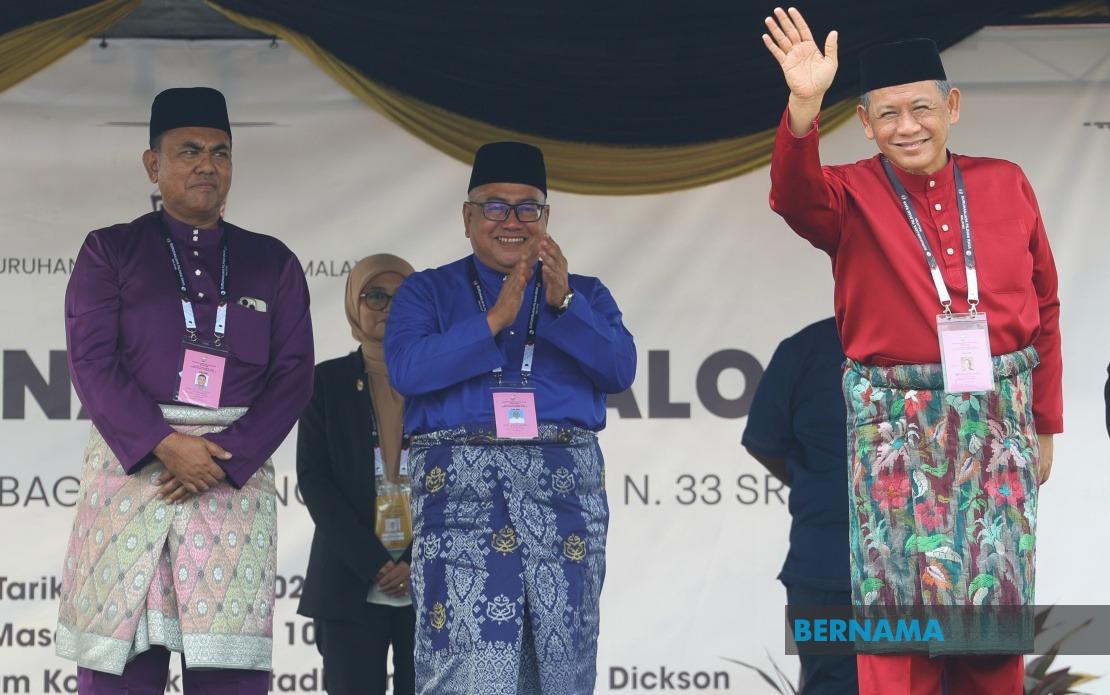
The 16th Negeri Sembilan state election is shaping up to deliver closely contested races across multiple constituencies, with the Linggi seat emerging as a particularly significant battleground. Pakatan Harapan's Menteri Besar Datuk Seri Aminuddin Harun will compete in a three-cornered contest after nominations closed on July 18, facing incumbent Datuk Mohd Faizal Ramli of Barisan Nasional and Bersatu candidate Datuk Zamri Md Said. The announcement came from returning officer Nurhazelin Makli at the Port Dickson District Administration Complex, marking the official confirmation of candidate lineups across the state's parliamentary constituencies.
The Linggi contest represents a critical test for Pakatan Harapan's grip on Negeri Sembilan's leadership, particularly given that Aminuddin's entry into the race signals the coalition's determination to retain control of the state government. The three-way dynamic introduces strategic complexity, as votes may split between the ruling coalition, the traditional opposition, and the increasingly assertive Bersatu faction. This represents a broader pattern across Negeri Sembilan's electoral landscape, where the consolidation of Malaysian politics into distinct blocs continues to fragment.
Elsewhere in the state, established patterns of competition are being disrupted by shifting political alignments. In Sri Tanjung, Pakatan Harapan's sitting assemblyman Dr G. Rajassekaran must defend against both Barisan Nasional's A. Achutan and Bersatu newcomer Leevineshwaraan Murugan. The Lukut constituency presents another triangular contest, with incumbent Choo Ken Hwa of Pakatan Harapan squaring off against Perikatan Nasional's Sathes Kumar Nilameham and independent candidate Teo Seng Lee. These multi-candidate races reflect the fractured opposition landscape that has emerged since the 2022 Federal election realignment.
Bagan Pinang offers a distinct political narrative, with incumbent Pas assemblyman Abd Fatah Zakaria now confronting challengers from both Pakatan Harapan, represented by Nasir Raman, and Bersatu's Sheikh Junaidy Jamaludin. This particular contest illustrates how even Islamic-based parties must now compete intensely within their traditional base territories, a consequence of Malaysia's evolving political mathematics. The presence of Bersatu candidates across multiple constituencies signals the party's commitment to establishing a substantive footprint in Negeri Sembilan, moving beyond its historical strongholds in other states.
The Chuah seat represents an exception to the three-way contests dominating this cycle, featuring a straight fight between incumbent Yew Boon Lye of Pakatan Harapan and Barisan Nasional's Pau Jeou Ching. This bifurcated race may well become one of the election's most closely watched, as it offers a clearer indication of voter preferences between the two largest coalitions without the complicating factor of a third major contender. For Malaysian observers, such races provide valuable indicators of baseline support levels in the absence of vote splitting.
The Election Commission has designated August 1 as polling day, with early voting scheduled for July 28, providing military and police personnel opportunities to participate before the general vote. This timing framework allows for a compressed campaign period, testing parties' ability to mobilize voter support within a relatively condensed window. Early voting provisions are particularly relevant in Negeri Sembilan given the state's substantial defense and security personnel presence through various military installations and government offices.
The eligible voter roll reflects Negeri Sembilan's demographic composition, with the Election Commission registering 889,490 qualified voters across the state. The broader electorate comprises 867,151 ordinary voters, supplemented by 16,884 military personnel and their spouses, and 5,455 police officers and their families. These specialized voter categories, while representing a small overall percentage, can prove decisive in closely contested constituencies and warrant targeted engagement strategies from political parties.
For Pakatan Harapan, the Negeri Sembilan election represents a crucial test of its viability as a governing coalition outside of Selangor and federal territories. Aminuddin's personal performance in Linggi will be scrutinized as an indicator of whether the coalition can maintain its support base amid ongoing competition from Bersatu and traditional Barisan Nasional strongholds. The outcome in Negeri Sembilan may influence perceptions about coalition stability heading into potential future national political contests.
Barisan Nasional enters this election cycle with renewed organizational focus following the 2022 federal election losses, and Negeri Sembilan offers a platform to demonstrate recovery and renewed appeal. The continued presence of incumbents such as Mohd Faizal Ramli in contested seats reflects the coalition's strategy of leveraging existing legislative presence rather than attempting wholesale seat captures.
The broader Southeast Asian context suggests that Malaysian electoral dynamics are increasingly fluid, with established party coalitions facing sustained pressure from mid-sized players and fractious realignments. Negeri Sembilan's election results will provide important data points about the durability of current political arrangements and the feasibility of various coalition configurations in Malaysian politics' medium-term future.

