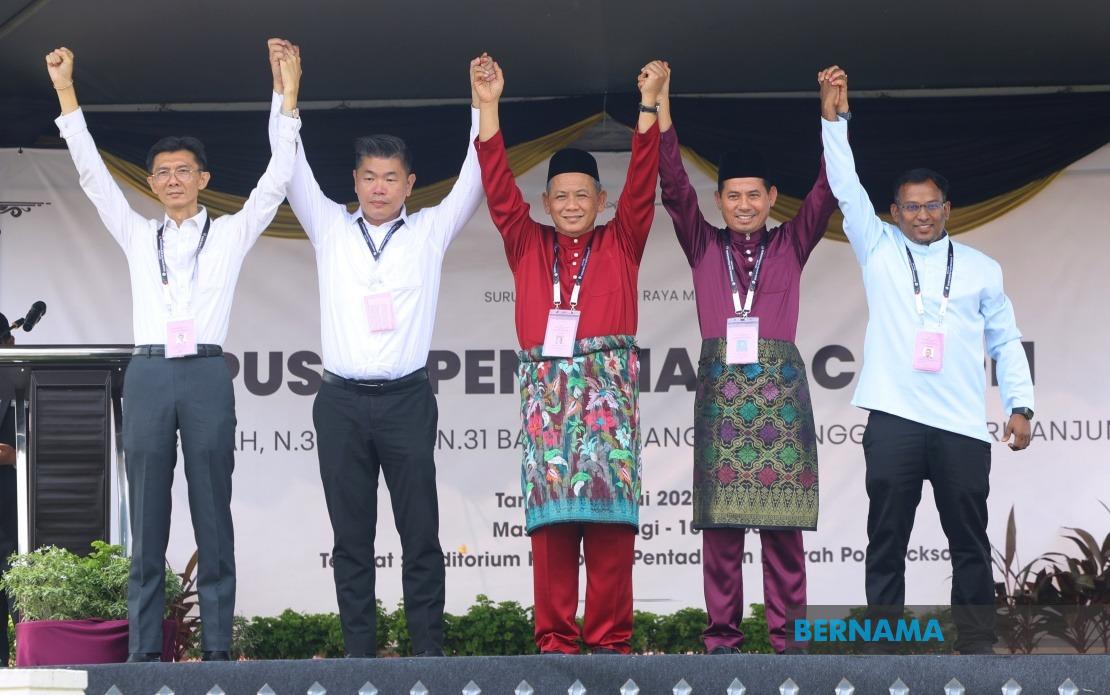
Negeri Sembilan Menteri Besar Datuk Seri Aminuddin Harun has unveiled an ambitious infrastructure agenda centred on port and industrial development for the Linggi state constituency, signalling his campaign's focus on economic growth and job creation as he seeks voter backing in the forthcoming state election scheduled for August 1. Speaking at the nomination proceedings held at Port Dickson's District Administration Complex Auditorium on July 18, Aminuddin positioned these flagship projects as components of a comprehensive regional development blueprint designed to strengthen the local economy and broaden opportunities for constituents.
The Pakatan Harapan chairman's emphasis on infrastructure reflects a broader strategy to address economic concerns in a constituency long dominated by rival political forces. By anchoring his campaign platform on tangible development proposals rather than abstract political messaging, Aminuddin is attempting to shift the electoral conversation toward delivery-focused governance. The port development initiative, in particular, carries significant regional implications, as Linggi's coastal positioning offers genuine potential for maritime commerce expansion and could complement existing Port Dickson operations.
Aminuddin's acknowledgement that Linggi represents a traditional Barisan Nasional stronghold underscores the difficulty of his challenge. The incumbent, Datuk Mohd Faizal Ramli, carries the advantage of established political machinery and historical voter loyalty that has consistently favoured BN candidates in this constituency. By openly recognising this terrain, Aminuddin demonstrates political realism while simultaneously attempting to frame his candidacy as a refreshing alternative to entrenched political patterns.
The contest has emerged as a three-way battle involving Aminuddin's Pakatan Harapan, Mohd Faizal's Barisan Nasional, and Datuk Zamri Md Said representing Bersatu. This fragmentation presents both opportunities and complications for all camps. For Aminuddin, a divided opposition to BN could theoretically improve PH prospects, though the outcome depends heavily on whether Bersatu's intervention splits anti-BN or anti-PH voters. For Mohd Faizal, the presence of a Bersatu candidate may dilute the BN vote in ways that undermine what might otherwise be a more comfortable advantage.
Mohd Faizal's cautionary remarks about treating the contest seriously, despite BN's traditional dominance, suggest that the incumbent recognises genuine campaign momentum building against his position. His appeal for a clean campaign avoiding excessive provocation or baseless allegations signals anxiety about the tenor of the coming fortnight. Such language often emerges when political camps sense vulnerability and wish to control what they perceive as an unfavourable information environment.
Aminddin's personal framing of the port and industrial proposals as initiatives he specifically advocated to party leadership before receiving endorsement carries narrative importance. This positioning allows him to claim individual agency and vision rather than simply executing party directives, potentially strengthening his personal brand as a decisive leader committed to the constituency. The approach also subtly distances his candidacy from broader PH performance and vulnerabilities by rooting his appeal in local grievances and opportunities.
For Malaysian observers and Southeast Asian economic analysts, Linggi's development potential merits consideration beyond campaign rhetoric. The constituency's geography positions it as a logical extension of Port Dickson's maritime infrastructure, and industrial development in this region could meaningfully contribute to Negeri Sembilan's economic diversification away from traditional sectors. Whether these proposals represent genuine planning or primarily campaign positioning will become clearer following the election outcome.
The political calculus in Negeri Sembilan reflects broader patterns across Malaysian electoral contests, where infrastructure pledges increasingly function as primary campaign currency. Voters increasingly demand tangible development commitments rather than ideological appeals, forcing political parties across the spectrum to articulate concrete economic visions. Aminuddin's strategy aligns with this trend, though translating campaign promises into implementation remains perpetually challenging regardless of which coalition ultimately governs.
The two-week campaign period leading to August 1 polling will determine whether Aminuddin's infrastructure-focused message resonates sufficiently to overcome BN's institutional advantages in Linggi. Traditional polling patterns and voter registration data favour the incumbent, yet recent electoral surprises across Malaysia demonstrate that motivated campaigns coupled with credible local leadership can produce unexpected outcomes. The constituency's economic situation and resident perceptions of incumbent performance will likely prove more determinative than campaign oratory.
For Negeri Sembilan's broader development trajectory, the Linggi election outcome carries significance beyond immediate political implications. A PH victory could signal willingness to pursue port infrastructure investments in coastal constituencies, potentially reshaping the state's economic geography. Conversely, a BN retention would maintain continuity in regional development strategy, though incumbent performance under Mohd Faizal's representation would face heightened scrutiny given the competitive challenge presented. Either way, the port and industrial development question has entered public consciousness and will likely feature in post-election accountability discussions.

