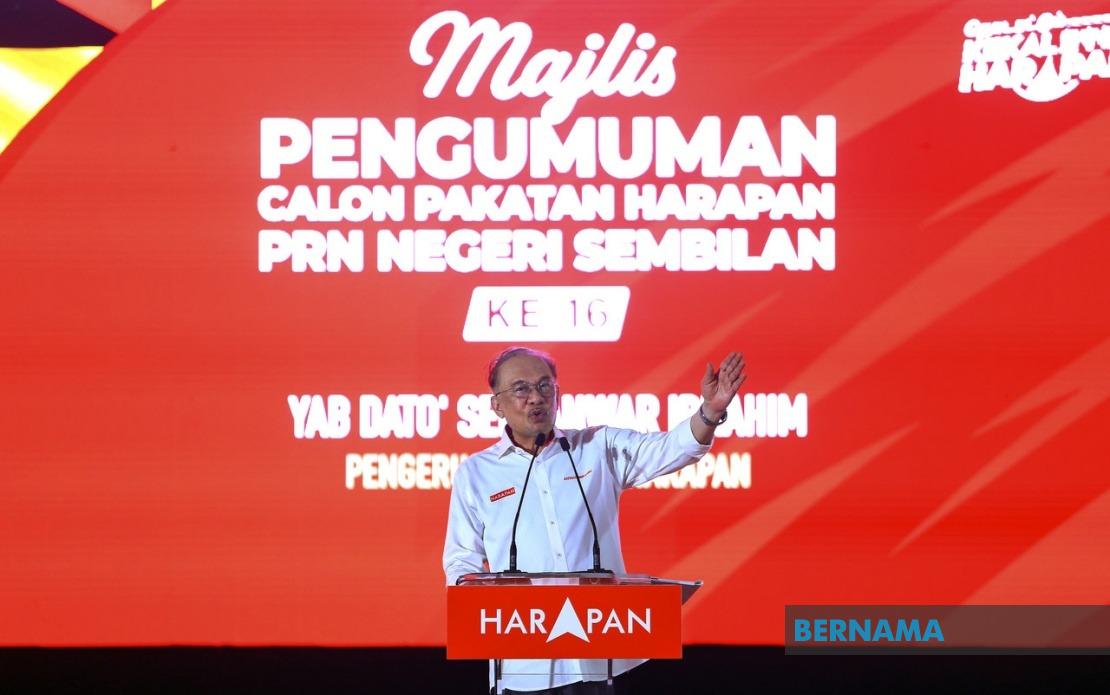
The governing Pakatan Harapan coalition has unveiled its slate of candidates for the forthcoming Negeri Sembilan state election, with Menteri Besar Datuk Seri Aminuddin Harun set to shift constituencies and contest the Linggi seat. The announcement came during a candidate declaration ceremony in Kuala Pilah, where Prime Minister Datuk Seri Anwar Ibrahim formally presented the coalition's nominees before a gathering of party leadership and thousands of grassroots supporters, underlining the strategic importance the coalition places on retaining control of the central state.
Aminuddin, who simultaneously holds the position of Pakatan Harapan chairman in Negeri Sembilan, represents a significant shift in his political trajectory. For sixteen consecutive years since the 2008 election, he has served as the assemblyman for Sikamat, establishing a formidable track record of electoral victories across four successive terms. His decision to contest Linggi instead signals either a strategic realignment of seats within the coalition or an effort to expand Pakatan Harapan's grip on key constituencies as the state heads toward polls.
Joining Aminuddin on the coalition ticket is Democratic Action Party secretary-general Anthony Loke, whose retention of the Chennah seat confirms the DAP's continued prominence within Pakatan Harapan's Negeri Sembilan machinery. Loke has represented Chennah since 2013, accumulating more than a decade of legislative experience in the state assembly. His re-nomination underscores the DAP's entrenchment in this particular constituency and the coalition's confidence in his ability to withstand electoral pressure from opposition forces.
The ceremony itself reflected the scale of Pakatan Harapan's electoral machinery. Beyond Prime Minister Anwar, the event drew senior coalition figures including Amanah president Datuk Seri Mohamad Sabu, PH communications director Datuk Seri Fahmi Fadzil, and the coalition's election director Datuk Seri Amirudin Shari. This concentration of top-tier leadership presence at a state-level candidate announcement demonstrates the coalition's view of Negeri Sembilan as electorally consequential, particularly given the state's history of competitive politics and its geographical proximity to the federal capital.
For Malaysian political observers, these nominations carry deeper implications for coalition dynamics. Negeri Sembilan has traditionally been a proving ground for ambitious politicians seeking higher office, and Aminuddin's repositioning to Linggi may indicate preparations for either state or federal advancement. Similarly, Loke's continued presence in Chennah suggests the DAP views the seat as a safe stronghold from which senior party figures can operate while maintaining state assembly representation.
The electoral significance of these constituencies extends beyond symbolic importance. Linggi and Chennah are demographically diverse seats where coalition performance will partly reflect its broader appeal across different voter segments in the state. Both constituencies have experienced shifts in voter sentiment during previous election cycles, making them bellwethers for gauging whether Pakatan Harapan can maintain its 2018 breakthrough in Negeri Sembilan or whether opposition parties have successfully rebuilt their organisational capacity since their 2018 setback.
From a Southeast Asian perspective, these state-level developments acquire importance as indicators of Malaysia's ongoing political stability and coalition viability. Negeri Sembilan's electoral outcomes will provide the first substantial test of whether Pakatan Harapan can translate its federal governance record into sustained electoral dominance at the state level. The opposition, meanwhile, will view these elections as an opportunity to recapture territory lost five years earlier.
Aminuddin's nomination also reflects leadership grooming within Pakatan Harapan's ranks. As Menteri Besar, he has administered the state government during a crucial period of economic recovery and development prioritisation. His performance as chief executive has shaped perceptions of coalition competence in Negeri Sembilan, and his re-nomination essentially asks voters to ratify the coalition's state governance track record.
The announcement process itself demonstrates how Malaysia's electoral system remains fluid and responsive to coalition strategies. The ability to reshuffle candidates, redraw focus between constituencies, and reposition senior figures reflects the flexibility inherent in party-based electoral competition. For voters in both Linggi and Chennah, these nominations effectively set the contest parameters and define the major candidates they will evaluate during the campaign period ahead.
Looking forward, the composition of Pakatan Harapan's full slate for all Negeri Sembilan seats will become clear as additional candidates are announced. However, the early designation of high-profile figures like Aminuddin and Loke signals that the coalition expects to contest these elections from a position of organisational strength and incumbency advantage. Whether this translates into electoral victory will depend on implementation of campaign strategies, voter sentiment regarding coalition performance since 2018, and the opposition's capacity to mobilise alternative visions for the state's future.

