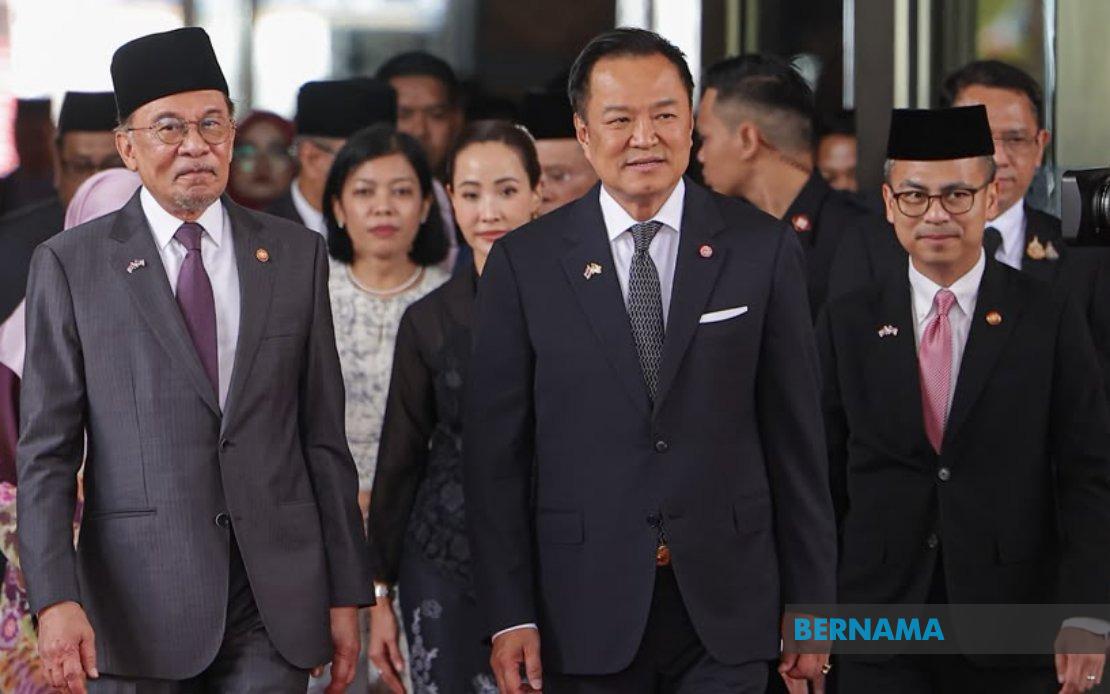
Prime Minister Datuk Seri Anwar Ibrahim and Thai counterpart Anutin Charnvirakul convened at the Perdana Putra Complex in Putrajaya on July 9 to assess the trajectory of bilateral ties and identify opportunities for deepening engagement across multiple sectors. The meeting marked a significant moment in Malaysia-Thailand relations, with Anutin arriving in Malaysia on a two-day official visit at Anwar's invitation. He touched down at Kuala Lumpur International Airport at 11.11 am, where Anwar received him at the Bunga Raya Complex before both delegations proceeded to the capital's administrative headquarters for substantive discussions.
The bilateral agenda reflected the breadth of contemporary cooperation between Southeast Asia's two major economies. Trade and investment featured prominently on the discussion table, underscoring both nations' commitment to expanding commercial ties that benefit their private sectors and working populations. Border connectivity issues took on particular importance given the shared terrestrial frontier that spans hundreds of kilometres, with smooth cross-border movement critical to regional competitiveness. The two leaders also devoted attention to security matters, an area where neighbouring countries increasingly coordinate given shared challenges ranging from transnational crime to maritime safety.
Agricultural collaboration emerged as a centrepiece of the engagement, with the delegations expected to sign a memorandum of understanding cementing their commitment to sector-wide partnerships. This initiative carries relevance for Malaysian farmers and consumers alike, as Thailand remains a significant agricultural producer in the region. Beyond the primary sectors, the leaders were set to explore tourism development, where both nations possess considerable natural and cultural assets capable of attracting international visitors. Educational exchanges and people-to-people connections formed another pillar, reflecting recognition that durable interstate relations rest on foundations of mutual understanding among ordinary citizens.
The Malaysian delegation demonstrated the gravity with which the government approaches this partnership. Deputy Prime Minister Datuk Seri Fadillah Yusof attended alongside Foreign Minister Datuk Seri Mohamad Hasan, Transport Minister Anthony Loke, and Agriculture Minister Datuk Seri Mohamad Sabu. The presence of Home Minister Datuk Seri Saifuddin Nasution Ismail signalled the security dimensions of the talks. Investment and trade portfolio holder Datuk Seri Johari Abdul Ghani, Human Resources Minister Datuk Seri Ramanan Ramakrishnan, and Economy Minister Akmal Nasrullah Mohd Nasir rounded out a cabinet representation that covered Malaysia's key policy domains.
Thailand's delegation carried equivalent institutional weight and sectoral coverage. Deputy Prime Minister and Foreign Minister Sihasak Phuangketkeow headed Thai participation, accompanied by colleagues overseeing transport, finance, tourism, defence, agriculture and labour portfolios. This ministerial pairing underscored the comprehensive nature of the bilateral agenda, with each side bringing expertise relevant to the partnership's multiple dimensions. The breadth of representation from both governments indicated that this was no ceremonial encounter but rather a serious effort to translate political commitment into concrete policy outcomes.
Regional and international developments featured in the leaders' conversation, particularly matters of mutual interest within ASEAN and other multilateral frameworks. This element proves crucial for Malaysian and Southeast Asian stakeholders, as coordinated action on regional issues often produces superior outcomes than individual national approaches. Both Malaysia and Thailand hold significant influence within ASEAN, and alignment between them on key regional questions strengthens the bloc's collective voice in global affairs. Climate change, digital economy transformation, and supply chain resilience likely formed components of this broader discussion, though specific statements on these matters were not detailed in official announcements.
The signing of the agricultural memorandum of understanding demonstrated tangible progress emerging from the talks. Agricultural cooperation carries particular significance for both societies, where farming communities represent important constituencies and where food security considerations loom large. Enhanced collaboration might encompass knowledge-sharing on crop techniques, market access arrangements, research partnerships, and technology transfer that benefit producers on both sides of the border. The initiative reflects growing recognition that addressing challenges in agricultural productivity and sustainability requires regional cooperation given shared climatic zones and supply-chain interdependencies.
Anwar's hosting of an official luncheon following the substantive discussions provided space for more informal exchanges and relationship-building between the two prime ministers. Such occasions, while ceremonial in appearance, often generate the personal rapport and mutual confidence that facilitates problem-solving during more difficult moments in bilateral relations. The lunch symbolized the warmth of Malaysia-Thailand ties at the leadership level and created opportunity for discussions that might not fit neatly into formal agenda items.
For Malaysian observers, this engagement carries broader significance within the context of regional geopolitics and economic competition. Thailand remains a critical neighbour with whom Malaysia shares terrestrial borders, maritime jurisdictions, and a complex history spanning centuries. The tenor and substance of Malaysia-Thailand relations influence broader regional stability and prosperity. Enhanced cooperation in trade and investment creates commercial opportunities that can translate into job creation and economic growth across both economies. Improved people-to-people exchanges foster understanding that helps prevent misunderstandings from escalating into diplomatic friction.
The focus on security cooperation reflects contemporary regional challenges that transcend national borders. Transnational criminal networks, maritime security threats, and other non-traditional security challenges require coordinated responses that individual nations cannot effectively address alone. Malaysian and Thai law enforcement agencies working in concert create force multipliers that deter criminal activity and protect citizens of both countries. Intelligence sharing and operational coordination have become staples of professional security relationships between regional partners.
The bilateral initiative also sits within the broader context of ASEAN cohesion and effectiveness. A region where major members cooperate effectively becomes a more attractive partner for external powers and presents a more unified front in negotiating global trade agreements, climate commitments, and regional arrangements. Malaysia's engagement with Thailand thus contributes to regional public goods that benefit all ASEAN members, from small island states to larger continental powers. The emphasis on multilateral frameworks in the leaders' discussions reflected understanding that Southeast Asian prosperity depends significantly on a stable, cooperative regional environment.
Going forward, the real test of this bilateral engagement lies in implementation of agreed frameworks and resolution of practical issues that inevitably arise between neighbouring countries. Border trade facilitation, resolution of occasional maritime boundary questions, and management of irregular migration flows require sustained attention and goodwill. The commitment demonstrated by this high-level meeting provides a foundation for professional administrators and diplomats to advance these agendas. Success in translating diplomatic courtesy into material improvements in bilateral relations will ultimately determine whether this engagement cycle strengthens Malaysia-Thailand ties or remains merely symbolic.

