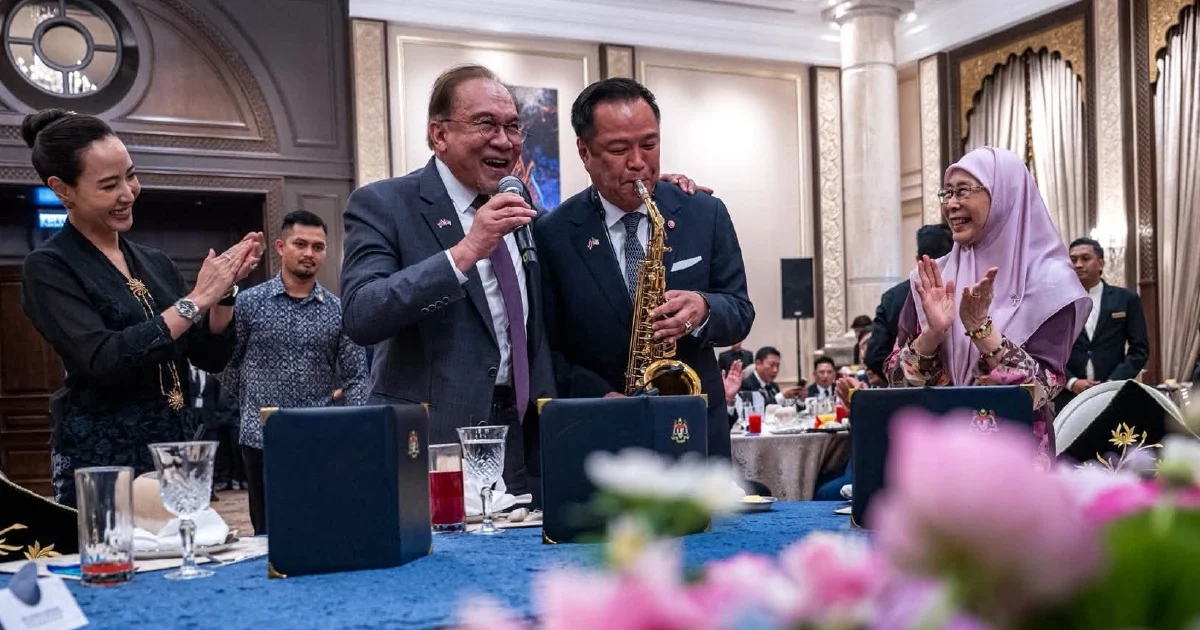
The bilateral relationship between Malaysia and Thailand took an unexpectedly lighthearted turn this week when Prime Minister Datuk Seri Anwar Ibrahim joined his Thai counterpart Anutin Charnvirakul in an unscheduled musical performance during an official luncheon held in Putrajaya. The spontaneous moment, which saw Anwar take to the microphone to sing Frank Sinatra's classic My Way while Anutin accompanied him on saxophone, represented a marked departure from the usual formality that characterises high-level diplomatic engagements between the two neighbouring nations.
The impromptu entertainment came in the wake of formal bilateral discussions between the two leaders, suggesting that the substantive negotiations had concluded on a positive footing. Such moments of informal interaction between government leaders rarely occur in official settings and often carry symbolic weight beyond their surface entertainment value. The willingness of both premiers to set aside protocol and engage in an unscripted cultural exchange underscores a deliberate effort to humanise the diplomatic relationship and project an image of personal rapport to domestic and international audiences.
Malaysia and Thailand maintain one of Southeast Asia's most complex and multifaceted bilateral relationships, spanning decades of cooperation interspersed with periodic tensions over shared maritime boundaries, cross-border security concerns, and the historical complications arising from the southernmost Thai provinces. While trade and tourism have flourished, and both nations coordinate closely on regional security matters through ASEAN mechanisms, the relationship has required careful management to prevent incidents from escalating. The casual nature of the musical performance suggests that current dialogue channels are functioning smoothly and that both governments view the partnership as sufficiently stable to permit such informal gestures.
Anutin Charnvirakul, who serves as Thailand's Deputy Prime Minister and Finance Minister, has become increasingly visible in international engagements over recent years. His presence at an official luncheon alongside Anwar indicates the Thai government's commitment to strengthening bilateral ties at the highest levels. The decision to bring a saxophone to what was ostensibly a formal state visit already hinted at a planned element of cultural exchange, though the spontaneous nature of the actual performance added an element of genuine camaraderie that carefully choreographed events sometimes lack.
The choice of Frank Sinatra's My Way carries its own subtle messaging. The 1969 standard, with its themes of independence and personal conviction, has become an unlikely diplomatic anthem in some Asian political circles. Both Malaysia and Thailand have emphasised their commitment to pursuing national interests while maintaining cooperative regional frameworks—a delicate balance that the song's philosophical content somewhat mirrors. The decision to perform this particular number rather than a traditional Thai or Malaysian composition might reflect the desire to select culturally neutral ground that both leaders could engage with comfortably.
Digital platforms have ensured that this moment reached audiences far beyond the official luncheon itself. The recording of the performance circulated widely across social media, particularly in Malaysia and Thailand, where it generated thousands of reactions and shares. Such viral moments serve important functions in modern diplomacy by humanising political leaders to the general public and creating relatable content that extends the reach of diplomatic messaging. Where formal statements might struggle to capture attention, a video of the Prime Minister singing alongside a regional peer proves far more effective at capturing the public imagination.
The timing of this visit and the accompanying cultural exchange comes at a moment when Malaysia and Thailand are navigating several substantive bilateral issues. Border security cooperation remains an ongoing priority, with both nations grappling with transnational crime networks and irregular migration patterns that affect the region. Additionally, trade relations and economic cooperation form central pillars of the relationship, with both countries benefiting from integrated supply chains and tourism flows. The lighter tone of the luncheon entertainment arguably reflects confidence that these weightier matters are progressing satisfactorily or at least in a direction that allows room for more personable engagement.
For Malaysia's diplomatic establishment, the event reinforces the government's broader strategy of strengthening ties across Southeast Asia. The Anwar administration has prioritised regional engagement as a cornerstone of its foreign policy, recognising that Malaysia's prosperity and security depend substantially on maintaining harmonious relationships with neighbouring nations. Performances such as this one, while seemingly trivial on their surface, contribute to building the emotional and relational infrastructure that underpins successful bilateral cooperation on more serious matters.
The saxophone performance by Anutin adds another layer to the interaction. The choice to perform rather than simply listen suggests a degree of preparation and willingness to participate fully in the cultural moment. It also reflects Thailand's cultural pride in its musical traditions and the Premier's personal confidence in such public displays. The two leaders' comfort with this mode of engagement speaks to generational shifts in diplomatic practice, where a degree of informality and personality increasingly characterises interactions between national leaders.
Looking forward, such moments of personal connection between leaders often have practical implications for the bilateral relationship. When government heads have established cordial personal relationships, they become more willing to extend political capital to resolve disagreements or negotiate compromises on contentious issues. The musical interlude at the luncheon may thus represent not merely a pleasant anecdote but a meaningful investment in the relational foundations upon which effective regional diplomacy ultimately rests.

